Command Brand Guidelines
The 3M hanging strip released in 1996.
Aa
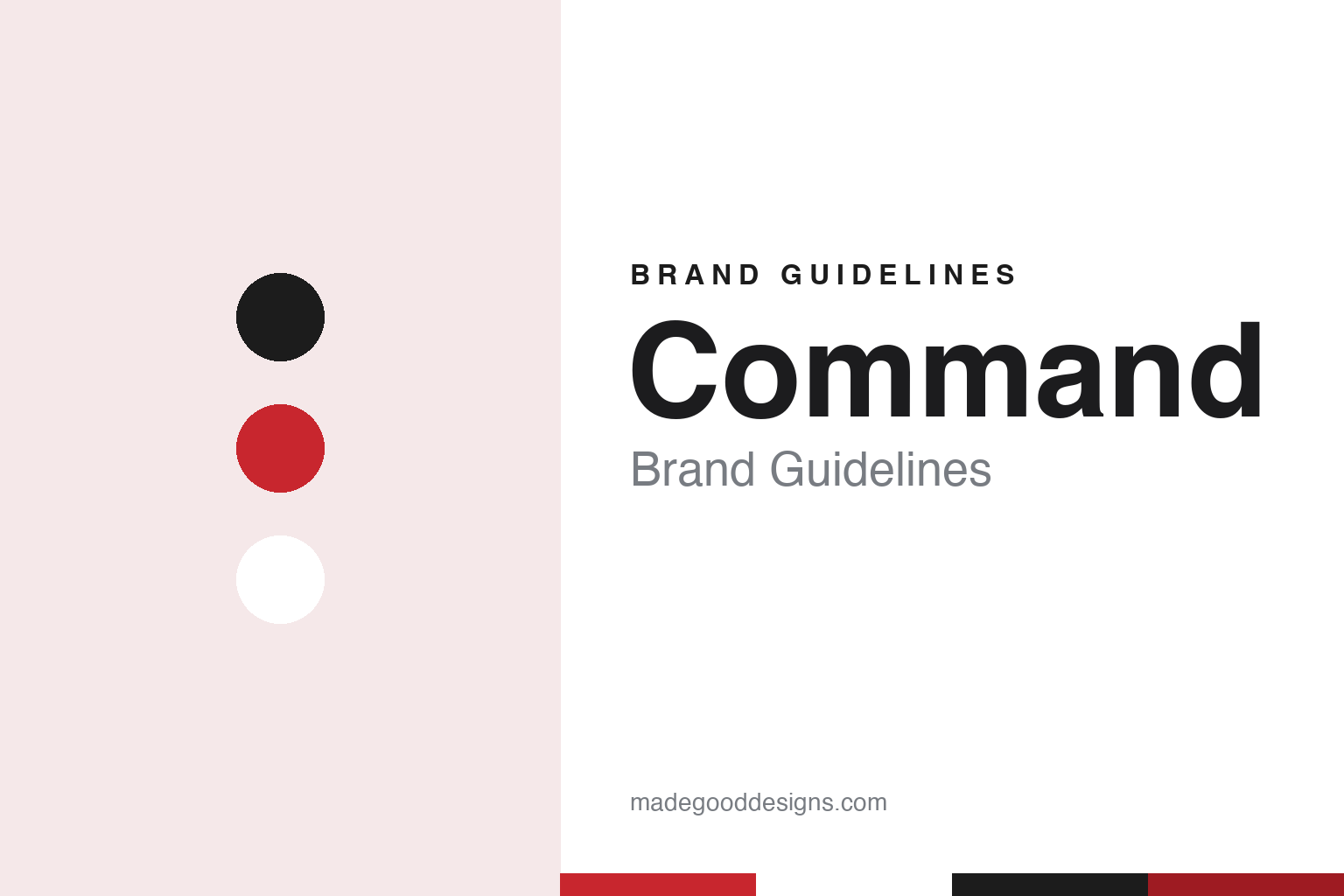
Two constants: a liner red, liner black and strip white palette and a clean retail sans register. Abstract homage — not a Command product or mark; no strip, hook, pack or logo is reproduced.
Command
A late-1980s 3M adhesive, released as a strip in 1996.
Command is a 3M brand of adhesive strips, hooks, hangers and clips for hanging and organising things on walls and other surfaces in the home and office. Bloomberg, in a report by Brooke Sutherland and Kiel Porter published on 30 September 2025, dates the release of the Command strip to 1996 and says the adhesive behind it was developed by a 3M scientist in the late 1980s. The same report says the product was almost lost to corporate bureaucracy before it reached shelves, and that 3M keeps the exact science of its adhesive a closely guarded secret.
The brand has belonged to 3M since its release. 3M began as the Minnesota Mining and Manufacturing Company in Two Harbors, Minnesota, where, according to the company’s centennial history A Century of Innovation (2002), five founders signed its articles of incorporation on 13 June 1902. The company’s timeline dates the move of its manufacturing to St. Paul to 1910, and English Wikipedia records that in 1962 it moved to its current headquarters at 3M Center in Maplewood, a suburb of Saint Paul. The abbreviation 3M became the company’s legal name on 8 April 2002, its hundredth anniversary.
Command arrived in a company with a long history of tape. The Minnesota Historical Society’s encyclopedia MNopedia, in an entry by Kathryn R. Goetz published in May 2013, records that 3M released Richard Drew’s Scotch-brand masking tape in 1925, after Drew had watched auto painters struggle to mask two-tone paint jobs, and his Scotch-brand cellulose tape in 1930. MNopedia describes the cellulose tape as another kind of pressure-sensitive tape. English Wikipedia records that 3M’s sticky notes, sold as Post-it, went on sale across the United States on 6 April 1980, after a store test in 1977 and a sampling campaign in Boise, Idaho, in 1978.
Command belongs to the consumer side of that business. 3M’s centennial timeline records the creation of a 3M Consumer Products Group in 1977, and the 2002 history names the brands of what was by then the Consumer and Office Markets business as Scotch, Post-it, Scotch-Brite, Command, Filtrete and O-Cel-O.
Colour
An executive’s prediction and a product sheet.
3M’s own history places the brand in its consumer business. In A Century of Innovation, Moe Nozari, then executive vice president of Consumer and Office Markets, listed “3M mounting products with Command adhesive” among the lower-cost consumer goods that, in his account, kept the consumer business steadier than its industrial lines during economic downturns.
3M’s own technical documents describe how the strip is made. The company’s product information sheet for Command adhesive products, dated March 2011, describes the strip as a pressure-sensitive foam tape with a stretchable backing, designed to be put up without tools. The sheet lists the foam as polyethylene and the adhesive type as rubber, gives the colour of the strip as white, and describes the release liner — the paper peeled away before a strip is applied — as red and black printed paper. The same document says the Command product line includes hooks, hangers and clips designed to work with the adhesive strips, for decorating and organising in the home or office.
Command has stayed with 3M through the company’s later restructurings. A 3M press release dated in St. Paul on 1 April 2024 announced that the company had completed the spin-off of its health care business as Solventum Corporation, an independent company listed on the New York Stock Exchange. English Wikipedia records that William Brown became 3M’s chief executive on 1 May 2024. Writing in September 2025, Bloomberg said the Command strip was soon fastening framed photos, bathroom towels and outdoor decorations after its release.
Typography
Design and documentation.
Greeting cards, tape and notebooks are everyday objects that most people buy without much thought, and that is exactly why their packaging and covers have to work hard. A card is usually chosen in a few seconds at a rack, so the back of the card, where the publisher’s name and mark sit, becomes a quiet signature that travels with every one sold. A roll of tape is often bought from a peg or a shelf beside dozens of similar rolls, and the core, the label and the colour of the roll itself carry much of the name.
A notebook brand works differently again: its cover is handled every day for months, so a name printed on that cover is carried in bags, on desks and in classrooms long after it was bought. Across all three categories, the companies behind familiar names may have been bought, merged or renamed several times, and the products may be made far from where the name began.
Each guide in this group separates what independent sources record from what the company says about itself — its founding story, its owners over time, where its products are made and how its packaging has changed — and marks plainly what rests only on the company’s own word.
Aa
A clean retail sans — a plain, instructional register. (Specimen set in Work Sans, a sans STAND-IN; NOT the Command logo.)
Command
Red, black and white on a small foam strip.
Much of Command’s visual identity is carried by the product itself. On the evidence of 3M’s March 2011 product sheet, the strip is a small piece of white foam, and the liner that protects its adhesive is printed in red and black.
The brand also sits under a parent with a strong mark of its own. 3M’s centennial timeline records that a red 3M logo was introduced in 1978, and the company’s consumer brands each developed separate looks: MNopedia records a tartan design for Scotch tapes from 1945, and Post-it built its identity on the sticky note it sold across the United States from 1980. Command joined that family in 1996 as a brand of strips and the hooks, hangers and clips made to work with them, and the name appears on the product line in 3M’s own documents, such as the 2011 sheet for Command adhesive products and the company history’s phrase “3M mounting products with Command adhesive.”
Bloomberg’s 2025 account dates the adhesive to the late 1980s and the strip’s release to 1996, and says the product was almost lost to corporate bureaucracy in between; by 2002, 3M’s own history listed Command beside Scotch, Post-it, Scotch-Brite, Filtrete and O-Cel-O as one of the brands of its Consumer and Office Markets business.
For a design guide, Command shows how a small, functional object — a white strip on a red and black liner — can carry a brand’s colours into everyday use. Compare it with 3M, the Minnesota company that owns it, and Post-it, its sibling sticky-note brand from 1980. For this guide we use liner red, liner black and strip white with a sans, an unofficial interpretation; no product or logo is reproduced.
Explore & save
Keep Command’s identity on hand — save it to a board in the Made Good inspiration library.
Command identity set
Pin the Command liner red, liner black and strip white palette and the clean retail sans register to your own board.