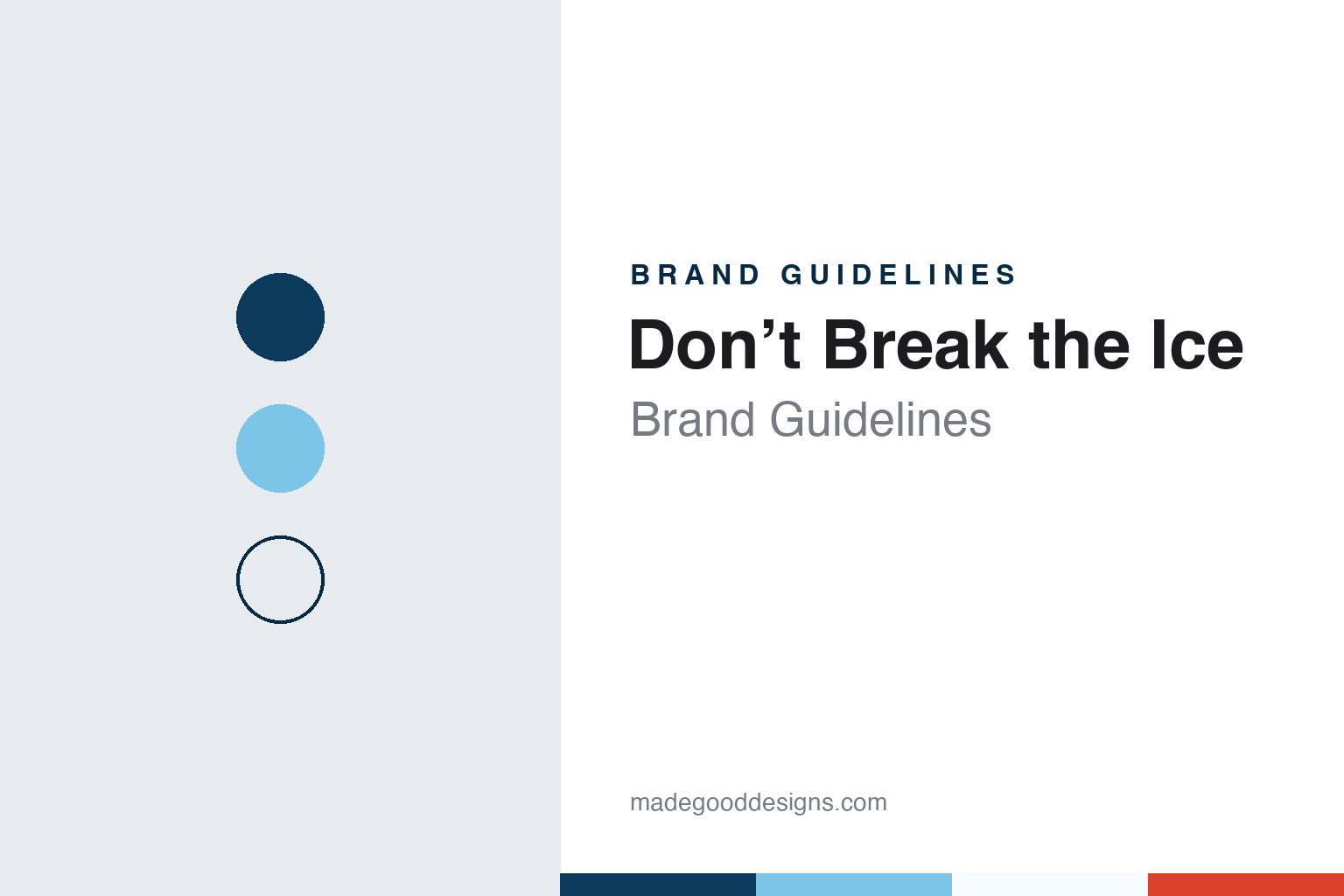
Don’t Break the Ice Brand Guidelines
A Minnesota tabletop game of ice blocks and mallets.
Aa
Two constants: a deep-water, ice-blue and mallet-red palette and a rounded toy sans register. Abstract homage — not a Hasbro or Schaper product or mark; no box, logo or game piece is reproduced.
Schaper
A Minnesota game maker built on plastic.
Don’t Break the Ice comes from Schaper, a game company in the Minneapolis area. English Wikipedia says the game was marketed by Schaper Toys from 1968; the toy-history site ToyTales, in a 2021 article by Todd Coopee, gives its release as 1969. The company’s own story starts two decades earlier. According to MNopedia, the Minnesota Historical Society’s encyclopedia, in an entry by Mary Laine published in 2019, Herbert W. Schaper was a Minneapolis mailman and an angler who carved his own fishing lures. In 1948 he gave six legs to one of them and called it a “Cootie,” and in 1949 he began turning the lure into the game Cootie from a basement factory in his home. English Wikipedia places the founding of W. H. Schaper Mfg. Co. in 1949 in Robbinsdale, Minnesota.
MNopedia describes a company that grew around plastic parts. In 1957 it expanded its headquarters in Golden Valley, in a building that held the offices of Thunderbird Plastics, which made the game pieces, and Highlander Sales, the sales arm. The company sold stock to the public in 1961. In 1971 it became a division of Kusan, Inc., a plastics manufacturer in Nashville, Tennessee, while keeping production and warehouse sites in Lakeville, Plymouth and Edina, Minnesota. Schaper’s catalogue in those years, English Wikipedia says, included Ants in the Pants and Don’t Spill the Beans as well as Cootie and Don’t Break the Ice.
That makes the game part of a family. Its name follows the same “Don’t…” pattern as Don’t Spill the Beans, and its pieces were moulded in plastic rather than printed on card, like the rest of the Schaper range MNopedia and Wikipedia describe. MNopedia names Ants in the Pants and Don’t Break the Ice together as Schaper games of 1969.
Colour
Ice blocks, a stand and a mallet each.
The game is built from a handful of parts. English Wikipedia describes a set of plastic “ice blocks,” a stand, and a small plastic hammer for each player. One block is larger than the rest and carries a plastic character. To set up, players turn the stand upside down and press the blocks into the frame, so that the pressure of the blocks against each other holds them in place when the stand is turned the right way up. Players then take turns tapping out blocks, and the game ends when someone sends the block with the figure through the ice.
ToyTales adds detail from the original Schaper version. Ordinary blocks were about an inch square, with one larger two-by-two block holding a figure in a seated position; each player chose a coloured mallet; and the game came with a rhyme warning that the ice is thin and a player may go in. A player who knocked the figure through was out, the board was “re-iced,” and play continued until one player was left.
The figure on the ice has changed between editions. English Wikipedia says it varies from edition to edition: Phillip the Penguin, a man referred to as “Ice Man,” or a polar bear. ToyTales wrote in 2021 that Hasbro had introduced Phillip the Penguin as a new mascot while keeping the basic play the same. The game has also been tied to films: English Wikipedia lists special editions linked to Disney’s Frozen (2013) and Frozen II (2019).
For a brand, that is a small but clear set of signals: a block of white and blue ice in a frame, coloured mallets, and a single character in danger in the middle. The name itself is phrased as an instruction to the players.
Typography
Kids’ games and their owners.
A toy or game is usually met first as a box, and the lid does much of the work that a label does on a bottle or a can. It carries the name in large lettering, a picture of the thing inside or of children using it, and often a line of copy that the brand repeats for years. Because toy and game names change hands between companies, the same name can appear over the decades on lids printed by several different owners, each redrawing the lettering and the artwork in the style of its own time.
That makes the box worth reading as a record. The name on the lid, the company credited in the small print, the country of manufacture and the copyright line together show who made and sold a product at a given moment, and those details can differ from one edition to the next.
Each guide separates what independent sources record from what the company says about itself — who started the name, who has owned it since, and how its boxes, logos and advertising have changed — and marks plainly what rests only on the company’s own word.
Aa
A rounded toy sans for a game of ice and mallets. (Specimen set in Baloo 2, a sans STAND-IN; NOT the Don’t Break the Ice logo.)
Don’t Break the Ice
From Kusan and Tyco to Milton Bradley and Hasbro.
The game changed hands with its maker. On 6 September 1986 the Chicago Tribune reported that Tyco Toys of Moorestown, New Jersey, and Kusan had agreed for Tyco to acquire Kusan’s Schaper Toy division, based in Minneapolis; terms were not disclosed. MNopedia says the Lakeville plant closed when Schaper Toys was sold to Tyco that year, and English Wikipedia says the Plymouth plant closed in 1987.
Tyco did not keep the games. English Wikipedia, citing the Chicago Sun-Times of September 1986, says Tyco sold the rights to Cootie and three other Schaper games, among them Don’t Break the Ice, to Milton Bradley, then a Hasbro division. Milton Bradley itself had begun in Springfield, Massachusetts, in 1860; English Wikipedia says Hasbro acquired it in 1984, merged it with its Parker Brothers subsidiary in 1998, and kept using the Milton Bradley name until 2009. MNopedia wrote in 2019 that Cootie was marketed by Milton Bradley, owned by Hasbro, and ToyTales wrote in 2021 that “after a series of mergers and acquisitions, Don’t Break the Ice is now sold by Hasbro.” English Wikipedia describes the game as still in production.
The Schaper plants at Lakeville and Plymouth closed in 1986 and 1987, but the game’s title, its frame of ice blocks and its figure on the ice moved with the rights to Milton Bradley and then into Hasbro’s range, where licensed editions sit alongside the standard set.
For a design guide, Don’t Break the Ice shows how a simple instruction can work as a brand name, and how a single character on a block of ice can carry a box. Compare Play-Doh, another children’s name that ended up with Hasbro, and Monopoly. For this guide we use deep water, ice blue and a mallet red with a rounded sans, an unofficial interpretation; no product or logo is reproduced.
Explore & save
Keep Don’t Break the Ice’s identity on hand — save it to a board in the Made Good inspiration library.
Don’t Break the Ice identity set
Pin the Don’t Break the Ice deep-water, ice-blue and mallet-red palette and the rounded toy sans register to your own board.