Weebles Brand Guidelines
Weighted eggs, a slogan and a run of playsets.
Aa
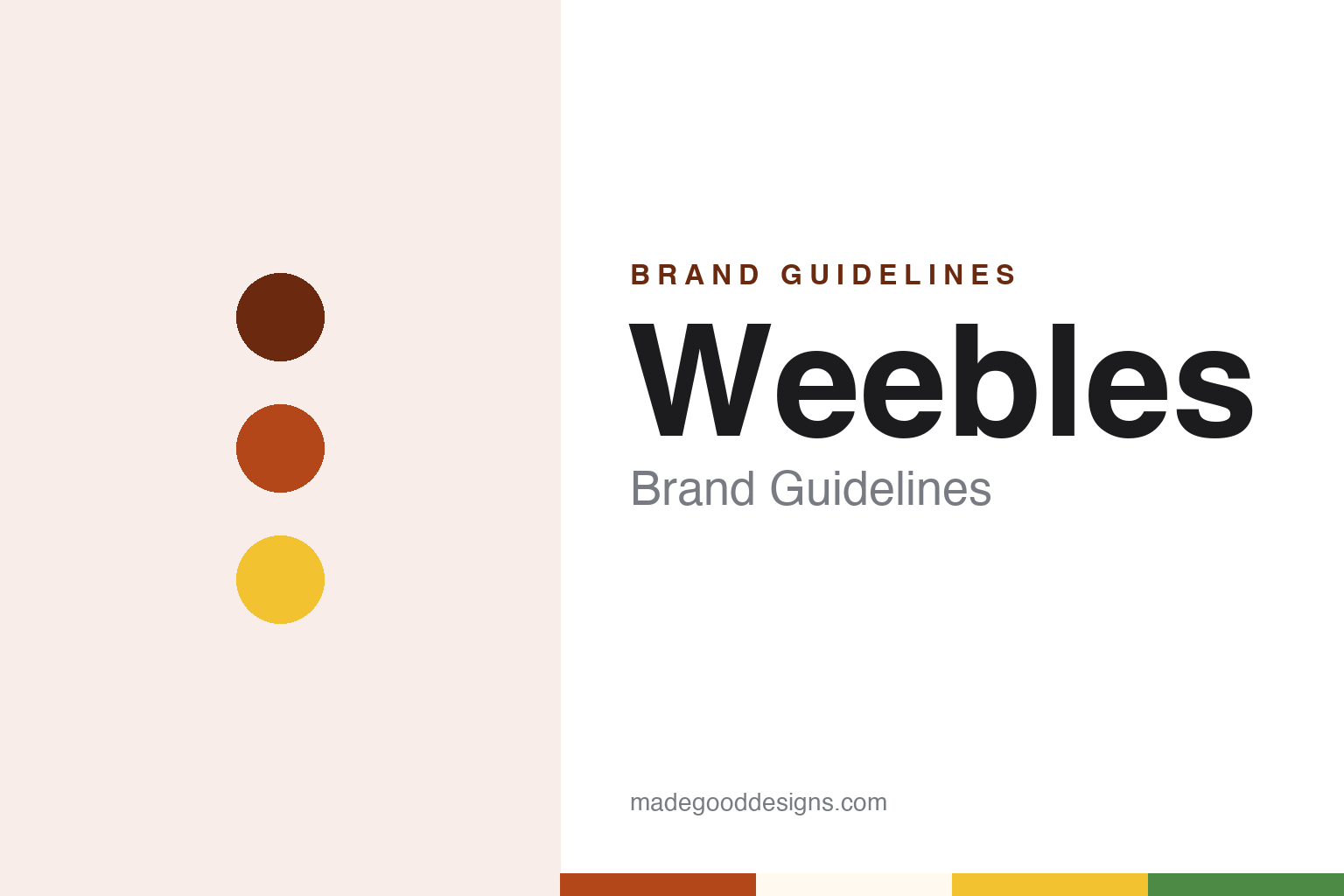
Two constants: a wobble orange, egg yellow and meadow green palette and a rounded toy-box sans register. Abstract homage — not a Weebles product or mark; no figure, playset or logo is reproduced.
Weighted eggs
A simple toy and a line that stuck.
Weebles are small, egg-shaped figures with a weighted base. They appeared in the United States in 1971, and the sources credit that launch in slightly different ways. English Wikipedia says the range was introduced by Playskool, then a subsidiary of the Milton Bradley Company. The pop-culture site Flashbak, in an article of 26 June 2016, says that in 1971 Hasbro introduced the Weebles under its Romper Room line. The Toy Book, reporting on 28 March 2023, says Playskool released the toys in 1971.
The idea behind the toy is the roly-poly principle. Wikipedia explains that each figure is shaped like an egg with a smooth, rounded bottom and a heavy weight low in the centre, so that tilting it raises its centre of mass; when it is let go, gravity rolls it back upright. The encyclopedia sets out the conditions for the effect to work: a near-hemispherical base, a shape that is close to symmetrical around its vertical axis, a heavy solid kept separate from a larger volume of lighter material, and a single position in which the figure can come to rest. Weebles have been made to look like people and animals, with the egg outline kept throughout.
A single sentence of advertising copy did as much for the name as the shape. Wikipedia says the line “Weebles wobble, but they don’t fall down” was used in the brand’s advertising as it grew in the 1970s and again in relaunches in the early 2000s, and credits the phrase to the advertising executive J. Mitchell Reed, writing in his Madison Avenue office in New York. Flashbak’s 2016 article describes the same words as a commercial jingle that accompanied the Weebles world, and reproduces a selection of the television commercials from the 1970s.
Colour
Playsets, a parade balloon and a British licence.
The figures were sold with places to put them. Wikipedia says numerous playsets were made and marketed in the United States through the 1970s, among them a Haunted House, a Treehouse, a Camper, a Playground, a Marina, a Circus and a Fun House, along with Mickey Mouse Club and Magic Kingdom sets and a Western theme. Flashbak’s 2016 article lists a similar run of tree house, haunted house, fun house, western set, circus, camper and Magic Kingdom. Playsets often came with particular figures, and the encyclopedia notes that figures could also be bought separately, along with vehicles, buildings and furniture.
In Britain the toys reached shops through a licence. Wikipedia says the model-kit company Airfix made and marketed Weebles in the United Kingdom under licence from 1973 until Airfix collapsed in 1981.
The figures also took to the air. Wikipedia says the Macy’s Thanksgiving Day Parade introduced a balloon of the standard Weeble design in 1975, which flew until 1978, and that almost two decades later “balloonicles” carrying the Weebles characters Tibbey, Tooey and Bumpus made their debut.
Ownership settled in the 1980s. The New York Times reported on 5 May 1984 that Hasbro Industries of Pawtucket, Rhode Island, had agreed to acquire the Milton Bradley Company, and Wikipedia says Hasbro has owned and marketed Weebles as part of the Playskool brand since 1984, through that purchase.
Under Hasbro the range kept changing shape around the egg. Wikipedia says a new line made in 2004 was not egg-shaped at all but modelled on different animals, sold under the name Weebleville with a town centre, a school and a barn dance, and accompanied by a short run of cartoon episodes. A Storybook World range followed in 2006, with fairy-tale sets such as a Cinderella carriage and a castle, and in 2011 Hasbro began a new line of larger egg-shaped figures with sets including a musical treehouse, a playground and a bus.
Typography
Design and documentation.
A toy or game is usually met first as a box, and the lid does much of the work that a label does on a bottle or a can. It carries the name in large lettering, a picture of the thing inside or of children using it, and often a line of copy that the brand repeats for years. Because toy and game names change hands between companies, the same name can appear over the decades on lids printed by several different owners, each redrawing the lettering and the artwork in the style of its own time.
That makes the box worth reading as a record. The name on the lid, the company credited in the small print, the country of manufacture and the copyright line together show who made and sold a product at a given moment, and those details can differ from one edition to the next.
Each guide separates what independent sources record from what the company says about itself — who started the name, who has owned it since, and how its boxes, logos and advertising have changed — and marks plainly what rests only on the company’s own word.
Aa
A rounded toy-box sans — the register of a preschool box lid and a sung slogan. (Specimen set in Baloo 2, a rounded-sans STAND-IN; NOT the Weebles logo.)
Weebles
A name built for wordplay.
The Weebles name has been stretched into a whole vocabulary. The product names Wikipedia records for the 2004–2005 Weebleville range swap the opening of ordinary words for “We”: a Weeschool, a Wegetable Stand, a set of Weehicles, a Weemobile and a Wescue Wagon, alongside a Weegoaway Camper and a Weebly Wobbly Tree House. The 2006 Storybook World range kept the habit with a Weebalot Castle, and the 2011 line used rhyming, clipped names such as Bobblin’ Boat and Wobblin’ Wings.
The licence era began in 2023. The Toy Book reported on 28 March 2023 that PlayMonster and Hasbro had expanded their partnership, that PlayMonster planned to relaunch Weebles that autumn with new playsets and figures, and that it would begin fully managing the Playskool portfolio in 2024. The article quoted PlayMonster’s chief executive, Steve Adolph, and Hasbro’s Jess Richardson, who tied the deal to Hasbro’s Blueprint 2.0 strategy of pairing its brands with partner companies. Wikipedia describes the same arrangement as an international licence to make and sell Weebles.
Wikipedia records the slogan’s use in the 1970s and again in the early-2000s relaunches, and Flashbak marked the toy’s 45th year, in its June 2016 article, by reproducing a selection of the 1970s commercials that carried it.
For a design guide, Weebles shows how a toy whose whole story fits into one line of copy can let that line act as its identity, while the name itself becomes raw material for product names. Compare it with Playskool, the preschool brand it has been sold under, and Lite-Brite, another Hasbro name that has passed to a licensee. For this guide we use wobble orange, egg yellow and meadow green with a sans, an unofficial interpretation; no product or logo is reproduced.
Explore & save
Keep Weebles’s identity on hand — save it to a board in the Made Good inspiration library.
Weebles identity set
Pin the Weebles wobble orange, egg yellow and meadow green palette and the rounded toy-box sans register to your own board.