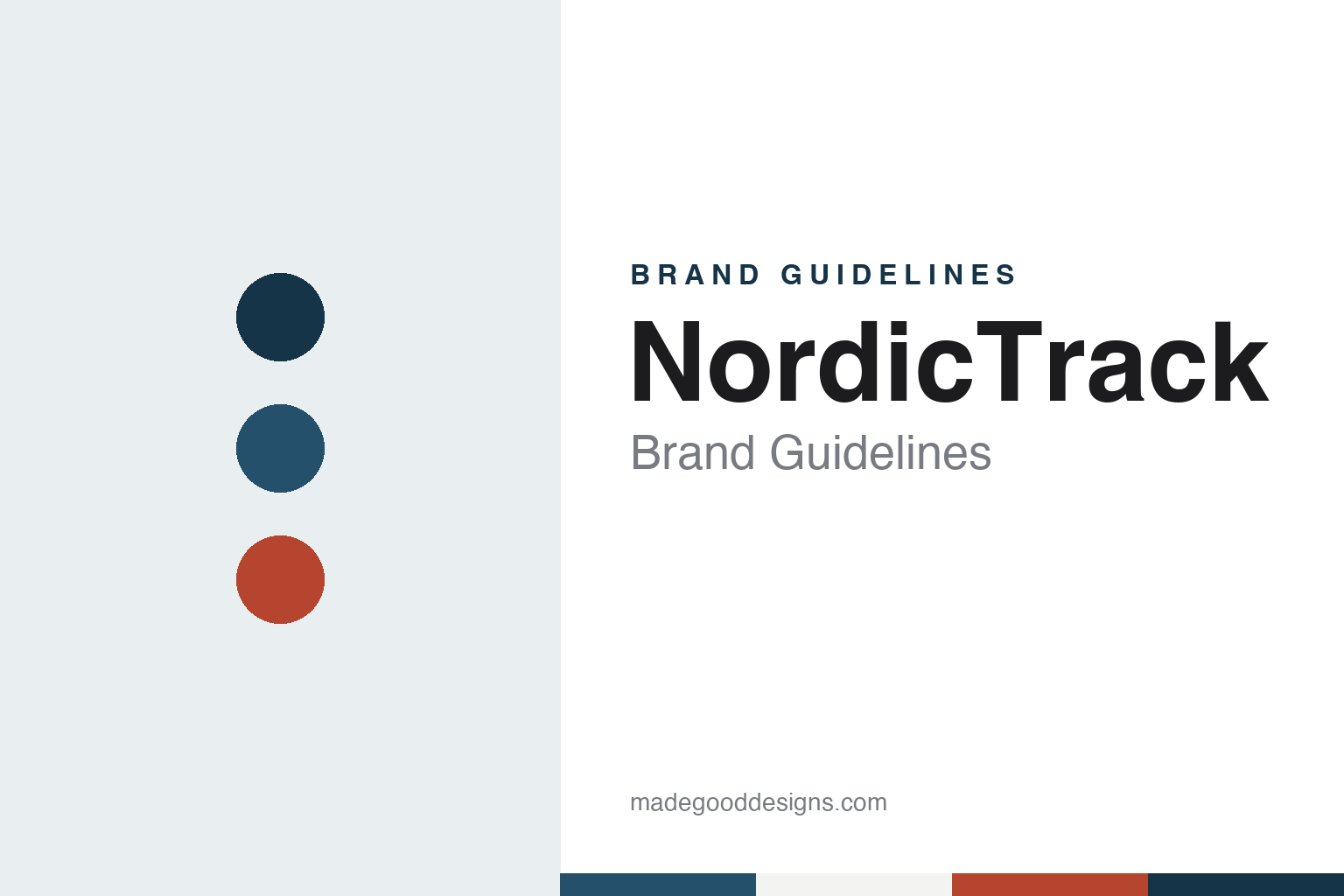
NordicTrack Brand Guidelines
The Chaska ski machine that became an iFIT brand.
Aa
Two constants: a spruce blue, wax red and snow white palette and a plain catalogue sans register. Abstract homage — not a NordicTrack product or mark; no machine, logo or advertisement is reproduced.
Chaska, 1975
An engineer, a wet training run and a machine in the garage.
NordicTrack began in Chaska, Minnesota, in 1975. The International Directory of Company Histories (St. James Press, 1998) says the business was founded as PSI NordicTrack, Inc. by Edward Pauls, who had studied mechanical engineering at the University of Wisconsin and had designed ski boots and bindings for the Minnesota firm Rosemount before turning to his own designs, among them “outrigger” skis for disabled skiers. English Wikipedia names Florence Pauls, his wife, as co-founder.
The idea, as the Los Angeles Times told it in 2011, came during a cold, wet winter run through the streets of Minnesota, when Pauls, a cross-country skier trained as an engineer, wondered whether he could build a machine that let him practise skiing indoors. The result used wooden slats, pulleys and wires to imitate the movement of gliding on skis through snow, and the paper says an early model used real wooden skis and a sofa cushion for hip padding, as his daughter Terri Pauls recalled. The Directory adds that the resistance came from a flywheel and one-way clutch, and that the device was patented in 1976, a date the Los Angeles Times also gives.
Production started in the Pauls’ garage, paid for from the family’s savings. As orders from the cross-country skiing community grew, the Directory says, manufacturing moved to a small warehouse in Chaska and workers were hired to build machines and take telephone orders. Florence Pauls, a former elementary school teacher, became business manager, keeping the books and running the telephone sales staff. English Wikipedia says several of the earliest machines were branded “Nordic Jock”, because college ski racers were the expected market, before the product took the NordicTrack name, and that the company later moved to the Jonathan industrial park in Chaska, where it built premises for manufacturing, mail and telephone sales and warehousing.
The Los Angeles Times reported in October 2011 that Ed Pauls had died; it recorded that he also developed equipment for adaptive skiing and a ski boot and binding system.
Colour
CML Group, bankruptcy, ICON and iFIT.
In 1986 the Pauls sold NordicTrack to CML Group, a public company run by Charles M. Leighton. The Directory says the deal kept the couple on under a five-year contract, Ed Pauls as chairman and Florence Pauls as a senior vice-president, and that CML put James Bostic, a former auto-industry executive, in charge of the subsidiary. Under Bostic the range widened beyond the ski machine to products such as the NordicPower strength trainer and an exercise chair for the office, and the advertising moved from print into network and cable television and infomercials.
Distribution changed too. The Directory says that in 1990 the company opened its own retail outlet in a mall outside Washington, D.C., and went on to run a chain of “NordicTrack Fitness at Home” stores alongside other retail formats. By the mid-1990s, it says, sales were falling; in 1996 and 1997 CML moved NordicTrack to contract manufacturing and closed several of its own plants, and in the autumn of 1997 it introduced an elliptical line called the Ellipse. English Wikipedia says CML moved operations out of Chaska after the purchase.
The end of the CML era came in 1998. The Deseret News, carrying an Associated Press report dated 19 December 1998, said NordicTrack had filed for bankruptcy on 5 November and that ICON Health & Fitness of Logan, Utah, would buy its key patents, trademarks and other intellectual property. The same report said ICON had begun in 1977 when Scott Watterson and Gary Stevenson, business students at Utah State University, started an import company in Cache Valley called Weslo, which moved from mini-trampolines into exercise bikes and rowing machines. ICON’s spokeswoman told the paper the purchase would help keep its manufacturing lines running in Cache Valley.
On 10 June 2021 the company announced that ICON Health & Fitness had changed its corporate name to iFIT Health & Fitness Inc., taking the name of the software platform used on its machines. The release, quoting Watterson as founder, chairman and chief executive, listed NordicTrack beside ProForm and Freemotion as the group’s brands and gave its base as Logan, Utah. English Wikipedia now lists the owner as iFIT Inc. and describes a range of treadmills, ellipticals, exercise bikes, rowers and strength equipment.
Typography
Design and documentation.
Boxing, fitness and yoga brands put their names on objects that are handled, stretched, sweated on and stacked in a gym corner. A logo on a glove has to sit on a curved, padded surface; a mark on a mat has to survive being rolled and unrolled; a name on a treadmill or a rack is read from across a room. That gives these brands a practical design problem as well as a commercial one.
Many of the names in this group have also changed hands over time. A brand may begin with a founder in one city, pass to a holding company or a licensing group, and be sold in places far from where it started, while the logo on the product stays familiar to the people who use it.
Each guide sets out what independent, dated sources record about a brand — who started it, who has owned it since when, and what it is known for — and marks plainly what rests only on the company’s own word. The palettes and typefaces shown are our interpretation; no product or logo is reproduced.
Aa
A plain catalogue sans — the register of a mail-order advertisement and a console label. (Specimen set in Barlow, a sans-serif STAND-IN; NOT the NordicTrack logo.)
NordicTrack
A name built in magazine pages, then on screens.
NordicTrack’s identity was built through direct-response advertising long before it reached shop floors. The Directory says the Pauls first placed ads in ski magazines and, as the machine drew buyers who did not ski, extended the campaign to general-interest titles such as Smithsonian and Scientific American, with Florence Pauls measuring each ad’s response through the telephone orders it produced and adjusting the campaign. English Wikipedia also lists National Geographic, The New Yorker and The Wall Street Journal, and describes the ads as mostly text explaining cardiovascular exercise, with a small picture of the machine in use.
The product’s look was part of the pitch. In an interview with Advertising Age quoted by the Directory, James Bostic said NordicTrack’s designers wanted machines that fitted into a home by resembling furniture, not instruments of torture. English Wikipedia says the Chaska plant ran its own woodworking, varnishing, sewing and printing work in the Pauls era, with a powder-coat paint line and a printing and bulk-mailing operation added as the business grew.
After 1998 NordicTrack became one brand among several in a Utah group, and since 2021 its machines have carried the software name that became the parent company’s own. English Wikipedia records, for example, a stationary bike shown at the Consumer Electronics Show in Las Vegas in January 2019 that paired a virtual-reality headset with handlebar controls and an iFit connection.
For a design guide, NordicTrack shows how a plain product name, tied to one machine and one sport, can be carried from a garage workshop and mail-order pages to a wider equipment range under new owners. Compare it with Concept2, the Vermont rowing-machine maker, and Bowflex, another home-fitness name that has changed hands. For this guide we use spruce blue, wax red and snow white with a sans, an unofficial interpretation; no product or logo is reproduced.
Explore & save
Keep NordicTrack’s identity on hand — save it to a board in the Made Good inspiration library.
NordicTrack identity set
Pin the NordicTrack spruce blue, wax red and snow white palette and the plain catalogue sans register to your own board.