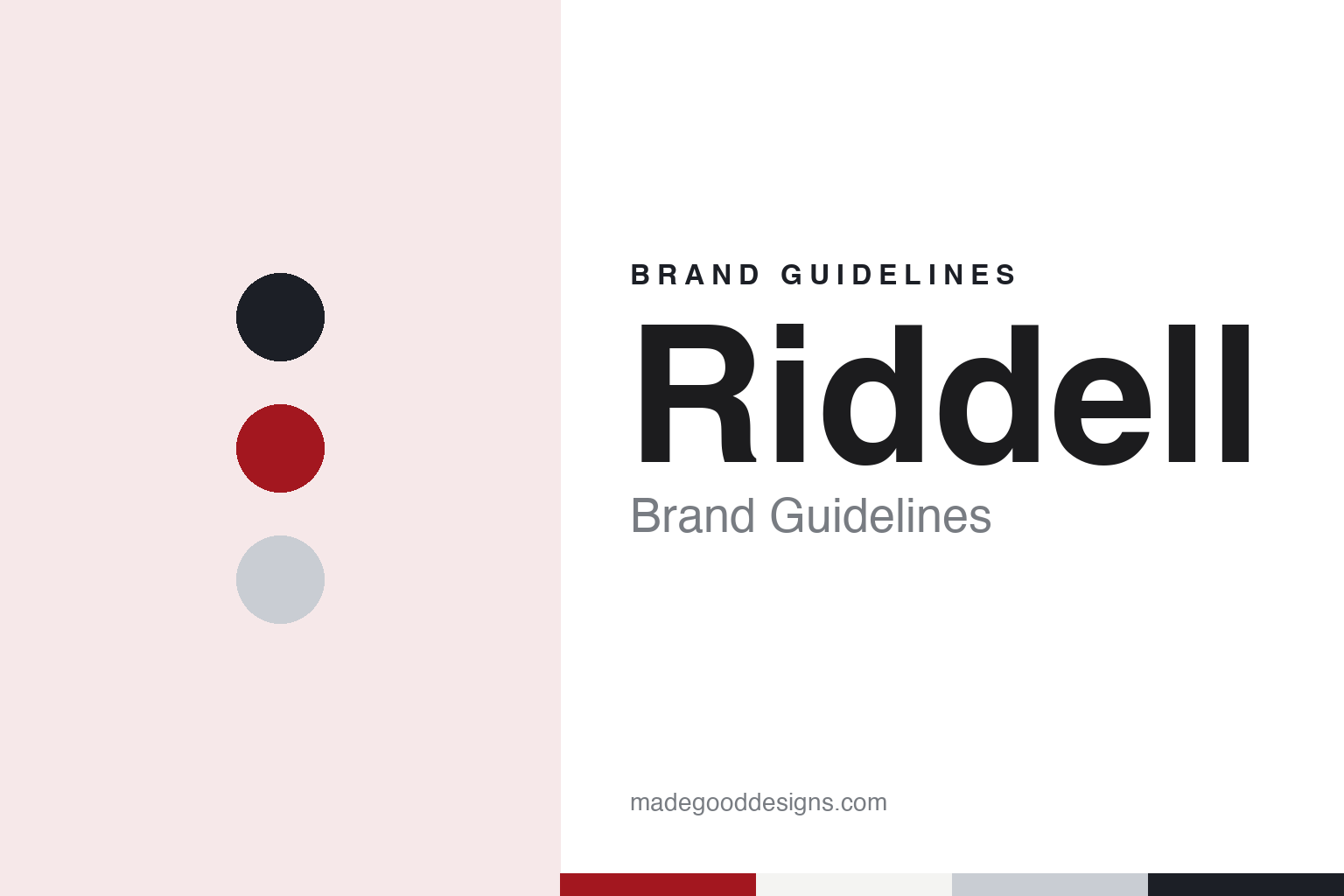
Riddell Brand Guidelines
The football helmet name from 1929.
Aa
Two constants: a helmet red, facemask black and shell silver palette and a condensed sans register. Abstract homage — not a Riddell product or mark; no helmet, bumper or logo is reproduced.
John Tate Riddell
A founder’s surname on a football equipment business.
Riddell carries the surname of John Tate Riddell, who founded the company in 1929, according to English Wikipedia. The same year is given in the April 2024 announcement that Riddell, Inc. issued with the investment firm BC Partners, which describes the business as founded in 1929 and based in Des Plaines, Illinois. Wikipedia gives the pronunciation as “rə-DEL”, with the stress on the second syllable.
Wikipedia says the company concentrated on football cleats until 1939 and that its work moved to helmets from that year. In the decades that followed, the encyclopedia records, the company introduced new helmet features, including facemasks in the 1950s and air-filled padding in the 1960s, and it names the Revolution helmet, released in 2002 and widely called the Revo, as well as later models sold as the Revolution Speed and the SpeedFlex. Riddell also makes a youth line, which Wikipedia describes as versions of the adult helmets made for players under fourteen.
The company has kept an Illinois address for its whole recorded history. Wikipedia says Riddell Sports Group was headquartered in Rosemont, Illinois, before it moved in 2017 to a new facility in Des Plaines, also in Illinois. The 2024 announcement uses the Des Plaines address as its dateline.
In its current form the business describes itself as a designer and maker of football helmets, other football equipment, head-impact sensing and reporting systems, and related apparel and accessories, the 2024 announcement says. Wikipedia names the Revolution IQ HITS system, in which sensors inside the helmet record each impact and pass the data to a laptop for coaching staff to review. Wikipedia also says Riddell is widely known for its line of football helmets.
Colour
From Lincolnshire to Fenway, Easton-Bell and BRG Sports.
Riddell has changed hands several times as a private company. SGB Executive reported on 7 July 2003 that the private equity firm Fenway Partners had acquired a controlling interest in Riddell Sports Group, Inc., buying the business from Lincolnshire Management. Fenway described itself at the time as a firm that invests in and builds branded goods companies.
Under Fenway, Riddell became part of a larger group. Fox Business, in a November 2023 report with Reuters, said Fenway combined Riddell with Bell Sports in 2004 and merged the combined business with Easton Sports in 2006, renaming it Easton-Bell Sports. In 2014 the group was renamed BRG Sports, for its Bell, Riddell and Giro brands, and the Easton baseball and softball business was sold to Bauer Performance Sports. In 2016 Vista Outdoor bought Bell, Giro and two other brands from BRG Sports, which, the report said, left Riddell as the group’s remaining brand.
The leadership carried across those changes. Wikipedia says Dan Arment became president of Riddell in 2008, and SGB identified him in February 2020 as president and chief executive of both Riddell and BRG Sports. That February 2020 report concerned the sale of Kollege Town Sports, a team and corporate apparel dealer Riddell had bought in 2015, to BSN Sports; Arment said the move would let Riddell concentrate on its core football equipment business.
In November 2023 Fox Business reported that Riddell was exploring a possible sale. The next public step was a financing rather than a change of control: on 3 April 2024 BC Partners Credit, the credit arm of BC Partners, announced a strategic partnership with Riddell built on convertible preferred equity and debt. The announcement said BC Partners would join Riddell’s board alongside management and existing investors, and it named Fenway Partners as the majority investor. Fox Business had described Fenway in 2023 as the owner of Riddell for two decades, since its 2003 purchase.
Typography
Design and documentation.
Protective and playing equipment gives a logo very little room and a great deal to compete with. A helmet is curved in two directions, carries vents, clips and face guards, and may also have to hold a team’s own crest, numbers and stripes. A stick or shaft is long and narrow, so a name usually runs along its length and is read sideways, often from across a field or a rink. A skate boot offers a heel, a tongue and a quarter panel, each seen from a different angle, while a ball is round, scuffed and spinning, and its print is broken up by panels and seams.
Brands working on these surfaces tend to lean on a short word or a simple symbol that survives being stretched, shrunk, repeated or partly hidden. Colour matters too: a mark has to read against team colours it does not control, under floodlights and on television.
Each guide that follows sets out who started the brand, who has owned it since, and how its name and mark have appeared on equipment, separating what independent sources record from what a company says about itself.
Aa
A condensed sans — the register of a helmet bumper and a sideline banner. (Specimen set in Oswald, a sans-serif STAND-IN; NOT the Riddell logo.)
Riddell
A surname on the front of the helmet.
To viewers, the Riddell identity is a single word in a small place: the nose bumper, the strip at the front of a football helmet just above the facemask. That position was the subject of a formal agreement with the National Football League. NFL spokesman Brian McCarthy told ESPN in October 2013 that the league had agreed in 1989 to give Riddell the rights to be the official helmet of the NFL in perpetuity, and that the deal had since been renegotiated to end at the conclusion of the 2013 season.
Sports Business Daily, summarising the coverage on 25 October 2013, explained how the arrangement worked on the field. Players could wear another maker’s helmet as long as it met the prescribed standards, but Riddell was the only company whose name could appear on the nose bumper. The same report said Riddell paid for that right together with the right to make regular-size and mini helmets carrying league logos, versions sold to autograph collectors. Riddell told ESPN at the time that it was proud of its relationship with the league.
ESPN reported the end of the arrangement on 24 October 2013. McCarthy told the outlet that the original 1989 agreement had been made after a number of helmet manufacturers went out of business, and that the league had since renegotiated it so that the 2013 season would be the last under the old terms.
The company name has also stayed constant while the owners’ names changed around it: Riddell Sports Group, Easton-Bell Sports, BRG Sports and Riddell, Inc. each kept Riddell as the brand on the product. Fox Business said the 2014 BRG Sports name was chosen to represent the group’s core Bell, Riddell and Giro brands.
For a design guide, Riddell shows how a short surname, fixed in one consistent spot on a piece of equipment, can carry a company through decades of new owners and new technology. Compare it with Schutt Sports, another football helmet maker founded in Illinois, and Wilson, another American team-sports brand. For this guide we use helmet red, facemask black and shell silver with a condensed sans, an unofficial interpretation; no product or logo is reproduced.
Explore & save
Keep Riddell’s identity on hand — save it to a board in the Made Good inspiration library.
Riddell identity set
Pin the Riddell helmet red, facemask black and shell silver palette and the condensed sans register to your own board.