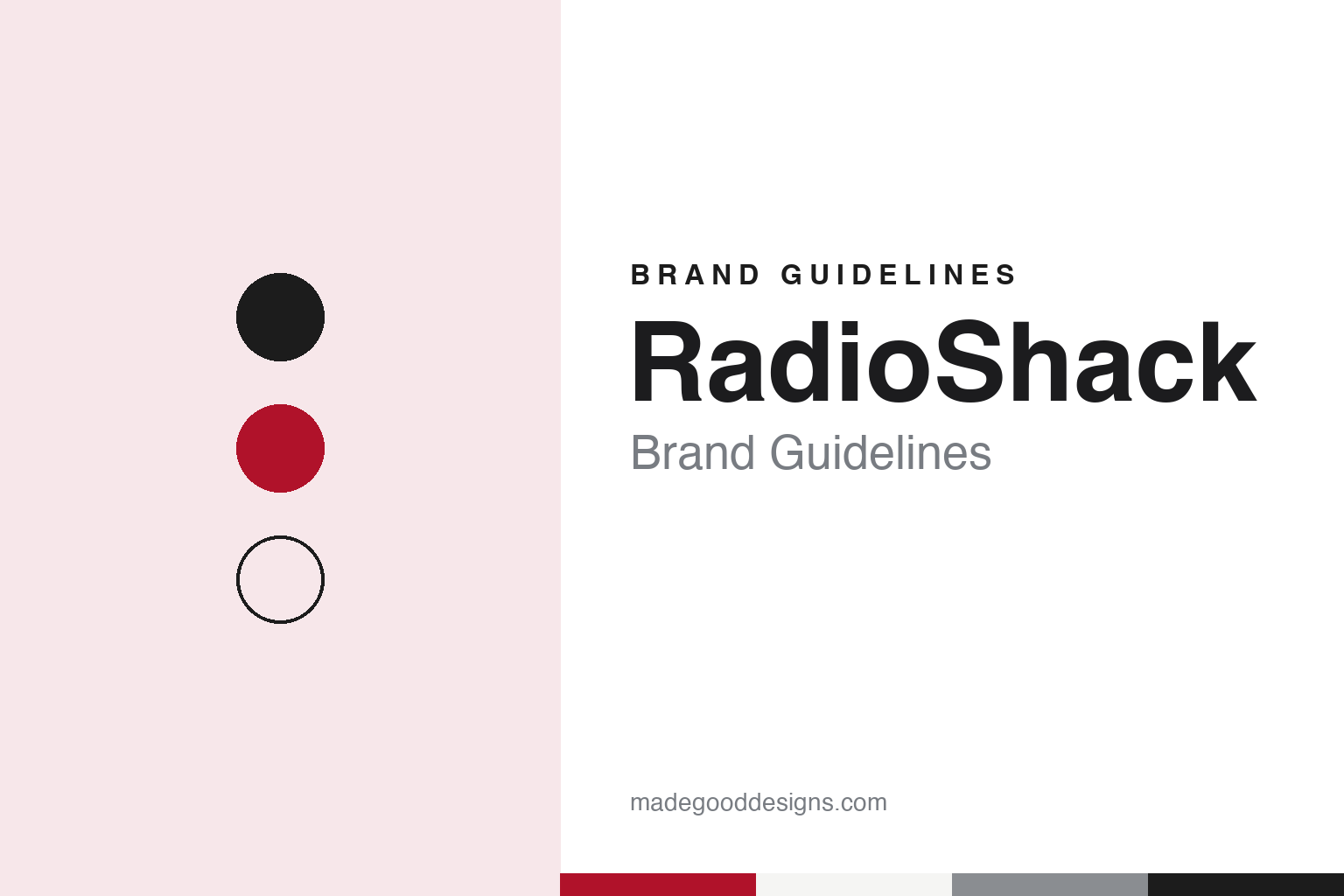
RadioShack Brand Guidelines
From a Boston radio store to a global franchise name.
Aa
Two constants: a shack red, chassis grey and panel white palette and a storefront sans register. Abstract homage — not a RadioShack product or mark; no sign, logo or packaging is reproduced.
Radio Shack
Two brothers, a ship’s radio room and a store in Boston.
RadioShack began in Boston in 1921. English Wikipedia names its founders as the brothers Theodore and Milton Deutschmann, who opened a single store with a mail-order business to supply equipment for amateur radio, then a new field. The New York Times DealBook column of 16 September 2014 also dates the company to 1921, and describes a business that sold radio parts and surplus supplies through its outlet and its catalog.
The name came from the sea. Wikipedia explains that a “radio shack” was the small wooden structure that housed a ship’s radio equipment, and that amateur operators used the same phrase for the place where they kept their own stations. The brothers thought it suited a store serving radio officers aboard ships as well as hobbyists at home. Wikipedia credits the suggestion to an employee, Bill Halligan, who went on to found the Hallicrafters radio company. For its opening four decades the name was written as two words: Radio Shack.
The store built up its own labels early. Wikipedia records a catalog in 1939, as the business moved into high-fidelity music equipment, and a private label introduced in 1954 under the name Realist. After a legal challenge from the maker of the Stereo Realist camera, the label was renamed Realistic, a name that stayed on the chain’s radios and stereos for decades. By the start of the 1960s, Wikipedia says, Radio Shack had moved its headquarters within Boston and grown to nine stores plus a large mail-order business, but had fallen on hard times.
It was rescued from Texas. Tandy Corporation, a Fort Worth leather-goods company led by Charles D. Tandy, was looking for hobby-related businesses and bought the Boston chain. Wikipedia dates the purchase to 1962. The Handbook of Texas Online entry on Charles Tandy, written by Diana J. Kleiner, gives 1963 and describes the purchase as a chain of nine Boston-based stores then selling electronics components; the 2014 DealBook column also gives 1963 and says the business was almost bankrupt at the time.
Tandy rebuilt the business around the name. According to Wikipedia, it closed the mail-order operation, cut the range from tens of thousands of items to a few thousand, replaced national brands with private labels and opened many small stores staffed by people who knew electronics, with store managers taking an ownership stake. The brand moved with its owner to Fort Worth, Texas, which stayed its home for decades: Wikipedia records a “Tandy Towers” headquarters built downtown in the 1970s and a riverside campus the company moved into in 2005.
Colour
One word, a nickname and a run of new owners.
In the 1990s the name changed shape. Wikipedia records that in 1994 the slogan “America’s technology store” gave way to “You’ve got questions, we’ve got answers,” and that in the early summer of 1995 the company changed its logo, closing up the two words into the camel-case RadioShack. In May 2000 the parent dropped the Tandy name and became RadioShack Corporation.
The Canadian chapter ran in parallel. A former Tandy subsidiary, InterTAN, held the rights to the RadioShack name in Canada. CBC News reported on 27 April 2005 that after Circuit City bought InterTAN, a US district court ordered the Canadian stores to stop using the RadioShack name on signs, packaging, products and advertising, and that they were being renamed The Source by Circuit City, starting with a store at Toronto’s Eaton Centre.
In 2009 the company tried a nickname. TechCrunch reported on 3 August 2009 that RadioShack planned to call itself “the Shack,” under a campaign the company titled “Rediscover THE SHACK.” Wikipedia records that the August 2009 rebrand lifted sales of mobile products at the expense of its core components business.
The ownership chain then broke apart. RadioShack filed for Chapter 11 bankruptcy protection in February 2015, and Wikipedia records that its assets were bought that May by General Wireless, an affiliate of Standard General. General Wireless filed for bankruptcy in March 2017; CNNMoney reported on 3 November 2017 that the business had emerged expecting to operate primarily as an online retailer, alongside stores run by independent dealers.
In November 2020, according to Wikipedia, the brand’s intellectual property and remaining operations were bought by Retail Ecommerce Ventures (REV), a Florida company whose other purchases included Pier 1. CultureMap Fort Worth described REV in December 2021 as the Miami-based owner of a RadioShack “once based in Fort Worth.”
A franchisee then took the whole name. A press release published by St Vincent Times on 30 May 2023 said the El Salvador-based Unicomer Group, through its affiliate Global Franchising Corporation, had bought RadioShack’s intellectual property and domains in many countries, including the United States, Canada, Europe and China. Unicomer, the release said, had bought the RadioShack franchise in El Salvador in January 1998 and, in 2015, the brand rights and franchise agreements for Central America, South America and the Caribbean. Unicomer Group has owned the worldwide RadioShack brand since 2023.
Typography
Design and documentation.
A music, video or electronics shop carried its name on far more than the sign over the door. The same mark turned up on the fascia above a mall entrance, on the plastic rental case handed across the counter, on the paper or plastic bag a customer carried home, on a membership card and on the small price sticker pressed onto a cassette, compact disc or box.
Each of those surfaces asked something different of a logo. A store sign had to read from across a car park or a shopping concourse; a rental case had to survive being opened and returned many times; a bag had to look right when folded, creased and printed in one or two flat colours; a price sticker had to carry a name at the size of a fingernail. Colours that worked on an illuminated sign did not always survive cheap printing, so many retail marks leaned on a few strong, flat tones and simple letterforms.
Each guide in this group sets out who started the store, who has owned the name since, and what became of it, and it marks plainly what rests only on a company’s own word. The palettes and type are our interpretation, not reproductions.
Aa
A storefront sans — the register of a fascia, a catalog cover and a price card. (Specimen set in Archivo, a sans-serif STAND-IN; NOT the RadioShack logo.)
RadioShack
A piece of radio slang, closed up into one word.
The RadioShack identity starts with its name. It is a piece of maritime radio slang — the cabin where a ship’s operator kept the set — that the Deutschmann brothers put over a Boston shop door in 1921, and that Tandy carried to Fort Worth four decades later. The documented changes to it are few and specific: the two words became one camel-case word when the logo changed in 1995, and in 2009 the company campaigned under the nickname “the Shack.”
Much of the visual memory of the chain sits in its house labels rather than in the logo. Wikipedia lists a long run of Tandy-era private brands, among them Realistic for stereos and radios, Archer for antenna equipment, Micronta for test meters and Enercell for batteries. Wikipedia also records that from the 1960s until the early 1990s the stores ran a “battery of the month” club: a free wallet-sized cardboard card entitled the holder to one free Enercell battery a month in the store, and the same cards served salespeople as generic business cards.
Ownership shaped what the name could carry. Under Tandy the stores sold mainly private labels. Wikipedia records that in 1970 Tandy bought Allied Radio and merged the two names as Allied Radio Shack, and that after a 1973 federal review it sold the remaining Allied stores and went back to the Radio Shack name. It also records that Realistic and Optimus were later discontinued, and that new house brands, Presidian and Accurian, followed the end of an RCA store-within-a-store agreement. Since the bankruptcies the name has moved from Texas to a Florida brand-buyer in 2020 and then, in 2023, to a franchisee based in El Salvador that had carried it in Latin America since 1998.
For a design guide, RadioShack shows how a plain descriptive name can outlast nearly everything around it — the founders, the parent company, the headquarters city and the store format — and how a small typographic change, closing up two words into one, can become the change people remember. Compare Circuit City, which took over its Canadian stores, and Best Buy, the electronics chain it competed against. For this guide we use a shack red, chassis grey and panel white palette with a sans, an unofficial interpretation; no product or logo is reproduced.
Explore & save
Keep RadioShack’s identity on hand — save it to a board in the Made Good inspiration library.
RadioShack identity set
Pin the RadioShack shack red, chassis grey and panel white palette and the storefront sans register to your own board.