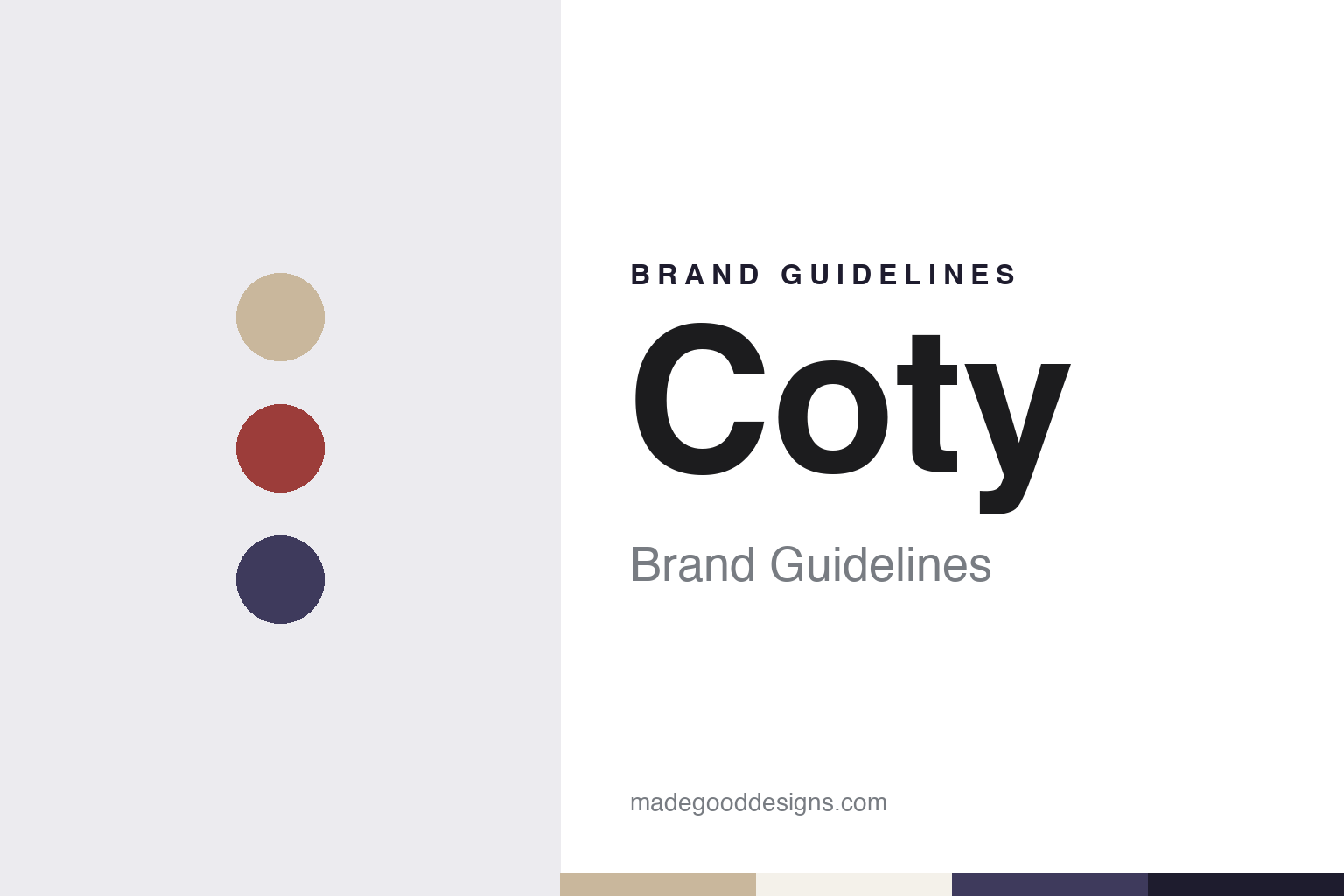
Coty Brand Guidelines
A Paris perfumer, a glassmaker next door and a wall of poppies.
Aa
Two constants: a frost, poppy and Vendôme palette and a fine display serif register. Abstract homage — not a Coty asset or mark; no logo, icon or wordmark is reproduced.
A perfumer’s name
Corsica, Grasse and Paris, 1904.
Coty is a surname, but not quite the one its founder was born with. The New York site 6sqft, in an article by Tracy A. Marciano published on 31 October 2016, says the founder was born Joseph Marie François Spoturno on Corsica, and that after years in the military he moved to Paris, began using the name François and took the surname Coty, a variation of his mother’s maiden name. The company that still carries that name was built on a word its founder chose for himself.
The same article traces how he came to perfume. It says Coty met a pharmacist, Raymond Goery, who made and sold scent, and that it was in Goery’s Paris shop that Coty experimented and developed his own Cologne Coty. Through his wife, the article says, he met a member of the Chiris family, long-established makers and distributors of perfume, and studied at their factory in Grasse in southern France, where he worked on a second scent, La Rose Jacqueminot.
6sqft says Coty returned to Paris in 1904 and opened his own shop there later that year. The English Wikipedia gives 1904 as the founding year of the company, in Paris, and says La Rose Jacqueminot was launched the same year in a bottle designed by Baccarat. 6sqft describes the same Baccarat bottle and says Coty understood early that an attractive bottle and packaging mattered to how a perfume was received.
Wikipedia adds that L’Origan followed in 1905, and that by 1908 Coty had opened a store on the Place Vendôme in Paris, next door to the glass designer René Lalique. That address put a perfumer and a glassmaker side by side on the same Paris square.
Colour
Lalique and the Cyclamen bottle.
The Victoria and Albert Museum in London holds one of the results. Its collection record for a Cyclamen scent bottle, designed by René Lalique in 1909, says that François Coty began commissioning perfume-bottle designs from Lalique in 1908, that the earliest of these was for the perfume Cyclamen and that its initial production was made at Baccarat. The museum says that on the strength of the Coty commission, Lalique rented the glassworks at Combs-la-Ville, south-east of Paris, in the autumn of 1908, and bought it in 1913.
The V&A bottle itself carries the names of both men in the glass. The museum’s record lists moulded marks reading “Coty Paris”, “Lalique Deposé” and “Cyclamen Coty Paris”, and describes the bottle as press-moulded, mould-blown and patinated. The house name is formed into the glass, beside the name of the man who designed the bottle. The record gives the maker as Verrerie Combs-la-Ville and the place of production as Combs, in Seine-et-Marne.
6sqft says Lalique had opened a Paris shop in 1905 where he showed jewellery and glass, and that Coty asked him to create bottles for two early scents, Ambre Antique and L’Origan. The article adds that Lalique went on to design bottles for other perfume houses through the 1930s, among them Guerlain, Worth and Roger & Gallet. Lalique’s own name later became a brand of its own, and its glass and perfume bottles are covered in our Lalique guide.
Typography
A perfumer, a glassmaker and a group.
Group identities in beauty and media work on two levels at once. On the shelf or the newsstand, a reader meets a lipstick, a fragrance, a newspaper or a television channel, each with its own name, typeface and colours. Behind those labels and mastheads sits a parent name that appears in smaller type: on the back of a carton, in the legal line under an advertisement, in the corner of a website footer or on a stock-market listing. The parent identity has a different job. It speaks to investors, employees, regulators and partners rather than to the shopper or the reader, so it tends to be quieter, more typographic and more stable than the brands it carries.
Those parent names also change more often than the labels below them. Groups merge, split into separately listed companies, sell divisions and take new names, and each change brings a new wordmark, a new set of corporate colours and, sometimes, a name chosen to sound neutral across many languages. A house colour can work in both directions: on packaging it can tie a range of products together, while on mastheads it can mark a title as part of a wider family. Reading a group identity well means looking at both layers and at the dates when each one changed.
Aa
A fine display serif — after a Paris perfume house whose name was moulded into glass. (Specimen set in Cormorant Garamond, a serif STAND-IN; NOT the Coty logo or any Coty typeface.)
Coty
Fifth Avenue to a group of brands.
The partnership also reached New York. 6sqft says the building at 714 Fifth Avenue was built in 1871 as a row house and given a new commercial facade in 1907 by its owner, Charles Gould, with glass walls across the top three floors. The article says The New York Times reported in 1908 that the house had been leased to a French perfumery; Coty signed a long lease and, in 1910, commissioned Lalique to replace the wall of windows. The design, 6sqft says, shows climbing vines and poppies. Wikipedia says Coty kept its US headquarters there until 1941.
The windows outlived that tenancy. 6sqft says that in 1983 a developer planned to clear the site for a tower; the Municipal Art Society petitioned the Landmarks Preservation Commission, and the building was designated a landmark in 1985. The panels were taken out and restored in 1986 by the Greenland Studio of Manhattan, and the facade was restored again in 1990 by Beyer Blinder Belle for the Henri Bendel store. The perfumer’s name stayed on Fifth Avenue as a building name, the Coty Building.
The company itself changed hands and shape several times. Wikipedia says Coty, Inc. was formed in New York in 1922 and listed in 1925; that Pfizer acquired it in 1963 and sold it to Joh. A. Benckiser in 1992; and that Coty bought Unilever’s European cosmetics brands, among them Rimmel, in 1996. On 9 July 2015, The Guardian, carrying an Associated Press report, said Procter & Gamble had agreed to hand 43 of its beauty brands to Coty, “the New York company”, among them Miss Clairol, CoverGirl and Max Factor. Wikipedia records the transaction, completed as a Reverse Morris Trust, across 2015 and 2016, and gives Coty’s global headquarters today as Amsterdam, with its consumer-beauty division in New York.
The Coty name now stands above names that came from elsewhere, each with its own history and its own mark. Coty has owned CoverGirl and Max Factor since 2016, and Rimmel since 1996.
For a design guide, Coty shows how a perfumer’s adopted surname became a bottle signature, then a building name, then the name of a group. Compare Max Factor, the Los Angeles make-up name Coty has owned since 2016, and CoverGirl, the American cosmetics line that arrived in the same deal. For this guide we use frost, poppy and Vendôme blue with a serif, an unofficial interpretation; no product or logo is reproduced.
Explore & save
Keep Coty’s identity on hand — save it to a board in the Made Good inspiration library.
Coty identity set
Pin the Coty frost, poppy and Vendôme palette and the fine display serif register to your own board.