Cree Lighting Brand Guidelines
A Wisconsin fixture maker, a North Carolina chip company and the name that stayed on the light.
Aa
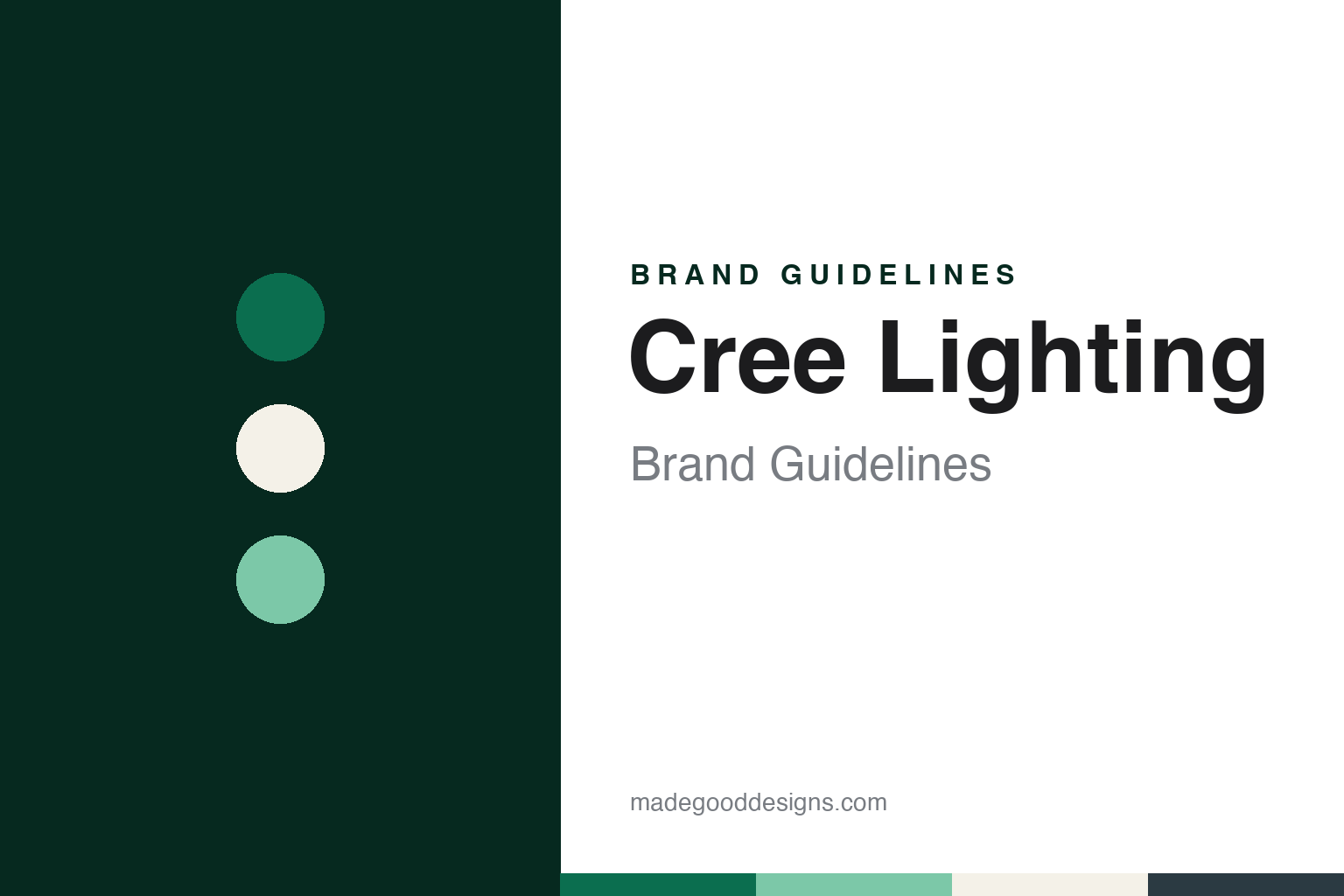
Two constants: a circuit green, diode mint and lens white palette and a technical geometric sans register. Abstract homage — not a Cree Lighting product or mark; no fixture, bulb or logo is reproduced.
A fixture maker and a chip company
Alan Ruud’s lighting firm in Wisconsin, Cree Research in North Carolina and a deal in 2011.
Cree Lighting is an American brand of LED light fixtures, controls and light bulbs for commercial, industrial and residential use. Its name comes from a semiconductor company in North Carolina, but its roots as a fixture maker lie in Wisconsin. The trade magazine LED professional reported on 12 September 2023 that Cree Lighting traces its beginnings to Ruud Lighting, founded in 1982 by Alan Ruud, and that Ruud Lighting was for a time part of the Advanced Lighting Technologies (ADLT) family before becoming a standalone company.
The name came from the other side of a 2011 deal. Forbes reported on 4 October 2021 that the company now called Wolfspeed was founded as Cree Research in 1987, and Cree’s own press releases of 2019 carry the dateline Durham, North Carolina. By 2011, the Journal Times reported, Cree Inc. was publicly held and made LED elements.
The two businesses came together that summer. The Journal Times of Racine, Wisconsin, reported on 17 August 2011 that Ruud Lighting would be acquired by Cree Inc. The paper said Ruud Lighting would continue to be based in Sturtevant, Wisconsin, and would operate as a subsidiary of Cree’s lighting business. Alan Ruud, Ruud Lighting’s chairman and chief executive, would become Cree’s vice chairman in charge of lighting and join the Cree board, the report said. Ruud told the paper the two companies were not competitors but “totally complementary”: Cree made LED elements and Ruud Lighting made LED fixtures. The paper also reported that Ruud Lighting was about to begin work on a new distribution centre.
Cree Lighting’s own website sets out the same lineage in a short timeline. It lists 1982 for the founding of Ruud Lighting, 1987 for the founding of Cree, Inc. and 2011 for Cree’s acquisition of Ruud Lighting, and dates its LED light bulbs to 2013. In the years that followed, the timeline says, the business added SmartCast Wireless controls with a OneButton setup in 2014 and WaveMax technology for street and parking lights in 2015.
Colour
Cree, IDEAL Industries, ADLT and the name Wolfspeed.
The lighting business left Cree in 2019. In a press release dated 15 March 2019, under a Durham, North Carolina dateline, Cree, Inc. announced a definitive agreement to sell its Lighting Products business unit, which it called “Cree Lighting”, to IDEAL INDUSTRIES, INC. Cree described the unit as its LED lighting fixtures, lamps and corporate lighting solutions business for commercial, industrial and consumer applications. The company said the sale continued a strategy, announced in February 2018, to make Cree a more focused semiconductor company, and that it would give Cree Lighting additional global focus, channel support and investment as part of the IDEAL team.
The deal closed two months later. In a release dated 13 May 2019, Cree said it had completed the sale of Cree Lighting to IDEAL Industries. Its chief executive, Gregg Lowe, called the sale a pivotal chapter as Cree sharpened its focus on silicon carbide and GaN semiconductor technologies. The lighting business kept the Cree Lighting name; its website timeline records 2019 as the year Cree Lighting joined the IDEAL Industries family, and the same year as the launch of the Cadiant Dynamic Lighting Experience.
The parent company then changed its own name. Forbes reported on 4 October 2021 that Cree was relisting from Nasdaq to the New York Stock Exchange and changing its name to Wolfspeed, marking its move from LEDs to wide-bandgap semiconductors. After the change, the Cree name remained on the lighting business. LED professional, in its 2023 report, described Ruud Lighting’s 2011 buyer as Cree Inc., “now known as Wolfspeed, Inc.”
A second change of owner followed in 2023. LED professional reported on 12 September 2023 that Advanced Lighting Technologies, LLC (ADLT) had announced that its affiliate CLNA Holdings LLC had acquired all of the equity interests of Cree Lighting USA, Cree Lighting Canada Corp. and E-conolight LLC, together “Cree Lighting”, from IDEAL Industries, Inc. and IDEAL Industries (Canada), Corp. ADLT’s chief executive, Sabu Krishnan, said that given the companies’ common history the purchase represented “a homecoming of sorts”, and described it as another step in a growth strategy that began with ADLT’s acquisition of Cree Italy in 2022. CLNA Holdings, an ADLT affiliate, has owned Cree Lighting since 2023, and the Cree Lighting website’s timeline records that year as the one in which it joined the ADLT family of lighting companies. Its website copyright line reads Cree Lighting USA, LLC.
Typography
Design and documentation.
The packaging around a household light is what a shopper sees on the shelf before buying it. A bulb arrives in a small box or a sleeve; a ceiling fixture or wall light arrives in a printed carton; a switch, outlet or dimmer arrives in a blister card or a narrow box hung on a peg; a wall plate may be sold loose with nothing but a label. Each format leaves a different amount of room for a name, a colour and a picture of the thing inside.
Because so much of this category is bought on a shelf in a hardware store or a home centre, the identity tends to be carried by repetition rather than by a single object: the same colour band across a run of boxes, the same lettering on a carton end, the same layout on a card hanging beside dozens of others.
The guides in this group look at those outer layers: the names, the marks and the colour habits that a company puts on its boxes, cartons and cards, alongside the history of who made the products and who owns the name today.
Aa
A squared, technical geometric sans — the engineered register of a specification sheet. (Specimen set in Exo 2, a technical sans STAND-IN; NOT the Cree Lighting logo.)
A borrowed name, a Wisconsin factory and a catalogue of light
Area lights and troffers, a bulb line, named technologies and a list of licensees.
The brand’s design story is the story of a name. Cree began as the name of a North Carolina semiconductor company; after 2011 it was applied to a lighting business whose fixture-making roots were in Wisconsin; after 2019 it belonged to a lighting company that no longer shared an owner with the chip maker; and after 2021 the chip maker itself traded as Wolfspeed. Through each change, the lighting business kept the words Cree Lighting.
The company places its identity in a Wisconsin plant. Cree Lighting says it is headquartered in Racine, Wisconsin, and that a team there designs, tests and builds nearly every solution in its portfolio. In 2011 the Journal Times gave Ruud Lighting’s base as Sturtevant, in Racine County. The company’s website presents itself under the heading “Light a Better Way” and organises its commercial catalogue by setting rather than by product family.
That catalogue is broad. For outdoor work it lists area lights, canopy and soffit fixtures for gas stations, street and roadway lights, pathway and bollard lights, floods and wall packs; indoors it lists troffers, high-bay and low-bay fixtures, architectural linear lighting and downlights. Several technologies carry their own trademarks. Besides SmartCast Wireless, WaveMax and Cadiant, the company’s timeline names ConnectedMax smart LED bulbs, launched in 2020, and NanoComfort technology, launched in 2023. The consumer side of the brand appears on the website as a separate path for light bulb support and a residential section.
The Cree Lighting name also appears in other companies’ agreements. The company’s licensing page lists Feit Electric Company, licensed on 20 December 2016 to the Cree Lighting patents asserted in a case at the US International Trade Commission and in Wisconsin. The same page lists Ledvance, with a cross-licence covering LED bulb and LED luminaire patents dated 3 March 2017, and Light Polymers, licensed in August 2017 to make and sell certain LED luminaires under certain Cree Lighting patents.
For a design guide, Cree Lighting shows how a component maker’s name can become the identity of a fixture brand and then travel on through two further owners without changing. Compare it with Lithonia, another American commercial fixture brand, and GE Lighting, a lamp brand whose name has also moved between owners. For this guide we use circuit green, diode mint, lens white and pole slate with a geometric sans, an unofficial interpretation; no product or logo is reproduced.
Explore & save
Keep Cree Lighting’s identity on hand — save it to a board in the Made Good inspiration library.
Cree Lighting identity set
Pin the Cree Lighting circuit green, diode mint and lens white palette and the technical geometric sans register to your own board.