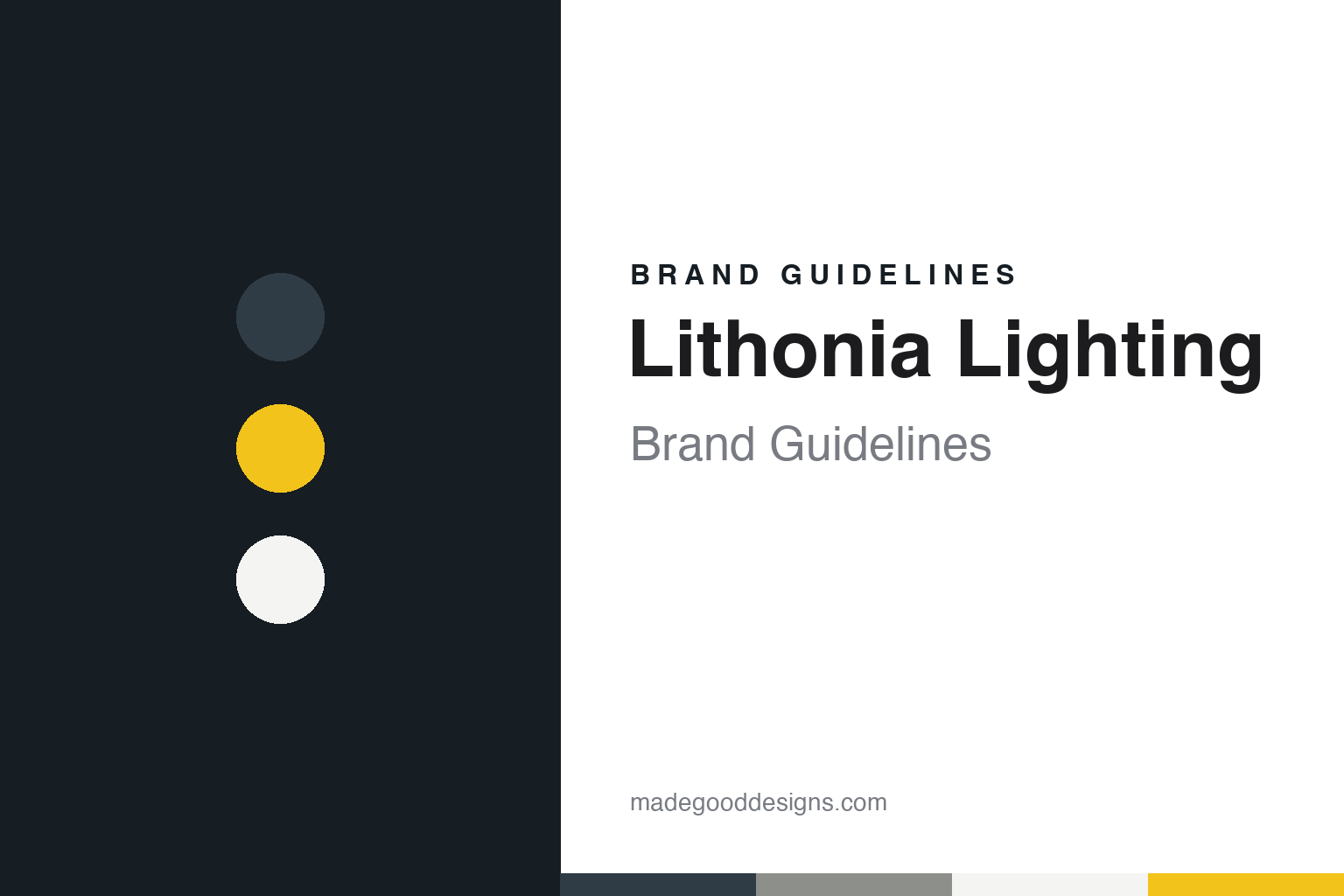
Lithonia Lighting Brand Guidelines
A Georgia fixture maker named after a granite town.
Aa
Two constants: a conduit charcoal, granite grey and fluorescent white palette and a condensed industrial sans register. Abstract homage — not a Lithonia Lighting product or mark; no fixture, catalogue or logo is reproduced.
A garage in the City of Granite
A stone town outside Atlanta, metal parts and a turn to fluorescent fixtures.
Lithonia Lighting is an American brand of light fixtures for commercial, industrial and residential buildings. It belongs to Acuity Inc., the Atlanta company that was called Acuity Brands until 2025. The brand takes its name from the town where it began, Lithonia, Georgia, outside Atlanta. English Wikipedia, citing Kenneth K. Krakow’s 1975 book Georgia Place-Names, says the town’s name comes from the Greek lithos, for stone, and that Lithonia lies in a granite-quarrying region. The town’s motto is “City of Granite”.
Acuity dates the brand to 1946. In a partner article written by Acuity Brands and published by Buildings on 1 June 2021, for the brand’s 75th anniversary, the company says Sam Freeman founded the Lithonia Lighting Products Company that year. Acuity says the business started in a garage in Lithonia, then a small town, and that at the start the business involved finishing and assembling metal parts.
Gale’s International Directory of Company Histories, in its entry on Acuity Brands, also gives 1946 as the year Lithonia began. It says the company was involved in both incandescent and fluorescent lighting fixtures, selling to residential, commercial and industrial customers.
The direction changed in the 1950s. Acuity’s 2021 account says that early in the decade Freeman chose to concentrate on commercial and industrial fluorescent fixtures, sold through wholesale electrical distributors and sales agents. Gale says that by the time of its 1969 sale Lithonia had narrowed its focus to the commercial and industrial fluorescent market.
Growth then took the company out of its home town. Acuity says that in 1957 Lithonia Lighting moved to larger facilities in nearby Conyers, Georgia. English Wikipedia’s article on Conyers records the same move from Lithonia in 1957, and its article on Lithonia describes the town as the birthplace of the company. The brand kept the name of the granite town after it left.
Colour
National Service Industries in 1969, the 2001 spin-off and Acuity Inc. in 2025.
Lithonia lost its independence in 1969. Gale’s history and Acuity’s 2021 account both say National Service Industries, or NSI, acquired the company that year. Gale traces NSI to 1919, when Isadore M. Weinstein founded the Atlanta Linen Supply company, a towel and linen rental business that grew into National Linen Service; English Wikipedia says the group took the National Service Industries name in 1964. Gale says the Lithonia purchase laid the foundation for a lighting division at NSI, which by then also had linen, chemicals, envelope and insulation businesses.
NSI built its lighting business around Lithonia. Gale lists purchases in the late 1970s and early 1980s that included the aluminium lighting-pole business of Kaiser Aluminum, an indoor lighting business of ITT Corporation, the Chicago-based Major Corporation and Acme Manufacturing Company, a maker of fluorescent fixtures. In 1995, Gale says, NSI built a fluorescent lighting plant near Monterrey, Mexico, to supply the division’s needs in North America, and in July 1999 it bought Holophane Corporation of Columbus, Ohio, which brought its own direct sales force for lighting fixtures.
The present structure dates from 2001. Gale reports that in June 2001 NSI announced it would package two of its divisions, Lithonia Lighting Group and its chemicals business, and spin them off as a separate public company. A Delaware corporation called L&C Spinco was formed that month; before the spin-off it bought American Electric Lighting and the Dark-to-Light product lines of Thomas & Betts. L&C Spinco was renamed Acuity Brands in November 2001, the spin-off was completed later that month, and the new company listed on the New York Stock Exchange. Gale quotes James S. Balloun, its chairman and chief executive, saying the name “implies strong, focused leadership.”
The chemicals side later left. English Wikipedia says that, effective 2007, the chemicals division was spun off as Zep Inc., leaving Acuity Brands as the holding company for Acuity Brands Lighting, whose brands included Lithonia Lighting, Holophane, Peerless and Mark Architectural.
The parent has since renamed itself. tED Magazine reported on 13 March 2025 that Acuity Brands, Inc. would change its corporate name to Acuity Inc. effective 26 March 2025, keep trading on the New York Stock Exchange as “AYI” and operate through two segments, Acuity Brands Lighting and Acuity Intelligent Spaces. The magazine quoted chief executive Neil Ashe. Acuity has owned Lithonia Lighting since the 2001 spin-off; NSI owned it from 1969 until then.
Typography
Design and documentation.
The packaging around a household light is what a shopper sees on the shelf before buying it. A bulb arrives in a small box or a sleeve; a ceiling fixture or wall light arrives in a printed carton; a switch, outlet or dimmer arrives in a blister card or a narrow box hung on a peg; a wall plate may be sold loose with nothing but a label. Each format leaves a different amount of room for a name, a colour and a picture of the thing inside.
Because so much of this category is bought on a shelf in a hardware store or a home centre, the identity tends to be carried by repetition rather than by a single object: the same colour band across a run of boxes, the same lettering on a carton end, the same layout on a card hanging beside dozens of others.
The guides in this group look at those outer layers: the names, the marks and the colour habits that a company puts on its boxes, cartons and cards, alongside the history of who made the products and who owns the name today.
Aa
A condensed, firm sans — the register of a fixture spec sheet and a contractor’s catalogue. (Specimen set in Barlow Condensed, a condensed STAND-IN; NOT the Lithonia Lighting logo.)
A town name for the trade
Specifiers and contractors, Contractor Select, LightQuick and a new corporate hierarchy.
Lithonia’s identity starts with a place name. The brand still carries the name of the granite town it left in 1957, and Acuity’s 2021 anniversary article opens its account of the brand with the garage in Lithonia and the move to Conyers before it turns to the present range.
The brand speaks mainly to the trade. The 2021 article names its audience as specifiers, facility and operations managers, electrical contractors and electrical distributors. It describes a range that runs from commercial indoor and outdoor lighting to industrial lighting, life-safety systems and residential lighting, for settings it lists as offices, schools, healthcare buildings, shops, factories, warehouses, parking garages and pedestrian walkways.
Named programmes carry much of the brand language. Acuity’s article lists a Contractor Select series of in-stock, everyday lighting products and a LightQuick quick-ship programme for same-day shipping, both printed with trademark symbols, along with indoor and outdoor LED fixtures that connect to lighting controls and building systems. It closes with a trademarked slogan built around the word “value”.
The corporate layer above the brand was redrawn in 2025. tED Magazine quoted April Appling, Acuity’s senior vice president of corporate marketing and communications, saying the company was “streamlining our branding hierarchy to align our business segments and promote a cohesive brand experience,” and that the new corporate identity reflected its evolution. The magazine reported that Acuity had launched a new corporate website at acuityinc.com. Neil Ashe was quoted describing the company as “innovators, disruptors and builders.”
The parent’s own name reaches back to 2001. Gale records Balloun’s explanation that the name Acuity Brands was meant to suggest focused leadership and a culture aspiring to high performance. Lithonia’s name, by contrast, comes from the town and the stone around it, and it has stayed on the fixtures through two owners and a change of the parent’s name.
For a design guide, Lithonia Lighting shows how a fixture brand aimed at contractors and distributors can keep a small-town name through two corporate owners and a parent’s renaming. Compare it with Cree Lighting, another American lighting brand, and Coca-Cola, another brand begun in Georgia. For this guide we use conduit charcoal, granite grey, fluorescent white and signal yellow with a condensed sans, an unofficial interpretation; no product or logo is reproduced.
Explore & save
Keep Lithonia Lighting’s identity on hand — save it to a board in the Made Good inspiration library.
Lithonia Lighting identity set
Pin the Lithonia Lighting conduit charcoal, granite grey and fluorescent white palette and the condensed industrial sans register to your own board.