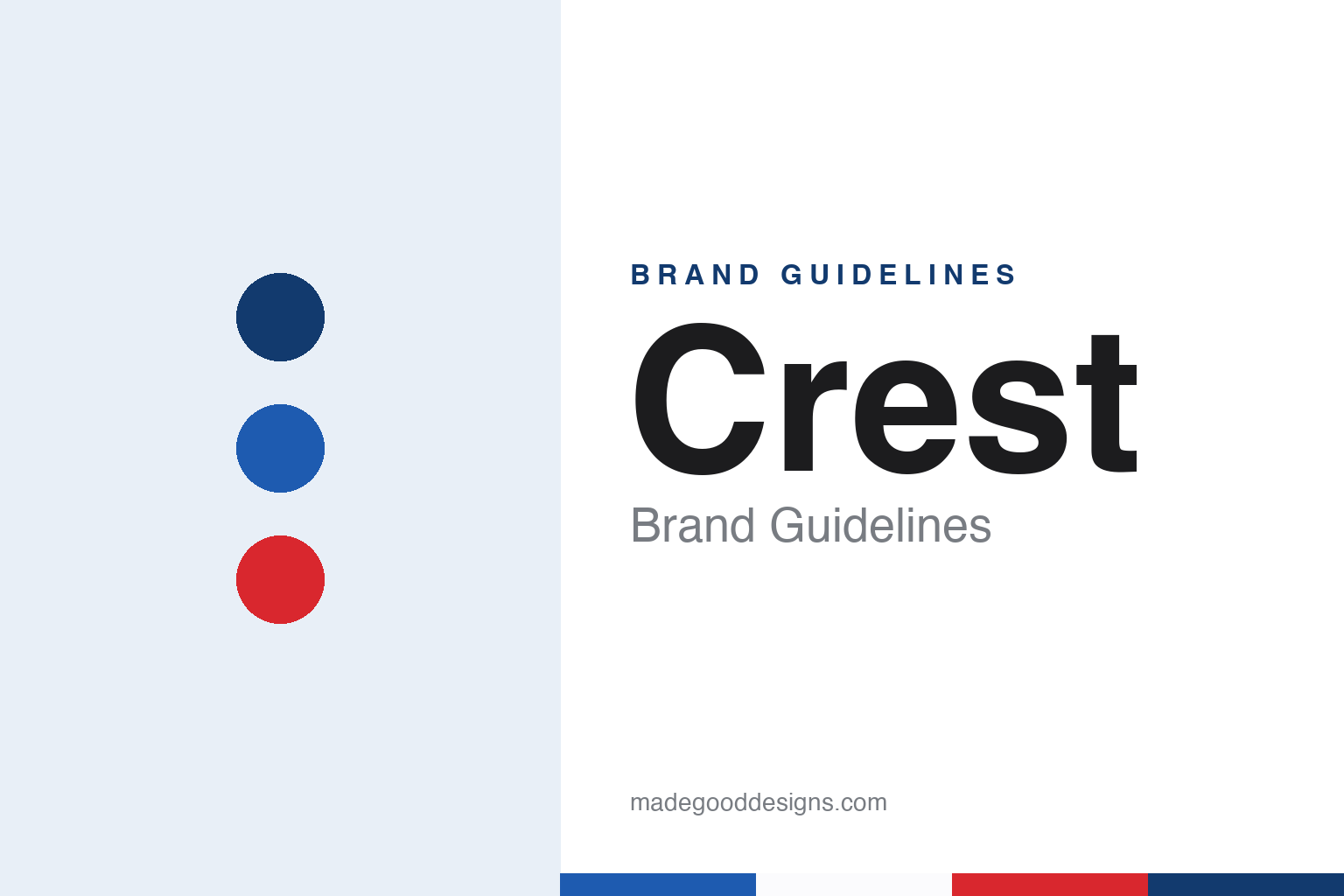
Crest Brand Guidelines
A Cincinnati company’s toothpaste, built on a university laboratory’s patent.
Aa
Two constants: a blue, navy and red palette and a geometric bold sans register. Abstract homage — not a Crest product or mark; no tube, box or logo is reproduced.
Fluoristan
A university laboratory and a Cincinnati company.
Crest grew out of chemistry research at Indiana University. A history page published by the university’s Indianapolis campus, archived in 2009, says that the dental researcher Joseph C. Muhler and the chemistry professors Harry Day and William Nebergall held the patent on a stannous fluoride formula that became the active ingredient of Crest in the 1950s, and that the university made a contractual agreement with Procter & Gamble to use it. The same page carries a 1952 photograph of Muhler handing out toothpaste samples to schoolchildren in Bloomington.
English Wikipedia’s article on Nebergall describes how the chemistry worked out. Muhler had been testing fluoride salts made by a fellow chemist, Frank C. Mathers, and settled on stannous fluoride; the team then found that the usual polishing agent in toothpaste absorbed the fluoride. Nebergall solved this by heating the polishing agent to turn it into calcium pyrophosphate, which did not react with the fluoride. Wikipedia says the studies were financed by Procter & Gamble of Cincinnati, Ohio.
The product had a different name at first. English Wikipedia says it was introduced in the United States as “Fluoristan” in 1954, after its stannous fluoride, and renamed “Crest with Fluoristan” in 1955, when it was launched in a number of test markets; it went on sale nationally in January 1956. Procter & Gamble’s own history, in a version archived in 2008, dates Crest’s introduction to consumers to 1955. P&G’s current history page describes the work as a collaboration between its researchers and Indiana University, and says the company began reaching out to dentists at the same time.
The royalties had a lasting effect on the campus. The Indiana University page says the university’s oral health research institute has long been known as “the House that Crest Built,” because it was funded with the royalties P&G paid on its sales of Crest.
Colour
From Fluoristan to Fluoristat, and beyond the tube.
Procter & Gamble kept reworking the formula for decades. Its archived 2008 history page says the company began work on an improved Crest soon after the launch, and that a new formula, sold as Advanced Formula Crest with a system it named “Fluoristat,” was introduced to consumers in 1981. English Wikipedia says that formula used sodium fluoride, and that the later Crest Pro-Health line returned to stannous fluoride.
The brand travels under more than one name. English Wikipedia says that in many European countries, including Germany, Poland and Hungary, P&G sells similar products as Blend-a-med, the name of an established German toothpaste it acquired with Blendax in 1987, and that in others, among them France, Italy and the United Kingdom, it markets them under the Oral-B name. After P&G bought Gillette, which owned Oral-B, the two brands were marketed together under the Pro-Health name; English Wikipedia adds that Crest sold dental floss as Crest Glide from 2004 to 2010, and that the line is now called Oral-B Glide.
The range also grew sideways. P&G’s current history page tells the origin of Crest Whitestrips around 2000: a young employee working on at-home products was shown a prototype of the cling film P&G had developed for Glad Press’n Seal, and he and his mentor cut it into small strips and tried them on their own teeth. English Wikipedia lists toothpaste, toothbrushes, mouthwash and dental floss among the products sold under the Crest name, alongside Whitestrips.
Where it is made is stated by English Wikipedia, citing Procter & Gamble: Crest products are made in North America, with the main plant in Greensboro, North Carolina, and some products made in Guanajuato, Mexico. Crest sits in P&G’s oral care business beside Oral-B and the mouthwash Scope.
Typography
Design and documentation.
Toothpaste and mouthwash brands are seen up close, every day, and usually for only a few seconds at a time. A tube sits on a basin, a bottle sits beside it, and a box is glimpsed on a crowded pharmacy shelf. Their identities tend to be carried by a few repeatable signals: the colour of the tube or carton, the shape and weight of the name, and in some cases the look of the product itself.
Colour does much of the work. Many oral-care names are tied to one strong pack colour, and a shopper often reaches for that colour before reading a word. Toothpaste adds a second surface that most packaged goods lack, the paste or gel squeezed onto a brush, which some brands have made part of their look with stripes or tinted gels. Mouthwash goes further still, because the liquid is visible through a clear bottle and its colour becomes part of the pack.
Each guide in this group looks at who started the brand, who owns it now and how its look has been described over time, and separates what independent sources record from what the company says about itself.
Aa
A geometric bold sans — the register of a short, confident name on a toothpaste carton. (Specimen set in Montserrat, a sans-serif STAND-IN; NOT the Crest logo.)
Crest
A check-up report, a cartoon city and a team in jumpsuits.
Crest’s best-known images came from its advertising. English Wikipedia’s article on the agency Benton & Bowles credits it with “Look, Ma, No Cavities” for Crest, and its article on the agency’s director Bob Brooks says that, with the new toothpaste struggling, he went against the photographic trend of the time and hired the illustrator Norman Rockwell to draw a series of children holding up a dental report reading “Look Mom, No Cavities!” The two articles word the line slightly differently; Wikipedia’s article on Nebergall gives it as “Look, Ma, no cavities” and calls it the initial marketing tag line.
A later campaign turned to animation. English Wikipedia says that in the late 1970s and early 1980s Crest ran animated commercials written and produced by Gregory Sinnott and designed by the comic-book artist Herb Trimpe. They featured the “Cavity Creeps,” grey, rocky creatures with the battle cry “We make holes in teeth!”, who attacked the island city of Toothopolis, protected by a great wall of teeth. They were driven off each time by the “Crest Team,” people in Crest-themed jumpsuits armed with giant toothbrushes and tubes of Crest, who closed each spot by telling children to watch treats and see their dentist.
For a design guide, Crest shows how a technical product, built on a patented formula, can be given a warm public face through illustration, a short spoken line and a cast of cartoon villains. Compare it with Oral-B, its P&G stablemate in oral care, and Colgate, the toothpaste of Procter & Gamble’s long-standing rival Colgate-Palmolive. For this guide we use Crest blue and navy with a signal red on white and a sans, an unofficial interpretation; no product or logo is reproduced.
Explore & save
Keep Crest’s identity on hand — save it to a board in the Made Good inspiration library.
Crest identity set
Pin the Crest blue, navy and signal red palette and the geometric bold sans register to your own board.


