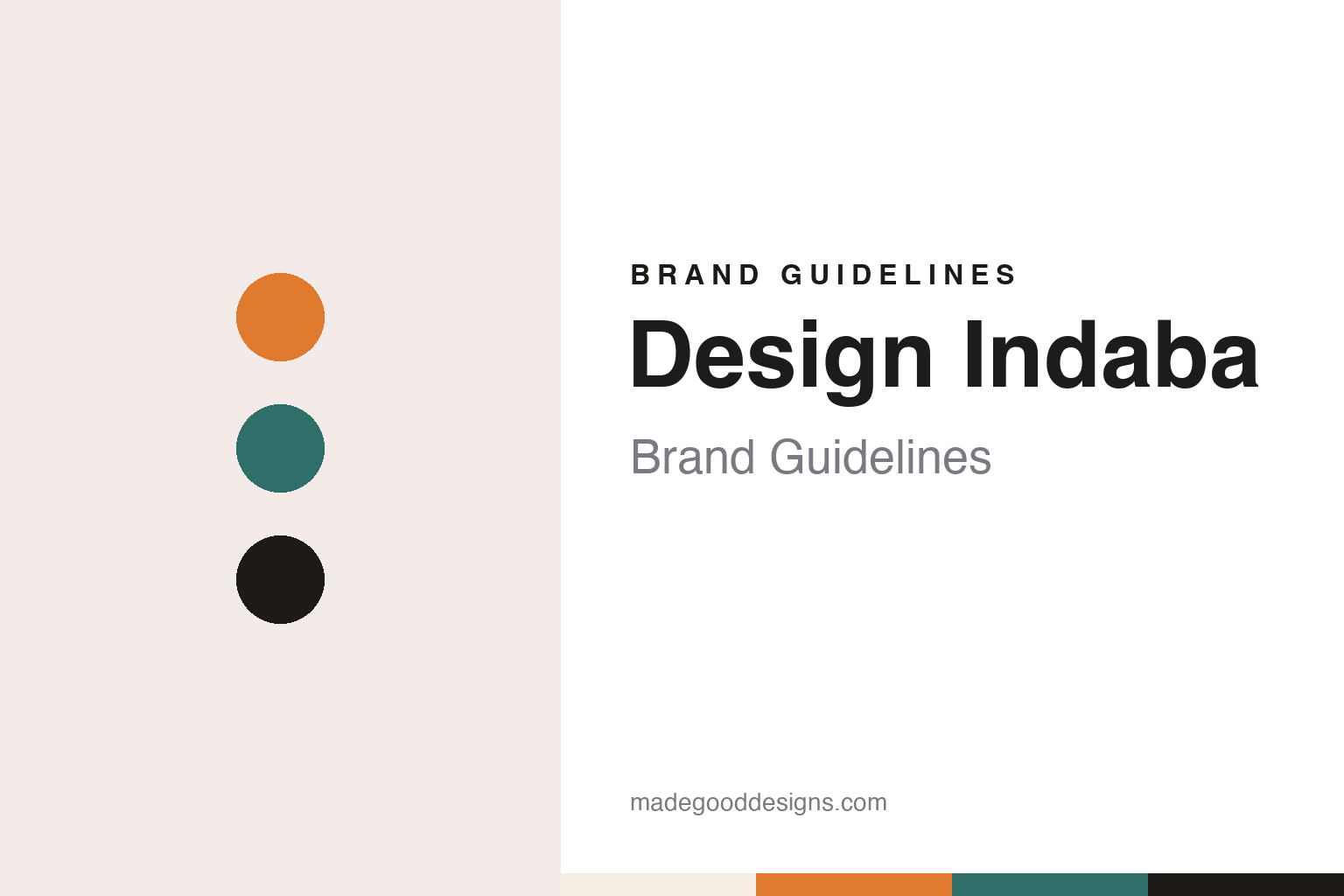
Design Indaba Brand Guidelines
A Cape Town design conference named with an old word for a gathering.
Aa
Two constants: an ochre, teal and black palette and a heavy grotesque register. Abstract homage — not a Design Indaba asset or mark; no logo, icon or wordmark is reproduced.
A gathering in Cape Town
From Interactive Africa to Design Indaba.
Design Indaba is a design conference and festival based in Cape Town, South Africa, and the name of the online publication, events and projects that have grown up around it. English Wikipedia describes Design Indaba as a trademark and brand founded and run by Interactive Africa in 1995, with a focus on design, and says it is known in particular for its annual festival in South Africa and in particular its three-day conference in Cape Town.
The person behind it is Ravi Naidoo. English Wikipedia says he worked as an account director at the advertising agency Young & Rubicam from 1990 to 1993, and in 1994 founded Interactive Africa, a Cape Town media and project-management company. A year later, it says, he founded Design Indaba. When the American magazine Cool Hunting interviewed him on 20 February 2020, ahead of the conference’s 25th edition, it described Naidoo as the founder of Design Indaba and as founder and managing director of Interactive Africa. The World Architecture Community news site, in a report of 19 January 2021, also gave 1995 as the year Naidoo founded the conference.
The name comes from southern Africa. English Wikipedia’s article on the word explains that an indaba is an important conference held by the izinDuna, the principal men, of the Zulu and Xhosa peoples, and that the term comes from the Zulu and Xhosa languages, where it means “business” or “matter”. It notes that the Swazi use a close cognate, indzaba, and that the word has been taken up by organisations around the world for their meetings and conferences. Joined to the English word “design”, it gives the event a name that says what it is: a gathering about design, rooted in the place where it happens.
Naidoo has described how the team started without a model to copy. In the Cool Hunting interview he said they had never been to a design conference and had no frame of reference, and that this turned out to be an advantage because they did not make something derivative but thought it up anew. The British magazine ICON, in a feature by Christopher Turner published on 19 May 2014, quoted Naidoo along similar lines, saying the team had built the event from the ground up, around what they wanted to say, and what they wanted to set in motion. ICON added that the inaugural event had a practical focus on graphics and advertising.
English Wikipedia sets out the early rhythm of the conference. It says the Design Indaba Conference has been held in Cape Town since 1995, every two years until 2001, and annually since then.
Colour
A convention centre, a theatre and a pause.
The conference has moved within Cape Town. A media statement issued by the Western Cape provincial department of Economic Development and Tourism and published on the South African Government’s website on 24 February 2014 placed that year’s Design Indaba at the Cape Town International Convention Centre. It gave the conference dates as 26 to 28 February 2014, followed by a Design Indaba Expo from 28 February to 2 March, and noted that the year coincided with Cape Town’s term as World Design Capital 2014.
By the end of the decade the event had a different home. ICON’s preview of 23 February 2020 said the festival would occupy the whole of the Artscape from 26 to 28 February that year, and English Wikipedia names the Artscape Theatre Centre as the venue of the main event in recent years. The World Architecture Community report of January 2021 also gave the Artscape Theatre Centre on Cape Town’s Foreshore as the conference’s venue.
The format around the talks has grown. ICON wrote in 2020 that what began as TED-style talks had evolved into a multidisciplinary festival, with conference talks simulcast to other locations in the country, an Emerging Creatives programme for young designers, a programme of after-hours music called Nightscape and a series of Night School workshops and talks. English Wikipedia describes the Design Indaba Festival as a week-long event made up of the conference, a film festival, a series of exhibitions including Emerging Creatives, and music and other performances, and says the conference is broadcast live to other cities; it lists Johannesburg, Durban, Nairobi, Windhoek, Kampala and Lausanne among recent ones.
Naidoo has framed the mix of speakers as the point. Speaking to Cool Hunting in 2020, he said the organisers could put an artist next to a chef, an architect next to a fashion designer, a graphic designer, a coder and a social scientist. English Wikipedia says the programme has included chefs, musicians, visual artists, filmmakers and founders of creative businesses alongside architects and product, graphic, fashion and furniture designers, and that the event has also been called the “Conference on Creativity”. ICON’s 2014 report listed that year’s speakers as including the Dutch graphic design collective Experimental Jetset, who spoke about their rebranding of the Whitney Museum, and the designer Stefan Sagmeister, who closed the conference.
In 2021 the calendar broke. The World Architecture Community reported on 19 January 2021 that the conference and festival, usually held in February, would not take place that year because of the continuing impact of Covid-19, and had been postponed to 2022. It said the organisation would use 2021 to plan and carry out a number of its Do Tank projects and to launch a new offering called Design Indaba Inside, and it quoted Naidoo as saying it made no sense to cut and paste a pre-Covid model onto a post-Covid world.
Typography
A conference named with a Zulu and Xhosa word.
A festival or conference carries its brand differently from a product. The name and the core mark usually stay fixed, while the look around them is rebuilt for each edition. That annual identity is often commissioned from a different studio or artist every year, which turns the event into a running sequence of design briefs and makes the archive of past posters, badges and websites part of the brand itself.
Moving image matters as much as print. Title sequences, stage openers and short idents run between talks and set the tone in a room before anyone speaks, and they are often where a commissioned designer has the most freedom. The venue becomes a brand surface too: a city, a building or a recurring location can attach itself so closely to the name that the two are remembered together, and a move to a new place can feel like a redesign.
The programme is the working document of the identity. Stage names, track colours, wayfinding, lanyards and schedule apps all carry the system at small sizes and under pressure, so type choices and colour coding have to stay legible on a phone screen, a printed map and a large projection in the same week.
Aa
A heavy grotesque — after a Cape Town conference with a short, plain name. (Specimen set in Archivo Black, a sans STAND-IN; NOT the Design Indaba logo, wordmark or any event typeface.)
Design Indaba
A motto, a Do Tank and projects in the city.
The brand’s words have changed alongside its format. In the Cool Hunting interview of February 2020, Naidoo said the organisers began with the line “a better future by design” and that it had since widened into “a better world through creativity”. ICON called that phrase the company motto in its preview the same month, and English Wikipedia gives it as the slogan under which Design Indaba was founded and runs. The same interview quoted Naidoo describing the organisers as activists rather than impresarios or event promoters, and saying the aim was to turn ideas into outcomes.
That aim has a name. English Wikipedia describes the Design Indaba Do Tank as a set of projects and initiatives largely funded by the Design Indaba Trust and independent sponsorship, and lists among them the Your Street Challenge, the 10×10 Low-Cost Housing Project, Another Light Up, Sonop and Arch for Arch. ICON wrote in May 2014 that the Do Tank had produced a series of model homes built by the architect Luyanda Mpahlwa and a scheme to bring lighting to an informal settlement, and in February 2020 it described the unveiling in 2017 of Arch for Arch, a monument in Cape Town in honour of Archbishop Desmond Tutu, designed by Snøhetta and Local Studio. English Wikipedia’s article on Naidoo says the 10×10 project involved international architects including David Adjaye, Tom Dixon and Shigeru Ban.
Behind the events sits a publishing side. English Wikipedia describes Design Indaba as consisting of an online publication as well as events and creative projects, and its article on Naidoo refers to a digital publication alongside the annual conference. The 2021 announcement of Design Indaba Inside pointed in the same direction, as a new offering launched during a year without the usual February gathering.
Through all of this the owner has stayed the same. English Wikipedia says Design Indaba is founded and run by Interactive Africa, and Cool Hunting in 2020 named Naidoo as the founder of both. The sequence of dated facts is short and clear: Interactive Africa in 1994, the conference in 1995, an every-other-year rhythm until 2001, the convention centre in 2014, the Artscape in 2020, and a pause in 2021.
For a design guide, Design Indaba shows how an event can carry its identity in a name and a motto as much as in a mark: an English word for the subject joined to a southern African word for the gathering, and a single line, “a better world through creativity”, repeated across a conference, a festival and a programme of built projects. Compare Dutch Design Week, another design gathering named for what it is, and KIKK Festival, a festival of creativity in this collection. For this guide we use ochre, teal and black with a heavy grotesque sans, an unofficial interpretation; no product or logo is reproduced.
Explore & save
Keep Design Indaba’s identity on hand — save it to a board in the Made Good inspiration library.
Design Indaba identity set
Pin the Design Indaba ochre, teal and black palette and the heavy grotesque register to your own board.