Echlinville Brand Guidelines
A Co Down farm distillery, licensed in 2013.
Aa
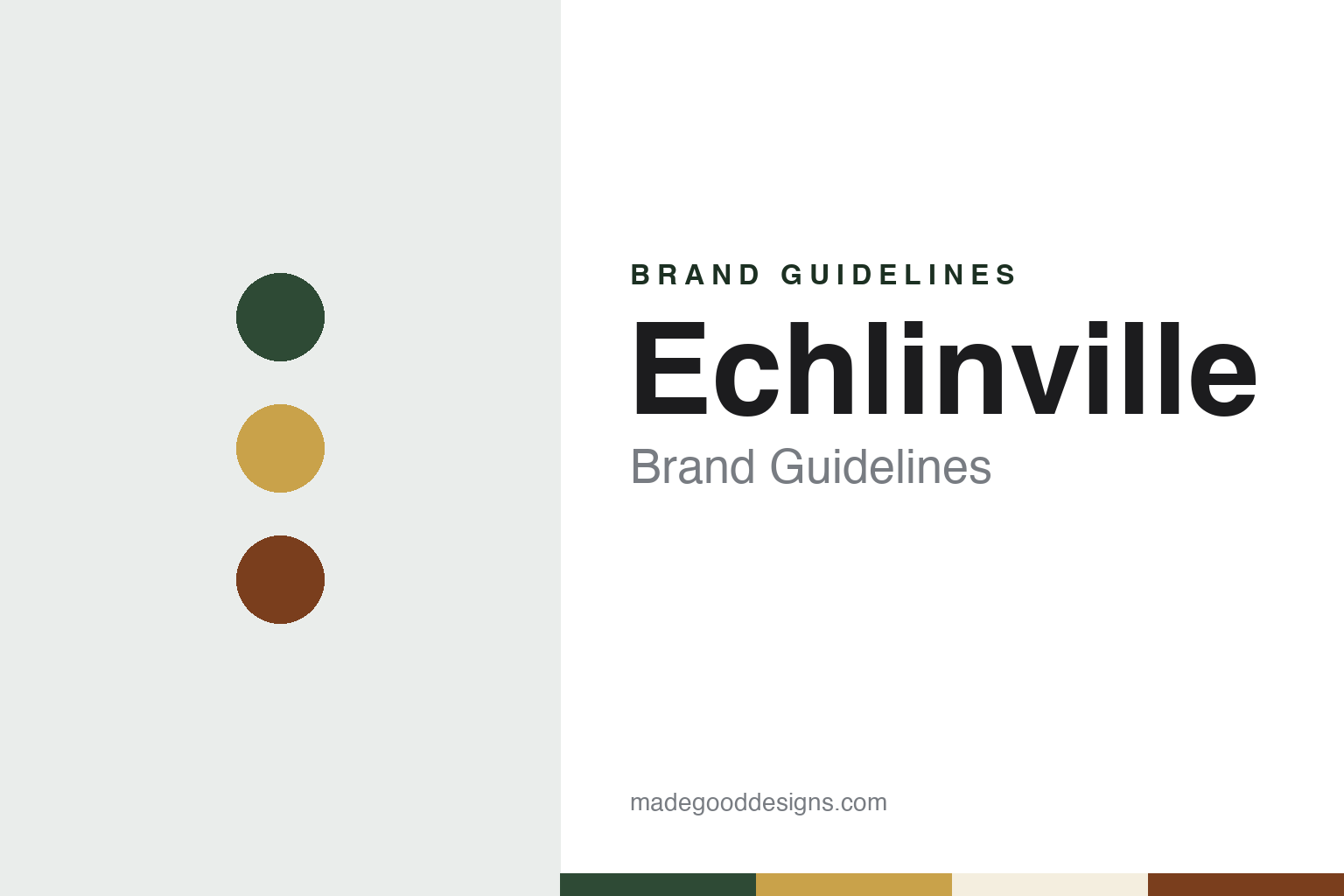
Two constants: an Ards green, barley gold and sherry-cask palette and a Victorian display serif register. Abstract homage — not an Echlinville or Dunville’s product or mark; no label, logo or bottle is reproduced.
A manor house on the Ards Peninsula
From a house bought in 2007 to a licence in 2013.
The Echlinville Distillery stands near Kircubbin on the Ards Peninsula in County Down, Northern Ireland. Its story, as the Irish News told it in May 2024, begins in 2007, when a local couple, Shane and Lynn Braniff, bought Echlinville Manor House near Kircubbin with plans for what the paper described as a field-to-glass distillery: one that would grow its own grain, distil it and mature it in the same place.
The licence came in 2013. BIM Ireland reported in January 2014 that Echlinville had been granted a licence to distil whiskey in May 2013. According to the Irish News, the first casks were filled on 5 August 2013.
The farm is the point of the brand. The Irish News reported in 2024 that Echlinville’s whiskey is made from barley grown, harvested and malted on the Braniff family farm, and the company’s own site makes the same promise for its gin, vodka and poitín, calling Echlinville a single-estate distillery and “Ireland’s first farm distillery.” Those last words are the company’s own description of itself. The site also describes the business as a family-owned distillery whose spirit is “trickle pot distilled.”
Shane Braniff has been the public face of the project from the start. BIM Ireland quoted him as Echlinville’s managing director in January 2014, noting that whiskey has to mature in a cask for at least three years and that the distillery expected its own product to reach the market in late 2016. In June 2025 the Irish News quoted Jarlath Watson, the distillery’s head of whiskey, on a new release.
Colour
A nineteenth-century Belfast name, redrawn for a new century.
Before it could sell its own whiskey, Echlinville borrowed a past. Dunville & Co was a Belfast tea and spirits merchant that went on to blend and distil its own whiskey, English Wikipedia says; BIM Ireland gives its founding year as 1801. The company took the Dunville & Co name in 1825, launched its best-known blend, Dunville’s VR, in 1837, and in 1869 built the Royal Irish Distilleries on the edge of Belfast. Sources differ on the end: BIM Ireland said in 2014 that whiskey production ceased in 1935, while English Wikipedia, citing a family history, says the company was liquidated in 1936.
Echlinville brought the name back. The Irish News dated the revival to 2012; English Wikipedia, citing The Irish Times of January 2014, and The Dieline date it to 2013. The first new Dunville’s was not distilled at Echlinville at all: BIM Ireland reported in 2014 that the company had bought a consignment of whiskey from another Irish distillery and finished and blended it itself, and English Wikipedia says the revived Dunville’s VR and Three Crowns reached the market in 2016.
The look was designed to read as old. The Dieline reported in December 2014 that the packaging was the work of the specialist drinks design agency Drinksology, and described a label that “combines intricate illustration with hand rendered typography throughout.” The same article said the design built on the brand’s original Victorian heritage, and that the label includes representations of Ireland, Scotland, England and Wales.
The range has since grown older. The Irish News reported in May 2024 that a Dunville’s Single Cask Series began in 2019, and in June 2025 that a 23-year-old single malt finished in Pedro Ximénez sherry casks was the oldest age statement the distillery had released to date.
Typography
Design and documentation.
The seven brands in this group are all names from the newer generation of distilleries on the island of Ireland: Dingle, Waterford, Glendalough, West Cork, Pearse Lyons, Boann and Echlinville. Distillery brands in general sit at many different points in the trade, from family-run sites that still carry a founder’s name or a farm’s fields to labels that belong to larger drinks groups, and a single name can cover a whiskey, a gin, a vodka or a poitín.
A young distillery’s identity is often carried less by its own aged spirit than by a place, a story and a label, because whiskey takes years in the cask before it can be sold as whiskey, and some distilleries sell gin, bought-in whiskey or spirit they have finished themselves while their own stock matures. That makes the questions behind each name worth asking plainly: who started it, who owns it now, and where its spirit is actually distilled, matured and bottled.
Each guide separates what independent sources record from what the company says about itself — its founding story, its owners over time, where its spirit is made and how its labels have changed — and marks plainly what rests only on the company’s own word.
Aa
A Victorian display serif for a revived nineteenth-century Belfast name. (Specimen set in Playfair Display, a serif STAND-IN; NOT the Echlinville or Dunville’s logo.)
Echlinville
One distillery, many revived names.
Dunville’s is only one of the names that pass through Kircubbin. The Irish News listed an Echlinville Irish Pot Still Gin and Weavers Dry Gin in 2024, and reported that the distillery had revived two more old names in 2021: Old Comber and Matt D’Arcy. The paper’s 2024 report announced Echlinville’s first single-estate whiskey under its own name, on sale from 1 June that year, and in 2025 it named that first release Echlinville The Beginning, noting that the distillery’s core range uses Pedro Ximénez, Oloroso and Palo Cortado sherry casks.
The distillery also makes spirit for others. NI Good Food reported in July 2024 that Jawbox gin, founded in 2016 by the Belfast publican Gerry White and named after the large “jawbox” sinks once common in the city’s homes, is distilled in small batches at Echlinville. In April 2018 the Irish News reported that the Co Down Feckin Drinks Co had rebranded its Irish whiskey, first launched in 2005, and added a gin and a vodka, all produced at Echlinville. The company’s own site lists both names, along with a poitín, among its brands.
The names need a little care online. Echlinville is the name of the house and estate as well as the distillery, and the distillery’s site is echlinville.com; Dunville’s is the whiskey, while Dunville & Co was the nineteenth-century Belfast firm behind it.
For a design guide, Echlinville shows how a young farm distillery can lean on an old city name, a Victorian label and barley from its own fields to build a whiskey identity before its own spirit has come of age. Compare Bushmills, the County Antrim whiskey, and Teeling, the Dublin whiskey distillery. For this guide we use Ards green, barley gold and sherry-cask brown with a serif, an unofficial interpretation; no product or logo is reproduced.
Explore & save
Keep Echlinville’s identity on hand — save it to a board in the Made Good inspiration library.
Echlinville identity set
Pin the Echlinville Ards green, barley gold and sherry-cask palette and the Victorian display serif register to your own board.