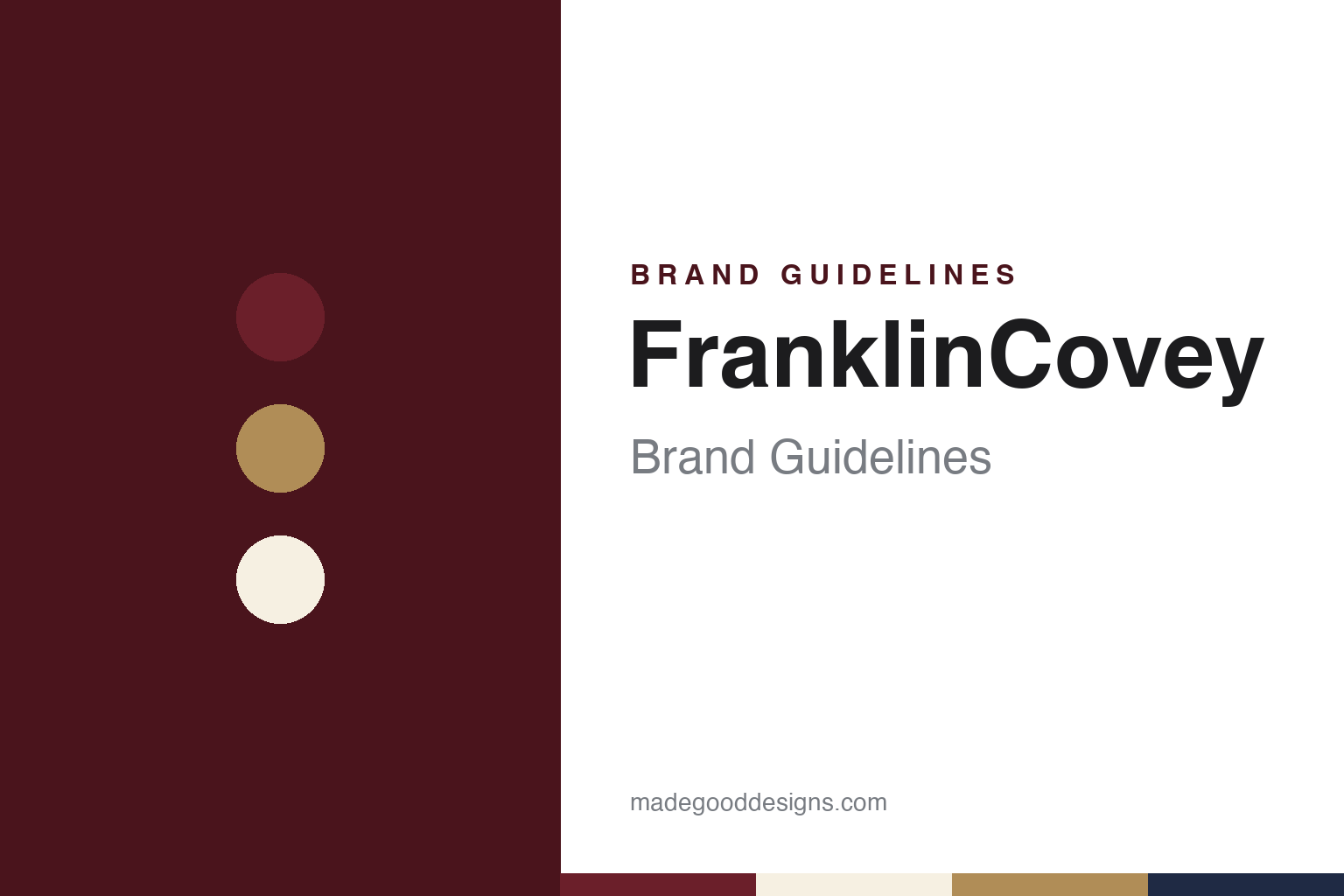
FranklinCovey Brand Guidelines
A seminar handout that became a ring-bound planner, then a licensed name.
Aa
Two constants: a binder oxblood, ring brass and ledger cream palette and a bookish ledger serif register. Abstract homage — not a FranklinCovey or Franklin Planner product or mark; no planner, binder, page or logo is reproduced.
A Planner Born in a Seminar
Hyrum W. Smith, Benjamin Franklin and a ring binder.
The FranklinCovey planner began life as a teaching aid. According to the company history in the International Directory of Company Histories (Vol. 37, St. James Press, 2001), Hyrum W. Smith, a graduate of Brigham Young University, started a home-based business giving management seminars in 1981, working from his basement. The Directory says the business was incorporated in 1983 as Franklin Institute, Inc. by Smith, Dick Winwood, Dennis Webb and Lynn Webb, and that Robert F. Bennett joined the following year as chairman of the board. The Directory gives the company’s address as Salt Lake City, Utah.
The name came from Benjamin Franklin. The Directory says Smith decided to build his time-management programme after reading Franklin’s autobiography, and that Franklin’s own system rested on a checklist of thirteen virtues, among them frugality, industry, sincerity and temperance. English Wikipedia says the planning system was named after Franklin, who kept a small private book, as described in The Autobiography of Benjamin Franklin.
The paper product followed the seminars. The Directory says the company introduced the Franklin Day Planner in 1984 as a way for seminar participants to put the Franklin system into practice, and describes it as a ring binder holding paper planning aids, monthly and annual calendars and various personal management aids. English Wikipedia, citing Smith’s Advanced Day Planner User’s Guide (1987), credits the planner to Smith and says it was sold in 1984 by Franklin International Institute, Inc. Customers, the Directory adds, came back each year for refill pages.
The company also chose to sell the planner itself. The Directory says Franklin offered the planner and related products through a catalogue from 1984, part of a strategy of keeping distribution and customer service in the hands of its own trained staff rather than independent retailers. By 1985, it says, people who had heard about the system were walking in to the company’s warehouse, which led Franklin to open a local retail store and then a programme of outlet stores, many of them in shopping malls, that also served as a showcase for the seminars.
Colour
From Franklin Quest to FranklinCovey.
The 1990s brought a new name. The Directory says that in 1992 Franklin Institute went public on the New York Stock Exchange and changed its name to Franklin Quest Co. The product line grew around the binder. The Directory describes a pocket planner introduced in 1992, designed to fit in a suit-coat pocket or a small purse, and a line of decorative filler pages printed with floral patterns that changed with the seasons. In late 1991, it says, the company released ASCEND, personal information management software designed to work alongside the paper planner or on its own.
Acquisitions followed. The Directory says Franklin Quest bought Productivity Plus, a supplier of planning materials for military customers, in 1996, and Premier Agendas, a maker of student planners, in 1997.
The defining step was a merger. English Wikipedia, citing the Deseret News of 22 January 1997, says Franklin Quest and the Covey Leadership Center jointly announced their merger that day. The Directory says the Covey Leadership Center had been formed in 1980 by Stephen R. Covey, a former Brigham Young University professor and the author of The 7 Habits of Highly Effective People (1989). Wikipedia dates the formation of Franklin Covey Co. to 30 May 1997, while the Directory dates the acquisition-merger to 31 May 1997. After the merger, Wikipedia says, citing the Salt Lake Enterprise of September 1997 and VMSD, the company’s shops were renamed Franklin Covey 7 Habits Stores and redesigned.
The planner kept company with other calendar names. The Directory records that in 1998 the firm entered an alliance with AT-A-GLANCE, and it lists Day Runner among Franklin Covey’s competitors. It also says the two merged companies kept separate headquarters, and quotes board member Robert H. Daines describing an “us-vs.-them culture.” Robert A. Whitman, the Directory says, became chairman in 1999 and chief executive in July 1999.
Typography
Design and documentation.
Planner and calendar brands sell something unusual: a product that is built around a single year and is replaced when that year runs out. A dated planner has to be designed, printed and on the shelf before the months it covers begin, and the same name may appear on a wall calendar, a desk pad, a pocket diary and an academic-year book that starts in summer rather than January.
The identity of a planner brand is often carried less by a logo than by a layout, a cover and a format people return to each year, because the company behind the name may have changed owners, licensed its covers to outside artists or moved its printing a long way from where it began. That makes the plain questions worth asking: who started it, who owns it now, and where its pages are printed and bound.
Each guide separates what independent sources record from what the company says about itself — its founding story, its owners over time, where its products are made and how its look has changed — and marks plainly what rests only on the company’s own word.
Aa
A bookish ledger serif. (Specimen set in Libre Baskerville, a serif STAND-IN; NOT the FranklinCovey or Franklin Planner logo.)
FranklinCovey
A licensed planner name since 2008.
In 2008 the planner and the parent company went separate ways. In a press release issued from Salt Lake City on 13 January 2009 and filed with the US Securities and Exchange Commission, Franklin Covey said that, effective 6 July 2008, its Consumer Solutions Business Unit had been sold to a new private-equity-funded entity, Franklin Covey Products, LLC. The release described that unit as responsible for the company’s consumer products, including the FranklinCovey Planner, binders and related accessories, sold through retail, wholesale, internet and call-centre channels. English Wikipedia says the sale came under chief executive Bob Whitman, as the company shifted its focus to in-person and live-online training.
The planner has since been sold under licence. English Wikipedia names FC Organizational Products, LLC as the parent of the Franklin Planner and as the exclusive worldwide licensee of the FranklinCovey brand. The footer of franklinplanner.com, in archived copies from 2021 and 2024, names Franklin Planner Corp. and states that FranklinCovey is a registered trademark of FranklinCovey Co., used by permission. Wikipedia lists the planner in four sizes — Monarch, Classic, Compact and Pocket — with drilled, loose-leaf pages.
The parent company carries the name in a different line of work. English Wikipedia describes Franklin Covey Co., trading as FranklinCovey, as a company based in Salt Lake City that provides training and assessment services for organisations and individuals, and lists it on the New York Stock Exchange under the symbol FC. It notes that, among other products, the company has marketed the FranklinCovey planning system, modelled in part on Franklin’s writings, and The 7 Habits of Highly Effective People.
For a design guide, FranklinCovey shows how a planner can carry two founders’ names and a historical namesake on a leather-look binder, and keep that name on the cover after the business behind it has been sold. Compare AT-A-GLANCE and Day-Runner. For this guide we use binder oxblood, ring brass and ledger cream with a serif, an unofficial interpretation; no product or logo is reproduced.
Explore & save
Keep FranklinCovey’s identity on hand — save it to a board in the Made Good inspiration library.
FranklinCovey identity set
Pin the FranklinCovey binder oxblood, ring brass and ledger cream palette and the bookish ledger serif register to your own board.


