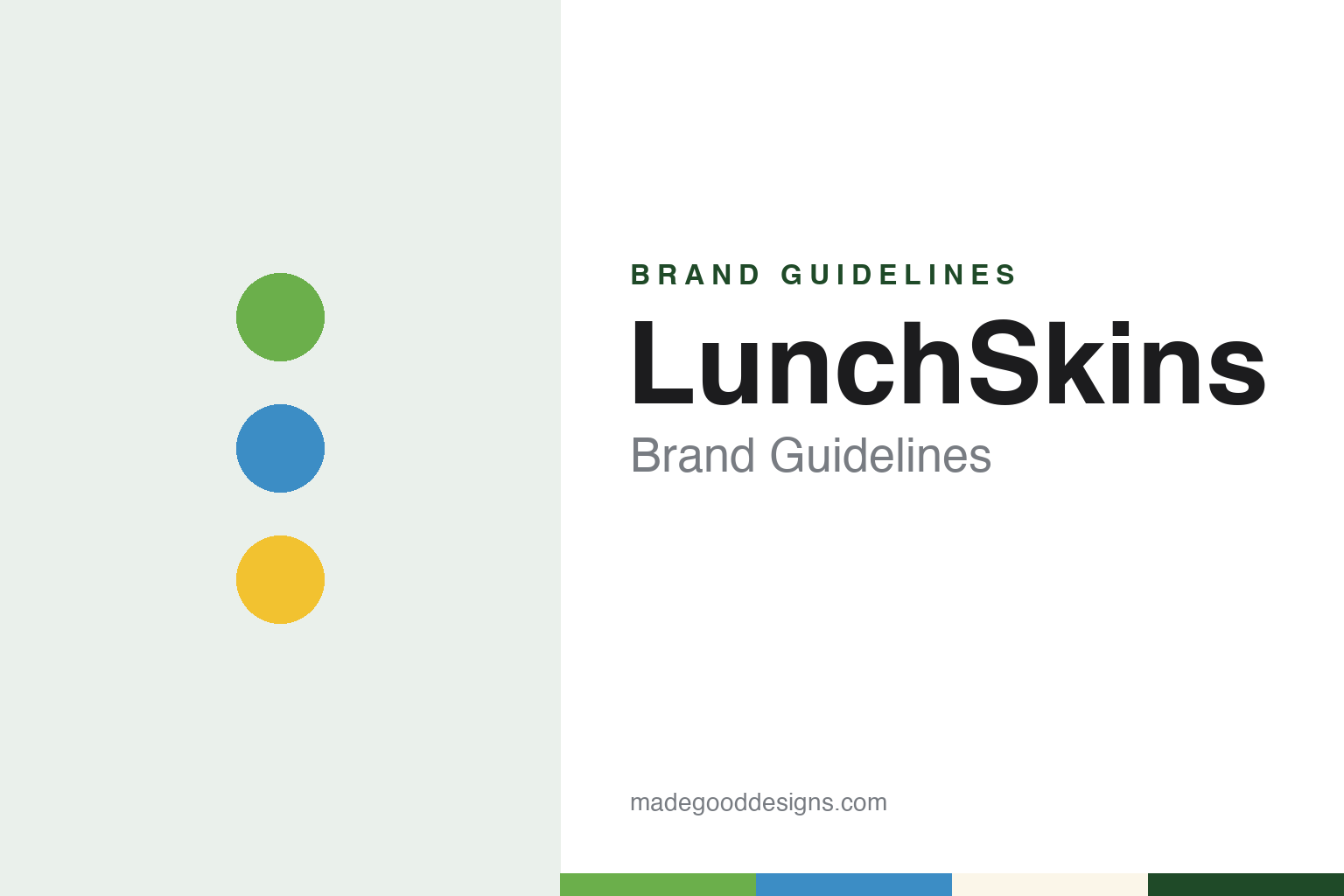
LunchSkins Brand Guidelines
A kitchen-table answer to the plastic sandwich bag, sold in bold prints.
Aa
Two constants: a leaf green, sky blue and sunshine yellow palette and a rounded friendly sans register. Abstract homage — not a LunchSkins product or mark; no bag, print or logo is reproduced.
A bag to replace a bag
Three mothers, a charity basket and a missing product.
LunchSkins is an American brand of reusable sandwich and snack bags, sold by a company that trades as 3GreenMoms. The brand’s own “our story” page dates it to 2008, when, it says, founder Kirsten Quigley noticed how much waste was being generated every day by packed lunches. The page presents the business as having grown from one mother’s frustration with daily plastic waste, and describes 3GreenMoms as a woman-owned company that has been helping families think and act greener ever since.
Independent reports give the start a slightly wider cast. In an article published on 4 March 2015, The Connection newspaper group’s writer Carole Funger described three founders — Kirsten Quigley, Cris Bourelly and Jennie Stoller Barakat — who had started the business at a kitchen table in 2008, and called them “three Potomac moms.” The same article set out their backgrounds: Quigley had worked for environmental nonprofits, Bourelly was a former corporate lawyer, and Barakat was a Los Angeles-based graphic designer and creative director. Quigley told the paper, “In the beginning, we were a small band of women working virtually trying to establish the business.”
An earlier report fills in how the idea arose. On 30 April 2010, the ABA Journal, citing The Washington Post, wrote that Bourelly, who had stepped away from corporate law to raise her children, co-founded LunchSkins with Quigley after the two were assembling a “trash free” lunch basket for a preschool charity auction and could not find a green alternative to the plastic sandwich bag. So they decided to make one. Quigley was quoted as saying, “You never anticipate when something is going to take shape like this,” and, “Half of life is being ready to take charge when you see something good.”
Colour
Bold prints, a German fabric and a small team.
The product itself is simple to describe. The ABA Journal report of 2010 described LunchSkins as a reusable replacement for the plastic sandwich bag, made in bold prints with a polyurethane liner, and said the bags could go in the dishwasher. Five years later, The Connection reported that the fabric came from Thermohauser, a German manufacturer.
By 2015 the range had moved well beyond the single sandwich bag. The Connection listed standard sandwich and snack bags, larger sub bags and a zippered lunch bag, along with wet bags sold for cloth diapers and a “sweat” bag for gym kit and travel. It added that insulated sandwich bags and freezable lunch totes were in development at the time. One print had a cause attached: the paper described a Seabird LunchSkin featuring an albatross, sold in support of the 5 Gyres Institute, an organisation that works on plastic pollution in the oceans.
The same article named some of the shops that carried the bags — The Container Store, Pottery Barn Kids, Target and Whole Foods — as well as organic markets, gift stores and hardware stores. It said a piece in O, The Oprah Magazine in April 2010 had brought a surge in demand, and that the business had grown from a group working remotely into a six-person team under one roof. Quigley summed up the aim: “Our hope is to inspire people to think about their choices and to give them an everyday solution to plastic waste.”
Typography
Design and documentation.
Lunchbox and food-carrier brands sit at a busy point in the household, between the kitchen counter and the school gate, the office desk or the picnic blanket. Some began with a parent’s own improvised prototype; others grew out of established housewares companies, and a single brand can be sold everywhere from a supermarket aisle to its own website.
A carrier’s identity is usually built less on a logo than on the object itself — its shape, its prints and colours, the way it opens and the name printed on its side — because the product is handled, washed and packed again every day. The companies behind these names may have changed hands, widened their ranges or moved where their products are made since they started.
That makes the plain questions worth asking: who started each brand, who owns it now, and where its products are actually made. Each guide separates what independent, dated sources record from what the company says about itself — its founding story, its owners over time, its manufacturing and the way its packs and prints have changed — and marks plainly what rests only on the company’s own word.
Aa
A rounded sans for a brand built on cheerful prints. (Specimen set in Nunito, a rounded sans-serif STAND-IN; NOT the LunchSkins logo.)
LunchSkins
Still under the 3GreenMoms name.
Ownership is set out most plainly in the brand’s own small print. The footer of the LunchSkins website states that Lunchskins® is a registered trademark of 3GreenMoms Benefit LLC, and the “our story” page describes 3GreenMoms as woman-owned. LunchSkins remains the 3GreenMoms brand, as it was when the founders started it in 2008.
The way the founders are credited has shifted over the years. The 2010 ABA Journal report named Bourelly and Quigley as the co-founders; the 2015 Connection article named three, adding Barakat; and the brand’s current story page singles out Quigley as founder. All three accounts agree on the year and on the problem the bag was meant to solve.
The name does much of the brand’s work. “LunchSkins” describes a thin, washable outer layer for a sandwich rather than a container, and the company name, 3GreenMoms, puts its founders and its environmental purpose on every pack. The bold prints described in the 2010 report carry the rest: a reusable bag is meant to be seen in a lunchbox every day, so pattern and colour do the job a logo might do on a disposable product.
For a design guide, LunchSkins shows how a small brand can build its identity around one everyday object and the founders who made it, keeping a plain descriptive name and letting printed fabric carry the personality. Compare Stasher, the silicone reusable bag, and Bee’s Wrap, the beeswax food wrap from Vermont. For this guide we use leaf green, sky blue and sunshine yellow with a sans, an unofficial interpretation; no product or logo is reproduced.
Explore & save
Keep LunchSkins’s identity on hand — save it to a board in the Made Good inspiration library.
LunchSkins identity set
Pin the LunchSkins leaf green, sky blue and sunshine yellow palette and the rounded friendly sans register to your own board.