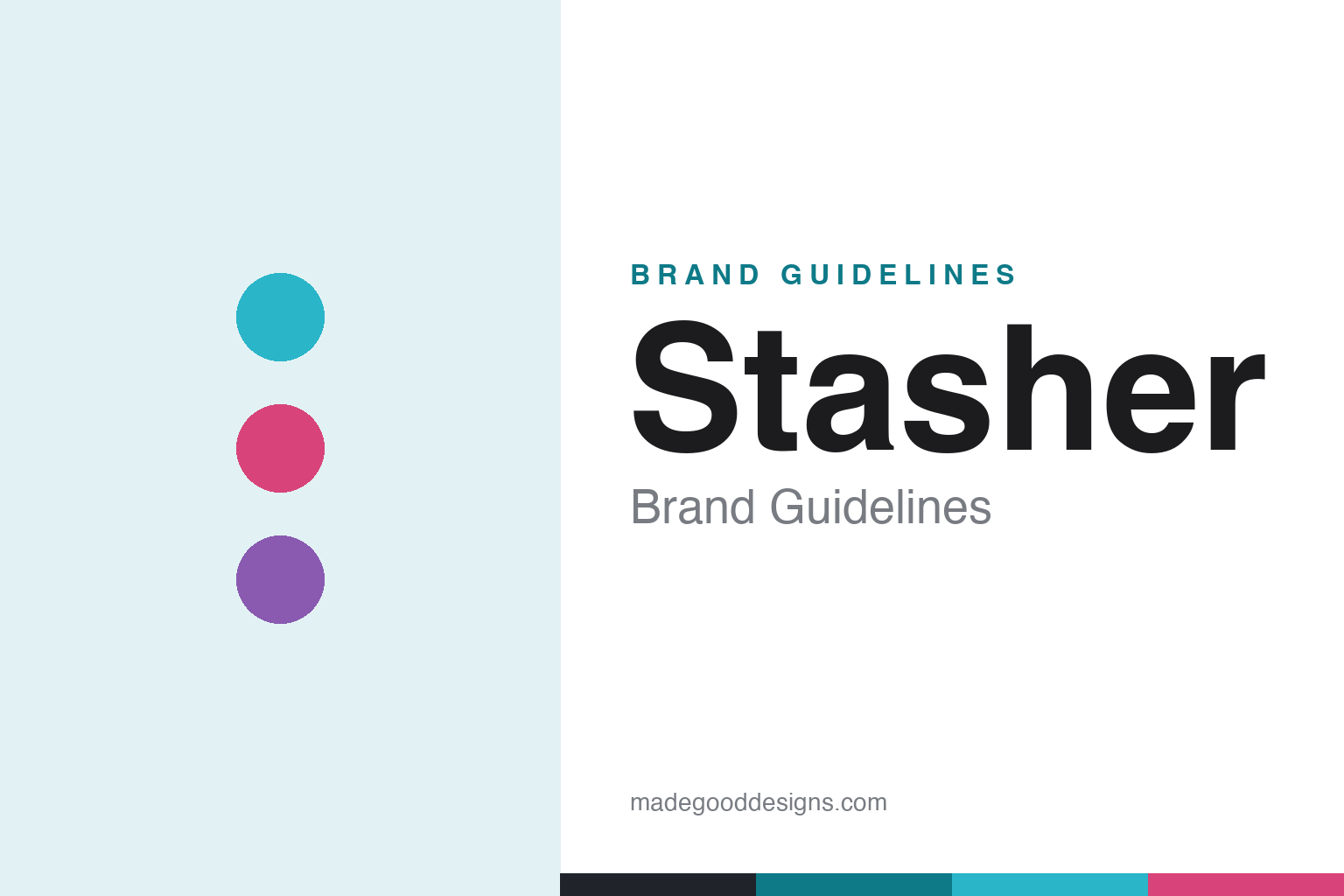
Stasher Brand Guidelines
The reusable bag that replaced plastic — platinum silicone, a pinch-seal, and a very ironic acquirer.
Aa
Two constants: a bright, cheerful multi-colour palette and a friendly, modern sans. Abstract homage — not the Stasher wordmark.
The bag that replaced plastic
Stasher reinvented the storage bag.
Stasher is a lesson in designing out single-use plastic. It was founded in 2016 by Kat Nouri — an Iranian-born American entrepreneur in the San Francisco Bay Area — as a plastic-free alternative to disposable storage bags. It grew out of her earlier company, Modern Twist (founded 2006, food-grade silicone products), so the bag was an evolution of a decade of silicone expertise, not an overnight idea. (Two honest notes: no official brand hex is published, and the wordmark typeface is undocumented.)
The product is a reusable, self-sealing storage bag made of 100% pure platinum silicone, with a proprietary, trademarked “Pinch-Loc” airtight seal (pinch it closed — no zipper slider). It’s a genuine plastic-free alternative to Ziploc-style bags: dishwasher-, microwave- and freezer-safe (and widely used for sous-vide), in a range of bright colours, marketed on the promise that one Stasher can replace hundreds of single-use plastic bags. It won a Red Dot Design Award and a Global Innovation Award in 2016 — design credibility to match the mission.
Two chapters deserve honest, precise telling. First, Shark Tank: Stasher appeared in 2018 (not 2019), where Nouri got an on-air handshake with Mark Cuban for $400,000 — but that deal ultimately fell through after the show, so it’s wrong to say she “landed a deal with Mark Cuban.” Second, and deliciously ironic: in December 2019, Stasher was acquired by S.C. Johnson — the maker of Ziploc. The reusable-bag disruptor was bought by the single-use-bag incumbent (terms undisclosed). The identity is bright and cheerful — a spectrum of colours, a friendly wordmark. Brand lines include “the simple, reusable alternative to single-use plastic.” The bag that replaced plastic.
Colour
Stasher lives in bright, cheerful colour. Click a swatch to copy the hex.
Stasher’s identity is built on bright, cheerful, multi-colour — aquas, raspberries, amethysts and more, each a named colourway (plus a clear option). Rather than one signature hue, the spectrum of fun, saturated colours makes a plastic-free swap feel joyful and desirable rather than worthy or dull — turning an eco choice into a bright, personal object. The colour is central to the brand’s appeal, softening the “sustainability” message with playfulness and making the bags collectible. The honest caveat: Stasher publishes no official brand hex, so the aqua, raspberry and amethyst here are an original, unofficial interpretation of its named colourways, not first-party values.
The lesson is bright colour can make a sustainable choice desirable. Stasher’s cheerful palette makes going plastic-free feel fun. For designers, it’s a reminder that colour can turn a virtuous, potentially dry proposition into a joyful one. The takeaways: use bright, cheerful colour to make an eco product desirable; name colourways to build personality and collectibility; and treat specific hexes as unofficial when the identity is deliberately multi-colour.
Typography
The wordmark is a friendly modern sans — bright and optimistic.
Stasher’s identity carries a friendly, modern, optimistic spirit — a clean, approachable sans-serif wordmark whose warm letterforms read as fresh, cheerful and positive. The friendly type matches a brand built on bright colour and a feel-good, plastic-free mission, and it keeps the sustainability message inviting rather than preachy. Set against a bright, multi-colour palette, the type feels optimistic and modern — exactly the cheerful, do-good personality Stasher cultivates. It’s friendly and approachable rather than austere or technical, mirroring the colourful bags. Because the exact wordmark face isn’t publicly documented, the honest description is “a friendly modern sans spirit,” not a named font. The type behaves like the brand: bright, friendly and optimistic.
Aa
A friendly modern sans spirit — bright and optimistic. (Specimen set in Rubik, a friendly modern sans in the spirit of the Stasher identity; the real face is undocumented.)
Disrupting, then absorbed
Stasher out-designed single-use.
Stasher is a lesson in disrupting a commodity — and the irony of who buys the disruptor. The single-use plastic bag is one of the most entrenched, invisible products in the kitchen, and Stasher took it on not with guilt but with better design: a beautiful, durable, colourful, genuinely functional reusable bag (platinum silicone, the Pinch-Loc seal) that people actually want to own. That’s the model for disrupting a commodity — make the sustainable option more desirable, not just more virtuous. The deeper lesson is in the ending: having proven the reusable category, Stasher was acquired in 2019 by S.C. Johnson, the maker of Ziploc — the very incumbent it disrupted. That’s a classic pattern: a nimble challenger creates a new category, and the incumbent buys its way in. It’s both a validation (the disruption was real enough to acquire) and a caution (disruptors often end up inside the giants they challenged). Out-design the commodity, and you may just get bought by it.
For designers and brand-builders, Stasher offers a clear takeaway: make the sustainable choice more desirable than the disposable one, and be ready for the incumbent to buy in. The lessons: disrupt a commodity with genuinely better, more desirable design (platinum silicone, Pinch-Loc, bright colour); soften the eco message with joy rather than guilt; and understand the category-creation-then-acquisition pattern. It’s also a reminder to keep the facts precise — Stasher was founded in 2016 by Kat Nouri (out of Modern Twist), its Shark Tank Cuban deal fell through, and it was acquired by S.C. Johnson (the Ziploc maker) in 2019. Stasher out-designed single-use — proof that desirable design can disrupt a commodity.
Explore & save
Keep Stasher’s identity on hand — save it to a board in the Made Good inspiration library.
Stasher identity set
Pin the bright palette and the friendly-sans spirit to your own board.