Bee’s Wrap Brand Guidelines
A wrap you warm in your hands — beeswax and cotton, a Vermont mission, and the natural end of cling film.
Aa
Two constants: an earthy honey-and-sage natural palette and a warm serif spirit. Abstract homage — not the Bee’s Wrap wordmark.
A wrap you warm by hand
Bee’s Wrap replaced cling film.
Bee’s Wrap is a lesson in a simple, natural product with a real mission. It was founded in 2012 by Sarah Kaeck in Vermont (headquartered in Middlebury), out of her home kitchen, seeking a plastic-free way to store food. (Two honest notes up front: no official brand hex is published, and the wordmark typeface is undocumented — and it’s Kaeck, a spelling the brand’s own site occasionally typos.)
The product is elegantly simple: a reusable food wrap made of organic cotton coated in beeswax, plant oil (such as jojoba) and tree resin. You warm it with your hands, and the beeswax softens just enough to mould and cling around a bowl, a piece of cheese, half a lemon or a loaf of bread — a natural alternative to plastic cling film. It’s deliberately breathable, not airtight (a design choice that keeps cheese and produce fresher), washable and reusable for about a year, and then compostable (or usable as a fire starter). It comes in printed patterns, and the honeybee/honeycomb motif is central to the identity. (An honest, important caveat: the standard wraps contain beeswax, so they are not vegan — there is a separate Vegan line that swaps beeswax for candelilla wax.)
The mission is genuine and backed by credentials: Bee’s Wrap is a Certified B Corp and a member of 1% for the Planet, and it’s proudly made in Vermont. It was one of the category-defining reusable beeswax-wrap brands. An honest ownership note: it is not founder-led any more — Sarah Kaeck sold the company in February 2021 to Champlain Capital (a Vermont private-equity firm), stepping back as new leadership took over. The identity is warm and natural — honey golds, sage, the honeycomb. A wrap you warm by hand.
Colour
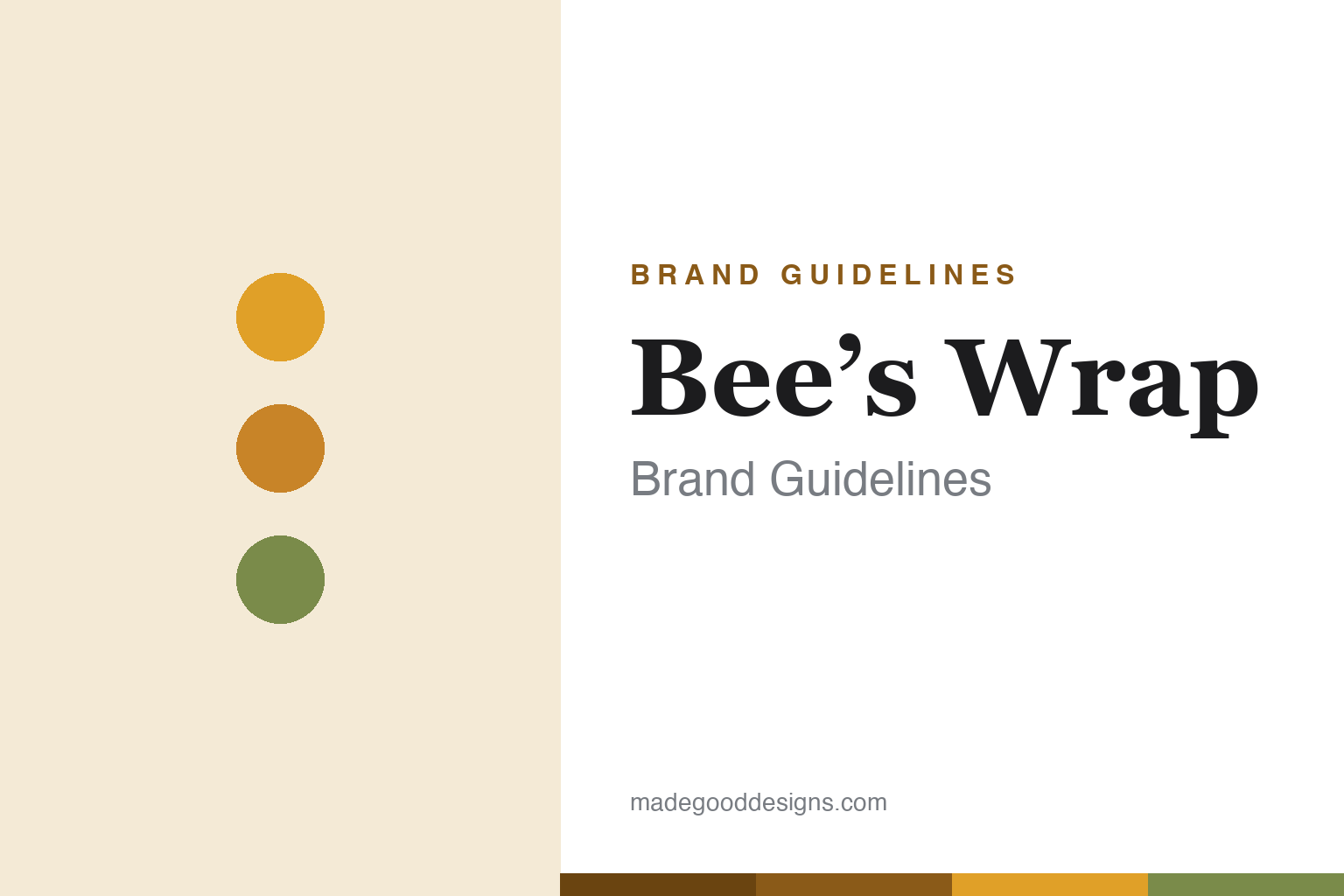
Bee’s Wrap lives in warm, natural tones. Click a swatch to copy the hex.
Bee’s Wrap’s identity leans on warm, earthy, natural tones — honey golds, amber, sage green and cream — anchored by the honeybee and honeycomb motif that is central to the brand’s origin and story. The palette reads as organic, wholesome and sustainable, matching a plastic-free, beeswax-based product made in Vermont: it feels handmade and natural rather than industrial or synthetic. The warm honey tones tie directly to the beeswax at the heart of the product. The honest caveat: Bee’s Wrap publishes no official brand hex, so the honey and sage here are an original, unofficial interpretation (the current logo appears in orange, but that’s an observation, not a spec), not first-party values.
The lesson is a natural, earthy palette can embody a sustainable product. Bee’s Wrap’s honey-and-sage tones literally reflect its beeswax-and-cotton material. For designers, it’s a reminder that a product’s natural ingredients can lead the palette and signal its values. The takeaways: use warm, earthy tones to signal a natural, sustainable product; tie the palette to the real material (beeswax honey); and treat specific hexes as unofficial when no brand spec is published.
Typography
The wordmark is a warm natural serif spirit — wholesome and handmade.
Bee’s Wrap’s identity carries a warm, natural, wholesome spirit — a feel befitting a handmade, plastic-free product born in a Vermont kitchen. A warm serif captures it well: the humane, slightly rustic letterforms read as natural, honest and craft-made, matching a brand built on beeswax, organic cotton and an environmental mission, and the warmth suits the honeycomb heritage. Set against honey-and-sage tones, the type feels wholesome and handmade — exactly the natural, sustainable personality Bee’s Wrap cultivates. It’s warm and natural rather than slick or synthetic, mirroring the earthy product. Because the exact wordmark face isn’t publicly documented, the honest description is “a warm natural serif spirit,” not a named font. The type behaves like the brand: wholesome, natural and handmade.
Aa
A warm natural serif spirit — wholesome and handmade. (Specimen set in Petrona, a warm humanist serif in the spirit of the Bee’s Wrap identity; the real face is undocumented.)
Nature as the differentiator
Bee’s Wrap sells natural simplicity.
Bee’s Wrap is a lesson in natural simplicity as the differentiator. Against plastic cling film — cheap, ubiquitous, effective but wasteful — Bee’s Wrap offers something almost old-fashioned: a simple, natural material (beeswax, cotton, plant oil, tree resin) that you warm by hand and reuse for a year, then compost. That naturalness is the entire proposition, and it works because it’s genuine: a real material solution, backed by real credentials (B Corp, 1% for the Planet, made in Vermont), not a marketing veneer. The lesson is that in a world of synthetic convenience, an honest, natural, low-tech alternative — beautifully made and clearly better for the planet — can carve out a devoted following and even define a category. The honest counterpoint is that mission-brands still operate as businesses: Bee’s Wrap was sold to a private-equity firm in 2021, a reminder that a genuine sustainability mission and a commercial exit can coexist. Sell natural simplicity truthfully, and the values do the marketing.
For designers and brand-builders, Bee’s Wrap offers a clear takeaway: an honest, natural, low-tech alternative can differentiate and even define a category. The lessons: solve a wasteful problem with a genuinely natural material (beeswax and cotton, not more plastic); back the mission with real credentials (B Corp, 1% for the Planet, made in Vermont); and let a warm, natural identity express it. It’s also a reminder to keep the facts precise — Bee’s Wrap was founded in 2012 by Sarah Kaeck in Vermont, is a beeswax-based (so not vegan, though a candelilla-wax vegan line exists) reusable wrap, and was sold to Champlain Capital in 2021. Bee’s Wrap sells natural simplicity — proof that an honest, natural alternative can be a brand.
Explore & save
Keep Bee’s Wrap’s identity on hand — save it to a board in the Made Good inspiration library.
Bee’s Wrap identity set
Pin the honey-and-sage palette and the natural-serif spirit to your own board.