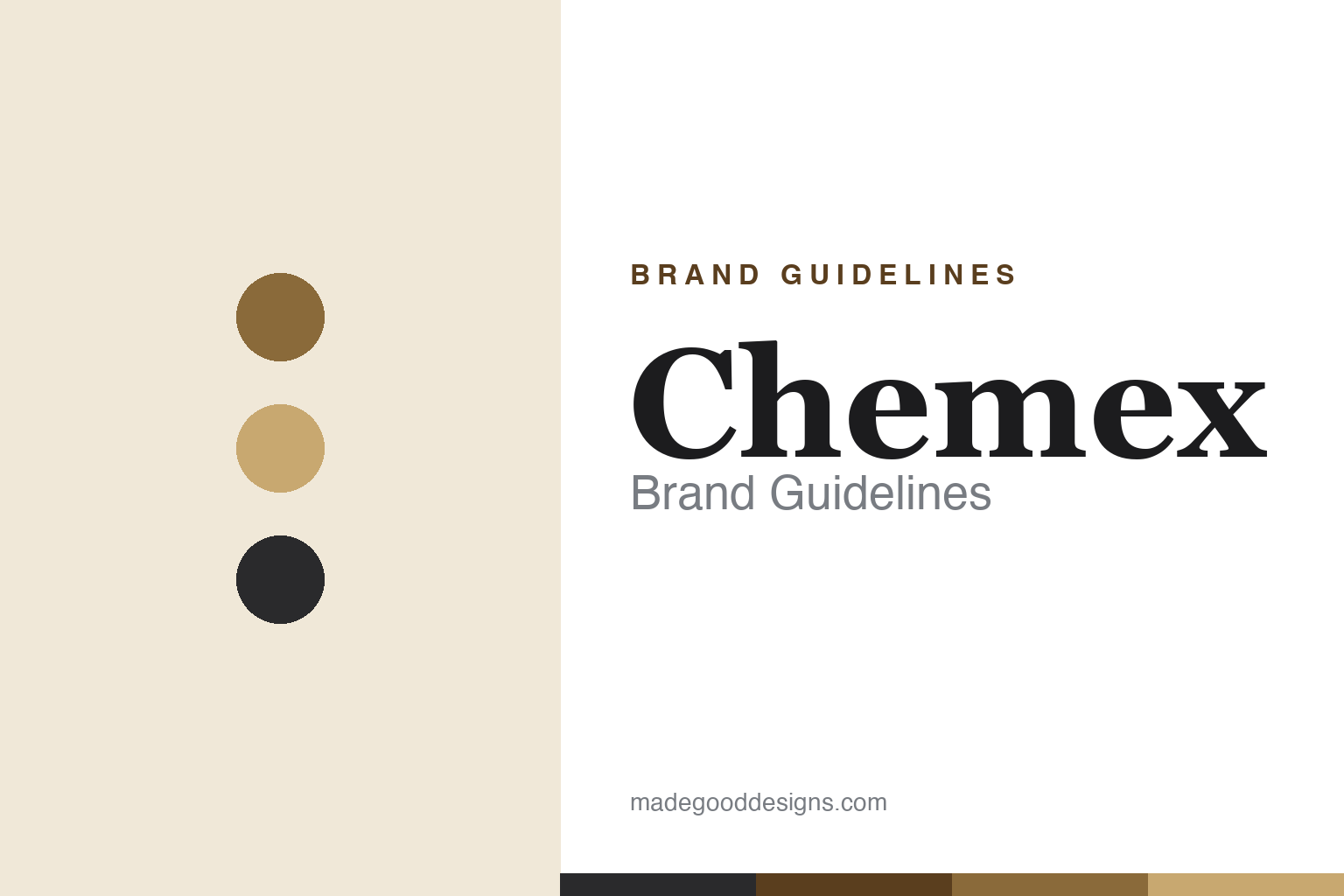
Chemex Brand Guidelines
A chemist’s coffee maker — hourglass lab glass, a wood collar and leather tie, and a design in MoMA.
Aa
Two constants: a natural wood-and-glass palette and an elegant heritage serif. Abstract homage — not the Chemex wordmark.
A chemist’s coffee maker
Chemex came from a chemistry lab.
Chemex is a lesson in science becoming design. It was invented by Dr. Peter Schlumbohm, a German-born chemist (born 1896 in Kiel, with a doctorate in chemistry from the University of Berlin) who immigrated to the US and lived in New York. He designed and patented the Chemex in 1941 (the underlying filtering-device patent was filed in 1939). Schlumbohm was a prolific inventor — he held around 300 patents, most of them in refrigeration — and the Chemex was a side project that outlasted them all. (Two honest notes: no official brand hex is published, and the wordmark typeface is undocumented.)
The design is the whole brand: an hourglass-shaped, one-piece borosilicate-glass carafe with a conical funnel-like top, a polished wooden collar (split in two) held by a leather (rawhide) tie as a heat-proof handle, and thick, proprietary bonded filters (made in-house, roughly 20–30% heavier than typical filters, for a clean cup). The form clearly evokes laboratory glass — a funnel set into a flask — combined with Bauhaus design principles and Schlumbohm’s chemistry expertise. (An honest note: it’s often said to be based on an “Erlenmeyer flask,” but that specific attribution isn’t documented — best described as echoing lab glass.)
The Chemex is a genuine design icon: it’s in the permanent collection of the Museum of Modern Art (MoMA), the Illinois Institute of Technology named it (1958) one of the best-designed products of modern times, and it even appears in Ian Fleming’s James Bond novel From Russia, with Love (1957) — where Bond brews coffee in one. Design critic Ralph Caplan called it “a synthesis of logic and madness.” It’s made by the family-owned Chemex Corporation in Chicopee, Massachusetts, with filters still produced in-house. The tagline: “Pure Design. Pure Flavor.” A chemist’s coffee maker.
Colour
Chemex lives in natural wood and glass. Click a swatch to copy the hex.
Chemex’s identity is the honest palette of its own materials: clear borosilicate glass, a warm wood collar, tan rawhide, and black type. There is no loud brand colour — the object’s natural materials are the palette, and they read as timeless, elegant and craft-made, fitting a design that has looked the same since 1941 and sits in a museum. It’s a warm, natural, understated look: the antithesis of plastic gadgetry. The honest caveat: Chemex publishes no official brand hex, so the wood and glass tones here are an original, unofficial interpretation derived from the object’s materials, not first-party values.
The lesson is an object’s natural materials can be its whole palette. Chemex’s wood-and-glass tones come straight from the product itself. For designers, it’s a reminder that honest materials can carry a timeless identity without any applied brand colour. The takeaways: let natural materials set the palette (glass, wood, rawhide); keep it warm and understated for a heritage-design object; and treat specific hexes as unofficial when the palette is the material itself.
Typography
The wordmark is an elegant heritage serif spirit — timeless and considered.
Chemex’s identity carries an elegant, heritage, considered spirit — a feel befitting a chemist-designed object that has been in production, unchanged, since 1941 and lives in MoMA. A refined serif captures it well: the timeless letterforms read as intelligent, crafted and enduring, matching a design that fuses science and Bauhaus clarity, and the restraint lets the beautiful glass-and-wood form speak. Set against natural wood-and-glass tones, the type feels classic and quietly premium — exactly the “pure design” personality Chemex cultivates. It’s elegant and timeless rather than trendy, mirroring the enduring object. Because the exact wordmark face isn’t publicly documented, the honest description is “an elegant heritage serif spirit,” not a named font. The type behaves like the brand: timeless, considered and elegant.
Aa
An elegant heritage serif spirit — timeless and considered. (Specimen set in Cardo, a classic serif in the heritage spirit of the Chemex identity; the real wordmark is undocumented.)
Timeless by design
Chemex never had to change.
Chemex is a lesson in a design so right it never had to change. Most products iterate constantly; the Chemex has been made, essentially unchanged, since 1941 — the same hourglass glass, the same wood collar and leather tie, the same clean cup. That timelessness is the brand: it signals that the design was correct from the start, born of a chemist’s logic and a modernist’s eye, and it gives the object a rare, museum-grade permanence (MoMA, IIT, a James Bond novel). The lesson is that genuine, first-principles design — solving the problem beautifully and honestly, from the materials up — can produce something that transcends trends and becomes a classic, needing no reinvention and no marketing gimmicks. In a category now full of gadgets and features, Chemex’s quiet confidence — one perfect object, made the same way for 80+ years, filters still produced in-house — is itself the differentiator. Get the design right, and it lasts forever.
For designers and brand-builders, Chemex offers a clear takeaway: first-principles design done right can become a timeless classic that never needs reinvention. The lessons: solve the problem beautifully from the materials up (lab glass, wood, a clean filter); trust a correct design to endure rather than chasing features; and let permanence and craft be the brand. It’s also a reminder to keep the facts precise — the Chemex was designed and patented in 1941 by chemist Peter Schlumbohm (who held ~300 patents, mostly in refrigeration), is one-piece borosilicate glass with a wood collar and leather tie, and is in MoMA. Chemex never had to change — proof that timeless design can be the brand.
Explore & save
Keep Chemex’s identity on hand — save it to a board in the Made Good inspiration library.
Chemex identity set
Pin the wood-and-glass palette and the heritage-serif spirit to your own board.