Bentgo Brand Guidelines
A stackable bento lunch box from 2013 that grew into a family of containers.
Aa
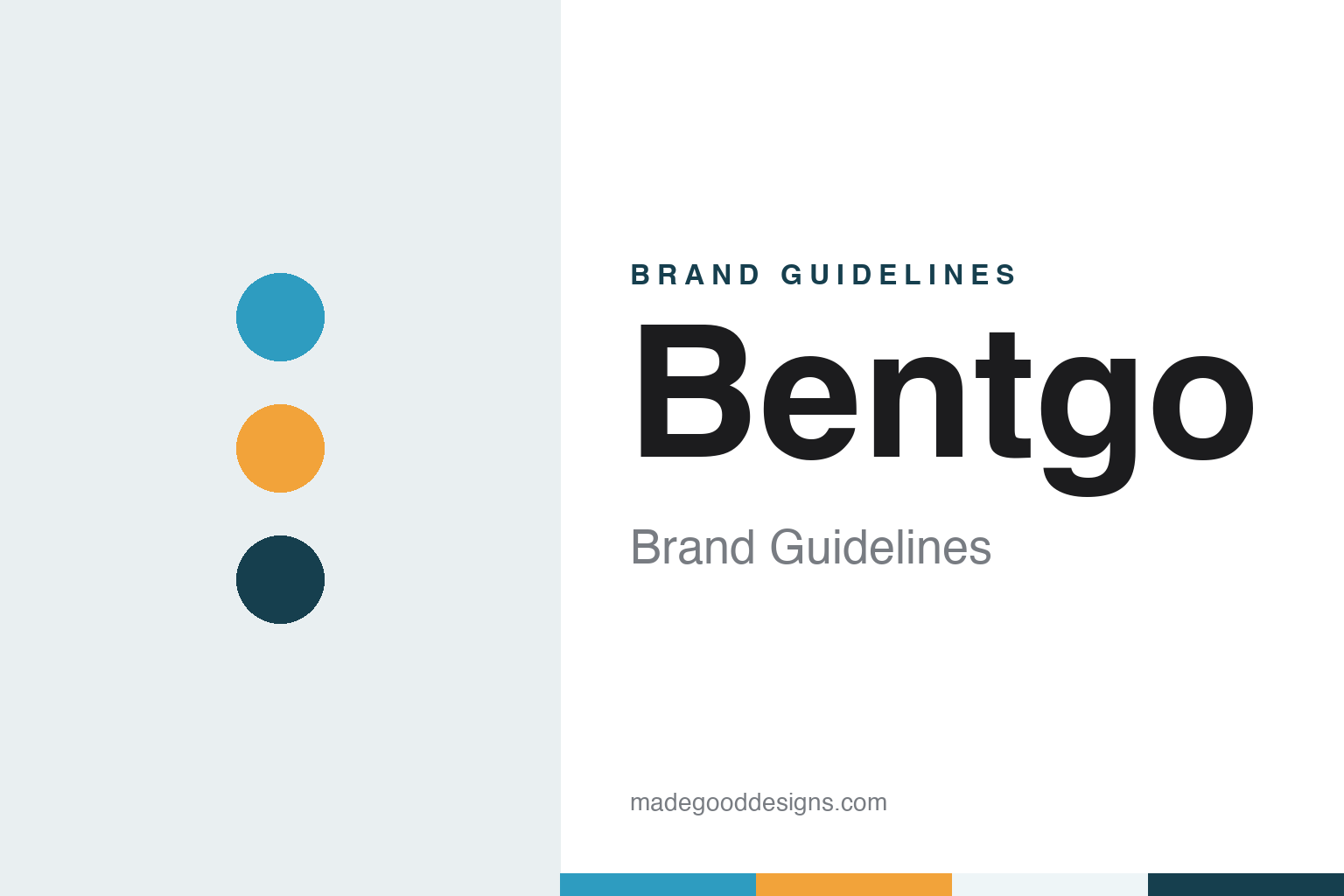
Two constants: a lunch blue, deep teal and snack orange palette and a rounded friendly sans register. Abstract homage — not a Bentgo product or mark; no lunch box, pack or logo is reproduced.
A box that stacks
An American lunch box brand built on the bento idea.
Bentgo is an American brand of bento-style lunch boxes and the containers, bags and accessories that have grown up around them. The company’s own account of its beginnings is short and specific. An About page captured by the Internet Archive with a 2014 copyright line says, “We launched our company in 2013 because we knew there was a better way to lunch.” The same page names a co-founder only by her first name: Bonnie, described as the company’s “dynamic spokesmom” and known to customers as “Bentgo Bonnie”, who helped introduce the first product. The page explained the motive in the company’s own words: “uninspired by the boring, non-practical lunch solutions on the market”, the founders “set out to create something innovative that would put the spark back into the idea of taking your lunch to work or school.” It called the result “the all-in-one, bento-inspired meal solution that is as beautiful as it is functional”.
That first product is visible in the earliest capture of bentgo.com, saved on 28 March 2013. At that point the site was a small online storefront with a shop, a gallery of “bentgo ideas”, testimonials, a press page and a link for retailers who wanted to become dealers. Its headline was a three-word promise, “Design. Health. Convenience.”, and its product description sat under the heading “Lunch That Stacks Up”. The box, the page explained, came as two stackable containers with lids, a set of built-in plastic cutlery and a strap that held the whole thing together for carrying. The company presented it as a lunch box for “school, work, and travel”, aimed at adults as much as at children, and as an alternative to brown paper bags and disposable containers. The page signed off “Copyright 2013 bentgo”, with the brand name written in lower case.
The company still refers to that original two-layer design as Bentgo Classic, and the 2013 storefront already wrote the name in lower case in its copyright line, while a customer testimonial on the same page used the plural “Bentgos”.
Colour
From one adult lunch box to a children’s line.
The same archived About page sets out the next steps. It says that after the first box the company “quickly expanded” its range to include insulated lunch bags, portable cups and sauce containers. Then, it says, “In 2014, we added Bentgo Kids,” which it described as a lunch solution “created for younger children between the ages of 3 and 7”. The page added that the company had “spared no detail in the design of Bentgo Kids”, and closed by inviting readers to follow both the brand and Bentgo Bonnie on social media for lunch ideas.
A capture of the home page from 2015 shows how the children’s box was introduced to shoppers. The page called Bentgo Kids “the newest member of our family” and said the box came in blue, purple or green. The menu structure was unchanged from 2013 — shop, ideas, testimonials, about, press, support and dealers — so the children’s line was folded into the same small storefront rather than launched under a separate name or site.
The press page of that period gathered short excerpts from magazines and blogs about the stacking box. One, credited to POPSUGAR, described Bentgo as that day’s “Daily Obsession” and said it was an item the editors had first chosen for a POPSUGAR Must Have box; others came from parents writing about packing the box for their children.
By 2017 the home page had a different message at the top. The company said its mission was “making lunch fun, healthy, and simple for everyone”, and announced a partnership with Feed the Children, which it described as a 501(c)(3) nonprofit organisation providing resources for children and families in need. A link to the partnership had joined the site’s footer. That relationship has lasted: the company’s current About page still says Bentgo has partnered with Feed the Children, and the site footer carries the line “Proudly partnering with Feed the Children”.
Typography
Design and documentation.
Lunchbox and food-carrier brands sit at a busy point in the household, between the kitchen counter and the school gate, the office desk or the picnic blanket. Some began with a parent’s own improvised prototype; others grew out of established housewares companies, and a single brand can be sold everywhere from a supermarket aisle to its own website.
A carrier’s identity is usually built less on a logo than on the object itself — its shape, its prints and colours, the way it opens and the name printed on its side — because the product is handled, washed and packed again every day. The companies behind these names may have changed hands, widened their ranges or moved where their products are made since they started.
That makes the plain questions worth asking: who started each brand, who owns it now, and where its products are actually made. Each guide separates what independent, dated sources record from what the company says about itself — its founding story, its owners over time, its manufacturing and the way its packs and prints have changed — and marks plainly what rests only on the company’s own word.
Aa
A rounded sans for a brand that writes its own name in friendly lower case. (Specimen set in Nunito, a sans-serif STAND-IN; NOT the Bentgo logo.)
Bentgo
A division of Bear Down Brands, with a much wider range.
Today Bentgo is part of a larger company. The terms of service on bentgo.com say the website “is operated by Bentgo, a division of Bear Down Brands, LLC”, and the footer of every page describes Bentgo as “A Bear Down Brands, LLC. Company.” The current About page retells the origin story in brief: more than ten years ago, it says, the company launched Bentgo Classic “to make lunch packing easier, more stylish, and — dare we say — a little healthier too”, then introduced Bentgo Kids “to bring that same style and simplicity to little ones (and their parents)”.
The range described on that page now goes well beyond the stacking box. The company lists Chill containers, lunch bags, backpacks, food storage, hydration products and accessories, and its shop includes the Heat electric lunch box and electric lunch bag, glass and stainless steel storage, meal-prep containers and replacement parts such as utensils and ice packs.
For a design guide, Bentgo shows how a single named lunch box — the Classic — can become the anchor of a family of products sold under the same short name. Compare Yumbox, the bento-style children’s box from two mothers in Pennsylvania and France, and Thermos, the vacuum-flask brand. For this guide we use lunch blue, deep teal and snack orange with a rounded sans, an unofficial interpretation; no product or logo is reproduced.
Explore & save
Keep Bentgo’s identity on hand — save it to a board in the Made Good inspiration library.
Bentgo identity set
Pin the Bentgo lunch blue, deep teal and snack orange palette and the rounded friendly sans register to your own board.