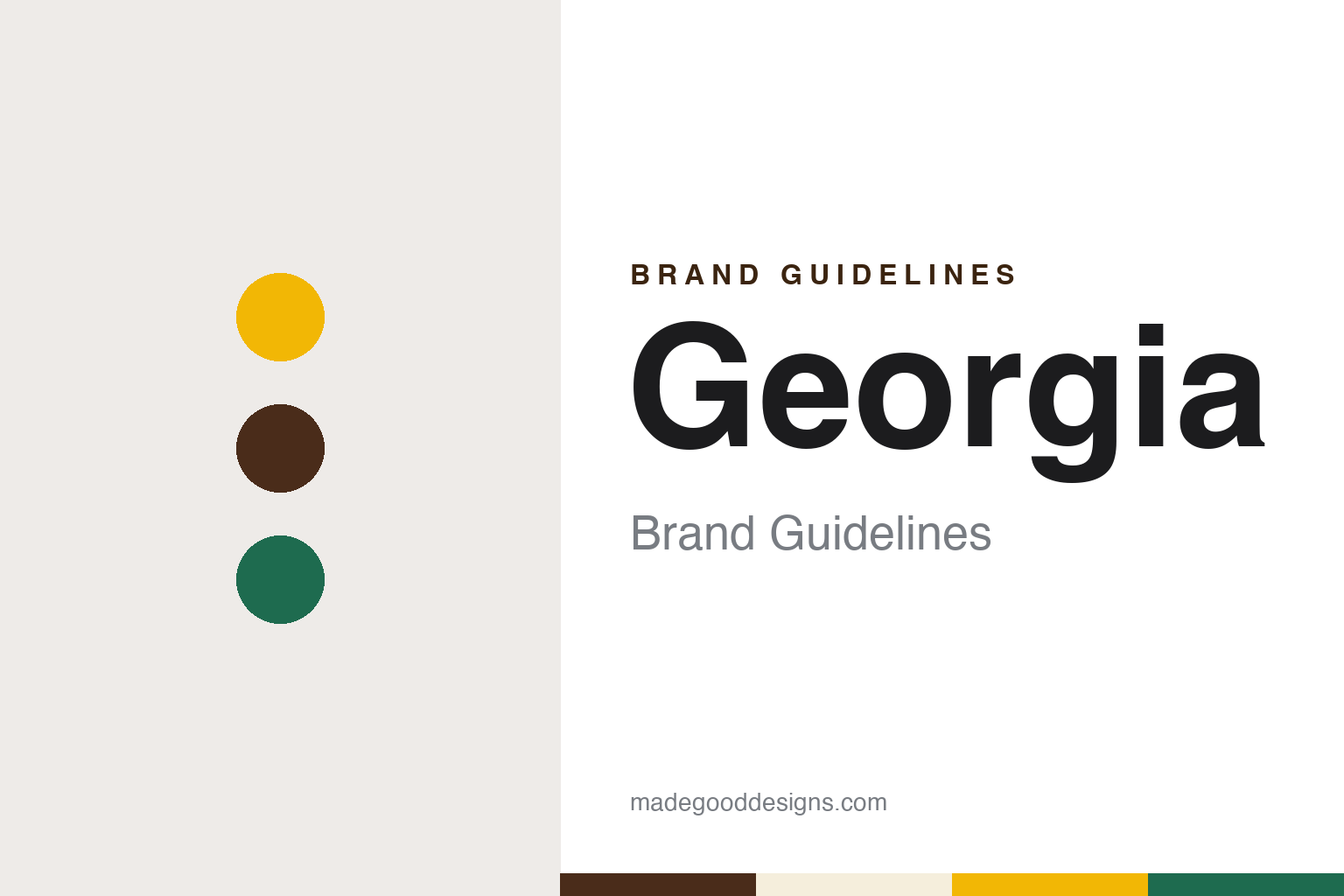
Georgia Brand Guidelines
Coca-Cola’s Japanese canned coffee, born in Kyushu in 1975.
Aa
Two constants: a can yellow, roast brown and emerald palette and a bold vending-machine sans register. Abstract homage — not a Georgia product or mark; no can, logo or pack is reproduced.
A winter drink for a summer company
A Kyushu bottler, a 250-gram can and a name from Atlanta.
Georgia is the canned coffee brand of the Coca-Cola system in Japan, and it began with a seasonal problem. Japanese Wikipedia says development started at Kita-Kyushu Coca-Cola Bottling, then one of the regional companies that bottled and sold Coca-Cola products in Japan, as a way to stop the business running at a loss through the winter months. In June 1975 the bottler launched a single product, a 250-gram can sold as “Coffee drink Georgia,” in its own territory of Fukuoka, Saga and Nagasaki prefectures in Kyushu. That can is the ancestor of the product sold today as Georgia Original.
The name points across the Pacific. Both English and Japanese Wikipedia say it comes from the US state of Georgia, home of The Coca-Cola Company’s headquarters in Atlanta. Coca-Cola (Japan) Company, in a press release of March 2023, describes Georgia as its core coffee brand since its birth in 1975.
Japan’s Coca-Cola business was then divided among regional bottlers, and each decided for itself when to take the new coffee. Japanese Wikipedia says eleven bottlers sold Georgia in its first year, and the rest followed one by one. Fuji Coca-Cola Bottling, whose territory covered Kanagawa, Yamanashi and Shizuoka, was then selling My Coffee from its parent company, the grocer Meidi-ya, and only introduced Georgia in 1979, so for a time national television advertisements carried a caption saying the coffee was not on sale in Kanagawa. The last holdout was Kinki Coca-Cola Bottling, covering Osaka, Kyoto and Hyogo, which brought Georgia to its ordinary market in 1982, making it a national brand.
One bottler ran two coffees side by side. Tone Coca-Cola Bottling sold Georgia in Tochigi, but in Chiba and Ibaraki it sold MAX Coffee, a very sweet milk coffee launched there in June 1975 as a separate local brand. Japanese Wikipedia says MAX Coffee joined the Georgia range in 1991 and went on sale nationwide in February 2009.
Colour
From one can to a range, and from steel to aluminium.
Georgia began as one product and grew into a family. Japanese Wikipedia says the range began to expand in the early 1980s. Tasty, a blend made with powdered milk, arrived in April 1987 and was a mainstay of the brand until Emerald Mountain Blend appeared in March 1994. Made with Emerald Mountain beans, a grade certified by the Colombian coffee growers’ federation, it became known to drinkers as “Ememan” and remained the brand’s leading product for nearly thirty years, Japanese Wikipedia says. Citing a 2008 Yomiuri Shimbun article, it calls Georgia the top brand by share of Japan’s canned coffee market.
The can itself has changed. The first Georgia held 250 grams; the standard size today is around 190 grams, a size Japanese Wikipedia links to ease of drinking. For years milk coffees in Japan had to be packed in flat-bottomed steel cans, because of an industry self-regulation that required each can to be tested by tapping. Georgia trialled its first aluminium can, an Emerald Mountain Blend Black, in parts of Japan in October 2012 and rolled it out nationally in April 2013. Milk coffees followed from 2014, after the rules changed in August that year, and by September 2015 almost the whole canned range had moved to aluminium. The instruction on the can changed with it, from “shake well before opening” to a request to shake lightly, wait a moment and then open.
Georgia has also looked back at its own packs. In May 2020, Japanese Wikipedia says, a reissue can reproducing the design of the 1975 Original went on year-round sale in the northern Tohoku prefectures of Aomori, Iwate and Akita, while the Michinoku area received a reissue of the 1987 Tasty design. Since 2018 the brand has also sold coffee in plastic bottles, first as the Japan Craftsman series and, from March 2023, as a renamed range developed with the Tokyo roaster Sarutahiko Coffee.
Typography
Design and documentation.
The seven brands in this group are all food and coffee names from Japan: Marukome, Hagoromo, Nagatanien, Sapporo Ichiban, UCC, Boss and Georgia. Japanese food and coffee brands in general sit at many different points in the trade, from family firms that still carry a founder’s name to names that now belong to much larger food and drink groups, and a single brand can be sold everywhere from a corner shop to a supermarket shelf.
A food or drink brand’s identity is usually carried less by a single product than by a pack, a name and the meal, snack or drink it promises, because the company behind the name may have changed hands, moved its production or grown far beyond the place where it started. That makes the questions behind each name worth asking plainly: who started it, who owns it now, and where its products are actually made and packed.
Each guide separates what independent sources record from what the company says about itself — its founding story, its owners over time, where its products are made and how its packaging has changed — and marks plainly what rests only on the company’s own word.
Aa
A bold, compact sans for a coffee sold from vending machines. (Specimen set in Archivo, a sans STAND-IN; NOT the Georgia logo.)
Georgia
A disputed name, long-running advertising and a yellow rhombus.
The name itself went to court. Japanese Wikipedia and the published judgment record that Coca-Cola applied to register “GEORGIA” as a trademark on 10 May 1975, and that the Japan Patent Office refused it as a mere indication of place of origin. On 23 January 1986 the Supreme Court of Japan dismissed the company’s appeal, holding that buyers would assume the coffee came from the US state of Georgia. Japanese Wikipedia adds that a later application with a narrower list of goods was registered in June 1988, on the strength of the brand’s years of continuous sales.
Advertising has carried much of the brand. Japanese Wikipedia lists the comedy duo Downtown as the faces of a 2000–2003 series built around the song “Ashita ga Aru Sa,” and the actor Takayuki Yamada as the lead of “The world is made of someone’s work” (世界は誰かの仕事でできている。), which ran from January 2014 to 2022. Coca-Cola (Japan) Company names the earlier slogan “Georgia de ikimashō” (Let’s go with Georgia) alongside that line in its 2023 release.
In March 2023 the company announced what it called the largest brand renewal in Georgia’s history. Its press release says the logo was renewed for the first time in fourteen years, replacing a design introduced in 2009, under the theme “Inner Glow”: a yellow brand colour, a rhombus shape and a glowing coffee bean at the top centre to suggest rising aroma. The company said the brand’s message was moving from expressing taste to expressing emotional value, under the new line “Every day is quite a drama” (毎日って、けっこうドラマだ。), with the musician Kenshi Yonezu as its new face and his song “LADY” in the television advertising.
Georgia is a brand rather than a factory. Japanese Wikipedia lists its makers as Coca-Cola Bottlers Japan and the Hokkaido, Michinoku, Hokuriku and Okinawa Coca-Cola bottling companies, with Coca-Cola Customer Marketing as distributor. Abroad, Georgia went on sale in South Korea in June 2011, under the Japanese logo used until 2009, Japanese Wikipedia says, and English Wikipedia records Georgia Gold as a machine-dispensed coffee in Coca-Cola India’s range.
For a design guide, Georgia shows how a bottler’s answer to slow winter sales became a national brand built on a can, a borrowed place name and decades of advertising. Compare Boss, Suntory’s canned coffee, and UCC, the Kobe coffee company. For this guide we use a can yellow, a roast brown and an emerald green with a bold sans, an unofficial interpretation; no product or logo is reproduced.
Explore & save
Keep Georgia’s identity on hand — save it to a board in the Made Good inspiration library.
Georgia identity set
Pin the Georgia can yellow, roast brown and emerald palette and the bold vending-machine sans register to your own board.