Boss Brand Guidelines
Suntory’s canned coffee with the pipe-smoking face.
Aa
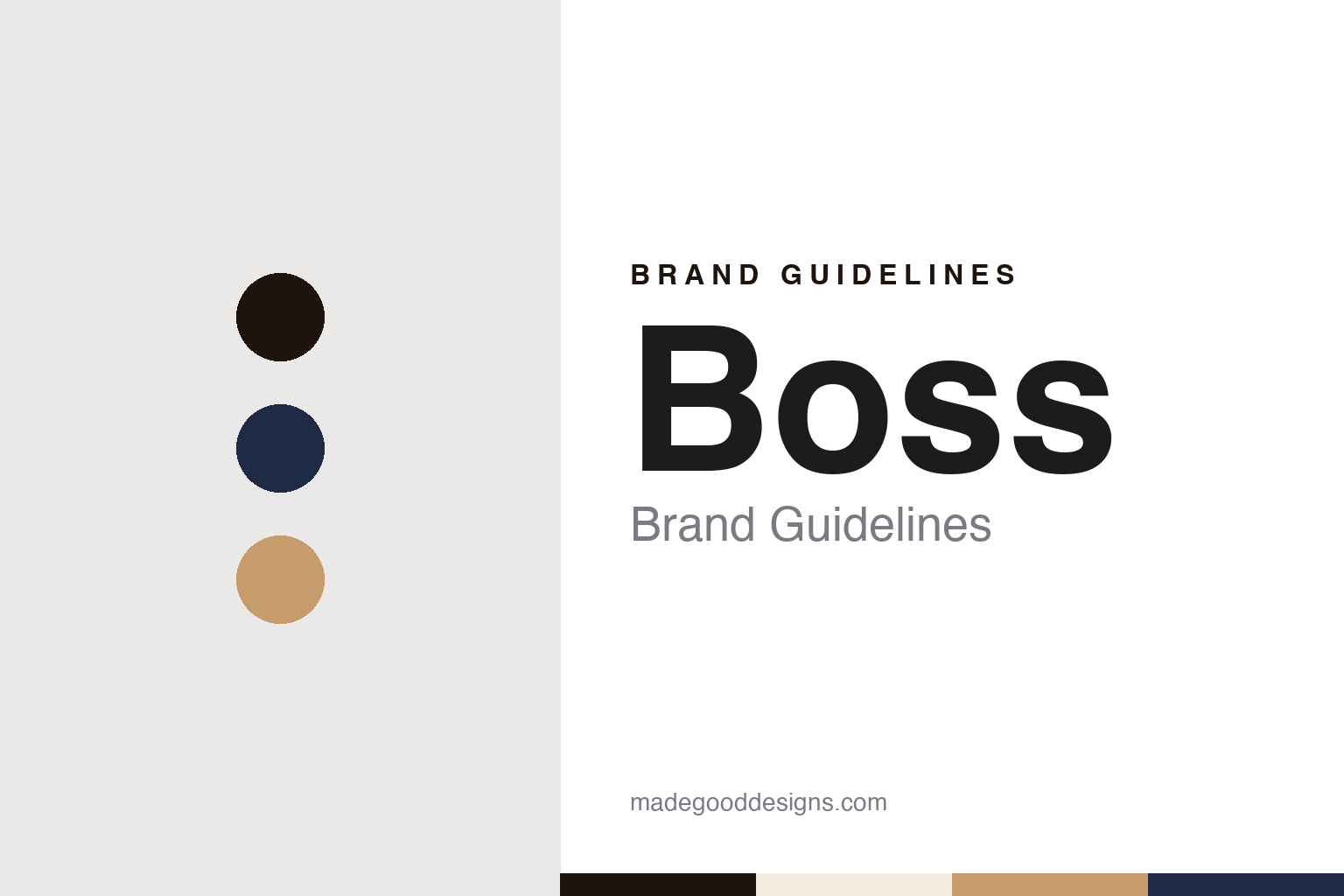
Two constants: an espresso, workwear navy and café-au-lait palette and a strong slab serif register. Abstract homage — not a Boss product or mark; no can, logo or character is reproduced.
After WEST
A second attempt, built around people who work alone.
Boss is the canned coffee of Suntory, the drinks group that began in Osaka, and it was built as a second attempt. Suntory had launched a canned coffee called WEST in 1987; it sold reasonably well but below the company’s hopes, Gendai Business reported in 2024, and for its successor the team set out to make a canned coffee that only Suntory could make. Boss was test-sold in Tokyo and Osaka in 1991 and launched nationally in August 1992; the trade paper Shokuhin Sangyo Shimbun gives the date as 27 August.
The brand began with research into who actually drank canned coffee. Suntory’s survey found that about 80% of buyers were men and that heavy users accounted for some 60% of consumption, Japanese Wikipedia says. The team focused on people who work with their hands. Speaking at Boss’s 25th-anniversary event in 2017, brand developer Shinichiro Yanai said Suntory had interviewed drivers and tradespeople and found that many of them spent their whole working day alone, from leaving home until they returned, Excite News reported. From that sense of solitude and freedom came the brand concept Suntory still uses: the coffee as a working person’s partner.
The product was shaped around that idea. A 2007 book on the brand’s development, Kan Kōhī Shokunin (“Canned Coffee Craftsmen”), published by Ushio Shuppan, says the team spent about twenty months on it rather than the usual six to eight, made more than a thousand prototypes, and chose a 190-gram can rather than the then-standard 250 grams because it suited a short break. It also kept a sweeter taste for people doing physical work, the book says, even though the trend was toward less sugar. The launch range had four drinks, led by Super Blend and a café au lait.
Colour
A face with no model, and an alien in the office.
The face of Boss is a drawing of a man with a pipe in his mouth, nicknamed “Boss ojisan” by some Japanese media. It was designed by Hiroyuki Ishiura, a creative director in the design department of Suntory Communications, who said at the 2017 anniversary event that many people asked who the model was — guesses included the rock singer Eikichi Yazawa and Steve McQueen — but that there was none: he deliberately avoided a real person so that each drinker could picture their own boss. The icon began as a sketch whose shading and lines were simplified, and for the first Super Blend can the team chose to convey the coffee’s taste through the man’s expression rather than a drawing of beans, Excite News reported.
Over the years the character has been adjusted rather than replaced. For the tenth anniversary in 2002, small props were added around the man without changing his face or angle, under the concept “Boss moves”; for the 15th anniversary in 2007 the Zeitaku Bitō can used a gold-bar motif; and Boss no Kyūjitsu, “Boss’s Holiday,” left him off the pack altogether. Not every change worked: Ishiura has said the 2001 Boss HG can, which enlarged the man to compete with rivals, was a failure. By 2017 the series had passed 300 products, including renewals, Excite News reported.
Advertising made the brand famous. At launch Suntory cast Eikichi Yazawa, who then rarely appeared on television, as a hapless office worker, Gendai Business reported. Since April 2006 the American actor Tommy Lee Jones has starred in the long-running “Alien Jones” series, playing an alien who takes jobs across Japan to investigate life on Earth; nippon.com wrote in 2020 that the role had made him one of the country’s most recognisable faces. Suntory told Mynavi News in 2022 that the series was created to keep the “working person’s partner” concept alive as canned coffee was drunk in more settings. Campaign prizes became well known too, above all the “Boss-jan” jacket; in 1996 Hugo Boss sued Suntory over that jacket on trademark grounds, a case Japanese Wikipedia says was settled on condition that wording identifying the product as coffee appear beside the logo.
Typography
Design and documentation.
The seven brands in this group are all food and coffee names from Japan: Marukome, Hagoromo, Nagatanien, Sapporo Ichiban, UCC, Boss and Georgia. Japanese food and coffee brands in general sit at many different points in the trade, from family firms that still carry a founder’s name to names that now belong to much larger food and drink groups, and a single brand can be sold everywhere from a corner shop to a supermarket shelf.
A food or drink brand’s identity is usually carried less by a single product than by a pack, a name and the meal, snack or drink it promises, because the company behind the name may have changed hands, moved its production or grown far beyond the place where it started. That makes the questions behind each name worth asking plainly: who started it, who owns it now, and where its products are actually made and packed.
Each guide separates what independent sources record from what the company says about itself — its founding story, its owners over time, where its products are made and how its packaging has changed — and marks plainly what rests only on the company’s own word.
Aa
A strong slab serif for a coffee named after the person in charge. (Specimen set in Roboto Slab, a serif STAND-IN; NOT the Boss logo.)
Boss
A Suntory brand, a roastery and a move abroad.
Boss belongs to Suntory Beverage & Food, the soft-drinks company of the Suntory group, which listed on the Tokyo Stock Exchange in July 2013 and adopted Suntory Beverage & Food as its Japanese name in April 2026; in Japan the drinks are sold through its subsidiary Suntory Foods. Japanese Wikipedia says the coffee is roasted from imported beans at Suntory’s coffee roastery in Ebina, Kanagawa, and in 2022 the company gave 5,000 used jute bean sacks to neighbouring Zama city, for residents to fill with garden prunings to be turned into biomass fuel, Nikkei reported. The wider group traces its roots to Shinjiro Torii’s Osaka wine shop, told in our Suntory guide.
The brand has kept moving beyond the short can. In September 2004 Rainbow Mountain Blend became the series’ core can, the trade paper Nihon Shokuryo Shimbun reported. In 2017 Suntory launched Craft Boss, coffee in plastic bottles: Craft Boss Black went on sale on 4 April 2017, Nikkei reported, and Craft Boss Latte, launched that June, sold so quickly that shipments were briefly halted, Japanese Wikipedia says. The range later spread into tea and other drinks under the same name.
From 1992 until 2019 Boss was sold only in Japan. In 2019 Suntory launched it in the United States, BevNET reported, and in Australia and New Zealand, where it is distributed by Suntory Oceania; the Australian launch campaign, “How Japan Can,” was created by Clemenger BBDO Sydney, Campaign Brief reported. The coffee news site Comunicaffe noted that the logo used in those markets drops the pipe.
For a design guide, Boss shows how a drawn character, held steady for three decades and changed only at the edges, can carry a brand across hundreds of products. Compare UCC, the Kobe company behind the 1969 milk-coffee can, and Georgia, the canned coffee sold by Coca-Cola in Japan. For this guide we use an espresso brown, a workwear navy and a café-au-lait tan with a strong slab serif, an unofficial interpretation; no product or logo is reproduced.
Explore & save
Keep Boss’s identity on hand — save it to a board in the Made Good inspiration library.
Boss identity set
Pin the Boss espresso, workwear navy and café-au-lait palette and the strong slab serif register to your own board.