Hachette Livre Brand Guidelines
A founder’s surname, from one shop to the whole group.
Aa
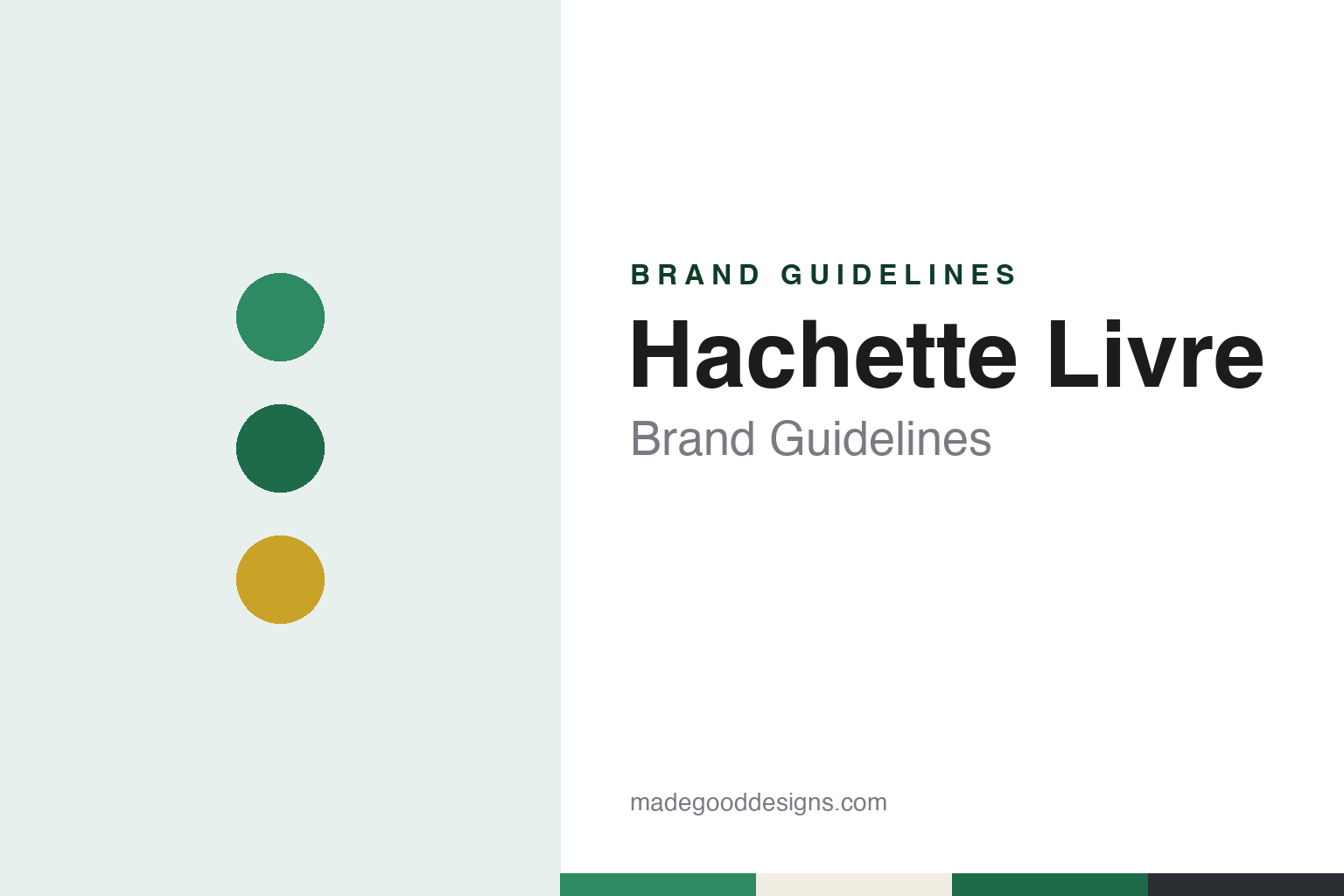
Two constants: a green, graphite and ochre palette and a transitional serif register. Abstract homage — not a Hachette asset or mark; no logo, cover or wordmark is reproduced.
A Paris bookshop called Hachette
Louis Hachette’s Librairie, opened in 1826.
Hachette Livre carries its founder’s name, and the group still dates itself to the shop he opened. French Wikipedia says Louis Hachette, who had wanted to become a teacher, bought the bookseller’s licence and the stock of Jean-François Brédif in Paris and opened a shop he called the Librairie L. Hachette, near the École de médecine on the Left Bank, in 1826. The early business was in schoolbooks: the article says the shop received orders for elementary textbooks from the ministry of public instruction in 1832, and that Hachette was named “libraire de l’Université” in 1836. He also launched periodicals for teachers and schools.
The name then moved onto railway platforms. French Wikipedia says that before 1850, following a British model, Hachette set up bookstalls in railway stations under the name Bibliothèque des chemins de fer, selling his own books alongside those of other publishers. It says he bought the Joanne travel-guide list in 1850, launched the illustrated serial magazine Journal pour tous in 1855, signed an exclusive contract with the Comtesse de Ségur and started the Bibliothèque rose children’s series in 1856, and started the travel magazine Le Tour du monde in 1860. The same article credits the house with spreading the illustrations of Gustave Doré.
The business, by then trading as Librairie L. Hachette et Cie, kept widening after the founder’s time. French Wikipedia says that once its station-bookstall contracts ended in the 1890s, the firm built up a distribution arm, the Messageries Hachette; that it took over the house of Pierre-Jules Hetzel, publisher of Jules Verne, in 1914; that it became a société anonyme in 1919 and was listed in 1922; and that it launched Le Journal de Mickey with Paul Winkler in 1934. In 1953, with Henri Filipacchi, its subsidiary Librairie générale française created the Livre de poche paperback collection. The group then bought Grasset in 1954, Fayard in 1958 and Stock in 1961.
The colour of an earlier mark gave the company a nickname. French Wikipedia says Hachette was called “la pieuvre verte”, the green octopus, because of the colour of its logo at the time.
Colour
From Matra to Lagardère to Louis Hachette Group.
The family era ended in 1980. French Wikipedia says the industrial group Matra bought Hachette in December 1980, and that in 1981 it came under the direction of Jean-Luc Lagardère, who named the combined group Matra-Hachette. In 1987 the book business became a distinct entity, Groupe Livre Hachette, and in 1992 the holding company took the name Lagardère. The article says Jean-Louis Hachette was the last member of the family to share in running the company, until 1980.
The book group then bought abroad. French Wikipedia lists the Spanish group Salvat, the American Grolier and the British houses Orion, Cassell and Octopus in 1988, a merger with Hatier in 1996, and in 2004 the French houses Larousse, Dunod, Dalloz and Armand Colin together with the British publisher Hodder Headline. Publishers Weekly, in a report by Jim Milliot dated 3 November 2008, said chief executive Arnaud Nourry had run the company since June 2003 and had bought the Time Warner Book Group in April 2006, the purchase that took Hachette into American trade publishing. The American company had been called Hachette Book Group USA, and the same report said it was dropping “USA” and would be known as Hachette Book Group.
The head office moved in 2015. Livres Hebdo, in a report by Fabrice Piault dated 6 March 2015, said the new headquarters of Hachette Livre at Vanves, just outside Paris, had been designed by the architect Jacques Ferrier on land the group had held for a long time, and that on 3 March 2015 Nourry gave the building the name of Louis Hachette. French Wikipedia dates the move from the old seat on the quai de Grenelle to 17 April 2015. Later additions it lists include Perseus in the United States in 2016, Workman Publishing in 2021 and Bragelonne in 2022.
The ownership above the book group changed again in 2024. French Wikipedia says Hachette Livre is held through Lagardère Publishing, part of the Lagardère group, and that Lagardère has in turn been held since December 2024 by Louis Hachette Group, the company created in the split of Vivendi. Euronext announced on 16 December 2024 that Louis Hachette Group had been admitted to trading on Euronext Growth in Paris, with Jean-Christophe Thiery as chairman and chief executive, and described it as a group working in publishing, travel retail and media. Louis Hachette Group has owned Lagardère, Hachette Livre’s parent, since 2024, so the founder’s name now sits at the top of the ownership chain as well as on the book group.
Typography
A surname, a logo and many houses.
For a book publisher, the name has to work in several places at once: on the spine, where a reader scans a shelf, on the title page, where the house is named in full, and on the series that a house builds over decades. Some names describe where a press began. Graywolf Press was named for the Graywolf Ridge and Graywolf River near Port Townsend, Washington, where it started printing poetry chapbooks by letterpress in 1974, and it kept the name after moving to St. Paul in 1985 and to Minneapolis in 2009. Other names describe who a house belongs to. New York Review Books, started in 1999, takes its name from The New York Review of Books, the magazine that publishes it, and shortens it to the initials NYRB for series such as NYRB Classics and NYRB Poets.
Series design often does more of the identifying than the colophon itself. Writing in Eye in the winter of 2007, Rick Poynor described how Penguin’s classics covers of the 1960s, under Germano Facetti, held a series together with a consistent type style and title position, and how Katy Homans’ format for NYRB Classics keeps a title box in a fixed place while changing its colour from book to book, carrying that colour onto the spine and back cover, and leaving the small NYRB logo off the front. When reading a publisher’s identity, look at what stays fixed from title to title, where the house name or mark actually appears, and how far a series format, rather than a logo, tells a reader which list a book belongs to.
Aa
A transitional serif with an old-bookshop register. (Specimen set in Libre Baskerville, a serif STAND-IN; NOT the Hachette logo or any Hachette typeface.)
Hachette Livre
One logo for the whole family.
The present Hachette mark was introduced as a group-wide signature. Publishers Weekly reported on 3 November 2008 that Hachette Livre had adopted a new logo to be used by all of its divisions, intended to give a more unified look to subsidiaries acquired in different countries. The magazine said the design had been unveiled at the Frankfurt Book Fair and was due to be in place across the group by the following April, and quoted Nourry: “We want the entire family to have one identity.” The renaming of the American company as Hachette Book Group was announced alongside it.
The group logo sits next to the names of the houses Hachette owns, each with its own history. French Wikipedia lists among them Grasset, Fayard, Stock and Larousse in France, and the article’s acquisition history explains how British and American names such as Hodder Headline, Orion and the former Time Warner imprints came into the same family. The 2008 logo was the device chosen to hold those names together.
The founder appears in the group’s buildings too. Livres Hebdo reported that at the March 2015 naming of the Vanves headquarters, Nourry unveiled a bronze bust of Louis Hachette, founder in 1826 of the Librairie Hachette, made as an enlarged reproduction of a bust held by the Cercle de la librairie, the French book-trade association. Colour has been part of the name’s story before: French Wikipedia ties the “pieuvre verte” nickname to the green of an earlier logo.
For a design guide, Hachette Livre shows how a founder’s surname can travel from a single Paris bookshop to an international group, how one logo was introduced in 2008 to sit across divisions in several countries, and how the same name has since been given to a head office and a parent company. Compare HarperCollins or Penguin Books. For this guide we use green, graphite and ochre with a transitional serif, an unofficial interpretation; no product or logo is reproduced.
Explore & save
Keep Hachette Livre’s identity on hand — save it to a board in the Made Good inspiration library.
Hachette Livre identity set
Pin the Hachette Livre green, graphite and ochre palette and the transitional serif register to your own board.