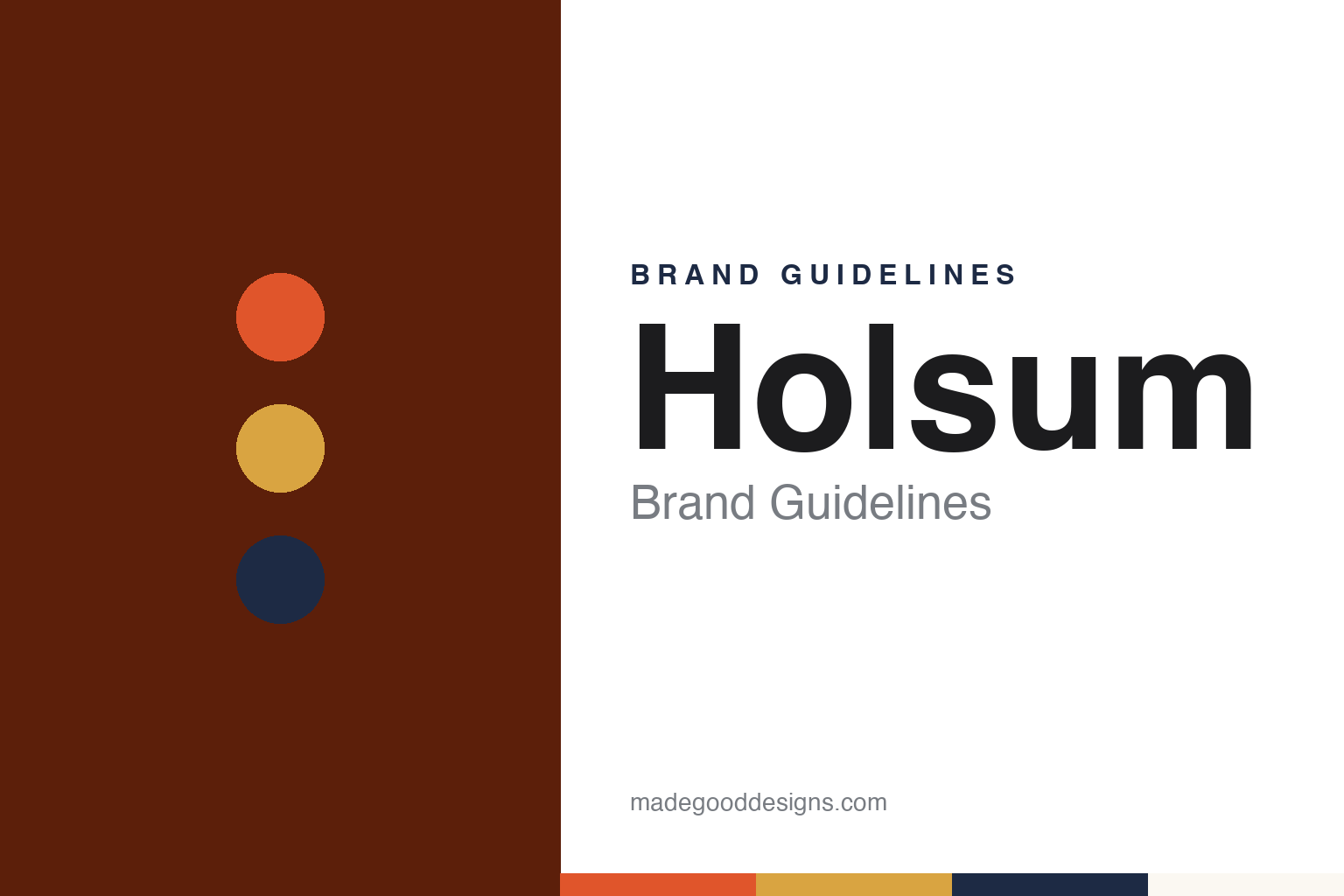
Holsum Brand Guidelines
One name, one licensor and many separately owned bakeries.
Aa
Two constants: a reddish orange, wheat gold and deep navy on wrapper white palette and a heavy, plain sans register. Abstract homage — not a Holsum product or mark; no bag, label or logo is reproduced.
A bread name held in common
A Chicago licensor, a cooperative of bakeries and one name used in many places.
Holsum is an American bread name that works differently from a brand owned and baked by a single company: it is a trademark licensed to separate bakeries in different regions. English Wikipedia says the Holsum name was already being used independently by many retail bakeries around the United States by the early 1900s, and that in 1908 the W. E. Long Company of Chicago acquired exclusive national rights to the name and formed a cooperative of bakeries to market a single recipe under the Holsum brand in various cities. Wikipedia says the Long Company took its name from its founder, William Edgar Long.
The Long Company presented Holsum as a benefit of membership. Its website, as archived in August 2011, said members had the option of using the HOLSUM® trademark, and that the name was known for bread across the United States, Canada, Mexico and Puerto Rico. The same page listed other marks available to Long Company members, among them Aunt Hattie’s and TownTalk, both already associated with bread. English Wikipedia also describes Holsum as a registered trademark of the Long Company cooperative and names the same four markets.
Because the name is licensed, the bakery behind a Holsum loaf depends on where it is bought. Wikipedia’s list of Holsum licensees, in its January 2026 revision, includes Aunt Millie’s Bakery in Michigan; Bimbo Bakeries USA, through operations it lists under the Butter Krust and Sara Lee names in a number of eastern and western states; Flowers Foods, in Alabama and, through Holsum Bakery, in Arizona, California, New Mexico and Utah; and Holsum de Puerto Rico, which it lists as the Puerto Rico Baking Company. The same list names regional bakers such as Klosterman Baking Company in Kentucky and Ohio, Schmidt Baking Company in Pennsylvania and United States Bakery, whose territory it gives as Alaska, California, Idaho, Montana, Oregon and Washington.
That arrangement means there is no single Holsum headquarters or single Holsum bakery. The trademark sits with the licensor, while ownership of the bakeries that use it is spread across family firms, regional bakers and national groups, including Bimbo and Flowers Foods.
Colour
The Phoenix licensee: from an 1881 bakery to Holsum Bakery and Flowers Foods.
The Phoenix licensee shows how the model worked on the ground. Phoenix Magazine, in a history by Jess Harter published on 1 January 2013, traced the business to the Phoenix Bakery of 1881. Edward Eisele, a baker from Saulgau in Germany who had arrived in Phoenix after working on a survey of the Arizona Canal, bought the bakery within three years of joining it, the magazine wrote, and later brought in his friend, the pharmacist Alfred Becker. It says Eisele baked bread, cakes, cookies and pies in the mornings and sold them door to door in the afternoons, before moving to bicycle and then horse-drawn deliveries. The bakery passed in 1927 to the next generation, Lloyd Eisele and Charles Becker, according to the magazine.
In 1929, Phoenix Magazine wrote, Lloyd Eisele and Charles Becker moved the business into wholesale, took a larger building in downtown Phoenix and bought statewide rights to the Holsum brand, joining a nationwide cooperative of independent bakeries. English Wikipedia says the bakery was renamed the Holsum Bakery that year after the pair bought the rights to the name from the Long Company. Dick Pattengale, then vice president of sales for Holsum of Arizona, told the magazine that the arrangement let independent bakeries compete against larger concerns by pooling their resources and buying materials and supplies together.
The magazine said the bakery sponsored local broadcasts of The Lone Ranger radio programme in the 1940s. In 1946 it moved into the plant it still occupied in 2013, near Interstate 17 and McDowell Road, and from then concentrated on breads and buns under three names: Holsum, Aunt Hattie’s and Roman Meal. It added a production site in Tolleson in 2001. Edward Eisele’s grandson, Ed Eisele, became president in 1976, the magazine wrote.
The Phoenix bakery changed hands in 2008. just-food reported on 12 August 2008 that Flowers Foods of Georgia had completed its merger with Holsum Bakery of Phoenix, which would operate as a subsidiary under its existing name and management. The report said Holsum Bakery sold Holsum, Aunt Hattie’s and Roman Meal products through independent distributors serving Arizona, New Mexico, southern Nevada and Southern California. Phoenix Magazine wrote in 2013 that Holsum had operated as part of Flowers Foods since 2008 and that, with the merger, it acquired Arizona rights to Flowers’ Nature’s Own brand. Flowers Foods has owned Holsum Bakery of Phoenix since 2008; the Holsum name itself, Wikipedia says, remains a trademark of the Long Company cooperative, used by other licensees elsewhere.
Typography
Design and documentation.
Packaged bread and Asian-style grocery goods sit side by side in many American supermarkets, yet they reach shoppers through very different kinds of packaging. A sliced loaf usually travels in a soft, printed bag gathered at the neck and closed with a twist tie or a small plastic tag, so the bag itself has to carry the name, the variety and the colour cues that help a shopper pick one loaf from a long shelf of similar ones.
Asian-style sauces, by contrast, are often sold in glass or plastic bottles with a wrap-around or front label, while dried and fresh noodles come in flat bags, trays or boxes with a window or a photograph of the cooked dish. In both cases the label has to work at arm’s length, in an aisle where many similar products compete for attention.
Each guide in this group sets out what independent sources record about a brand — who started it, who has owned it and where its products are made — separately from what the company says about itself, and treats the palette shown here as an unofficial interpretation rather than an official specification.
Aa
A heavy, plain sans — the bold, shelf-facing register of a supermarket bread name. (Specimen set in Archivo Black, a sans STAND-IN; NOT the Holsum logo.)
A colour and a name offered to members
Reddish-orange packaging, sister marks and buildings that kept the name.
With many bakers using one name, Holsum’s identity has rested on shared elements rather than on one company’s house style. The Long Company’s trademarks page, archived in 2011, described “reddish-orange packaging” as part of what the Holsum name was associated with, presenting the colour and the name together as the asset a member bakery could adopt.
The licensing model also explains why Holsum sits beside other names in the same bakeries. The Long Company offered Aunt Hattie’s and TownTalk to its members as well, and the Phoenix bakery, just-food reported in 2008, sold Holsum alongside Aunt Hattie’s and Roman Meal. In Arizona, Phoenix Magazine wrote in 2013, Nature’s Own was added after the Flowers merger, so the same bakery carried a licensed name next to a brand owned by its new parent.
Advertising followed the bakeries rather than a central plan. In Phoenix, Phoenix Magazine reported, the bakery put its name behind local radio broadcasts of The Lone Ranger in the 1940s, and Dick Pattengale described the cooperative to the magazine as a way for independent bakeries to pool resources while competing with larger groups.
The name has also lived on in buildings. Wikipedia notes that a former Holsum bakery location in Las Vegas, Nevada, was converted into lofts in 2004. Phoenix Magazine reported that the shell of the original red-brick Phoenix Bakery building was moved to a living history museum in north Phoenix in 1975.
For a design guide, Holsum shows how a trademark held by one licensor can travel through many separately owned bakeries, with a shared name and a reddish-orange colour cue doing the work that a single corporate owner would do elsewhere. Compare it with Sunbeam, the Quality Bakers of America bread name whose Mexican rights, Wikipedia says, Grupo Bimbo acquired in 1964, and Nature’s Own, the Flowers Foods brand that joined Holsum in Arizona after 2008. For this guide we use reddish orange, wheat gold, crust brown, deep navy and wrapper white with a heavy sans, an unofficial interpretation; no product or logo is reproduced.
Explore & save
Keep Holsum’s identity on hand — save it to a board in the Made Good inspiration library.
Holsum identity set
Pin the Holsum reddish orange, wheat gold and deep navy palette and the heavy sans register to your own board.


