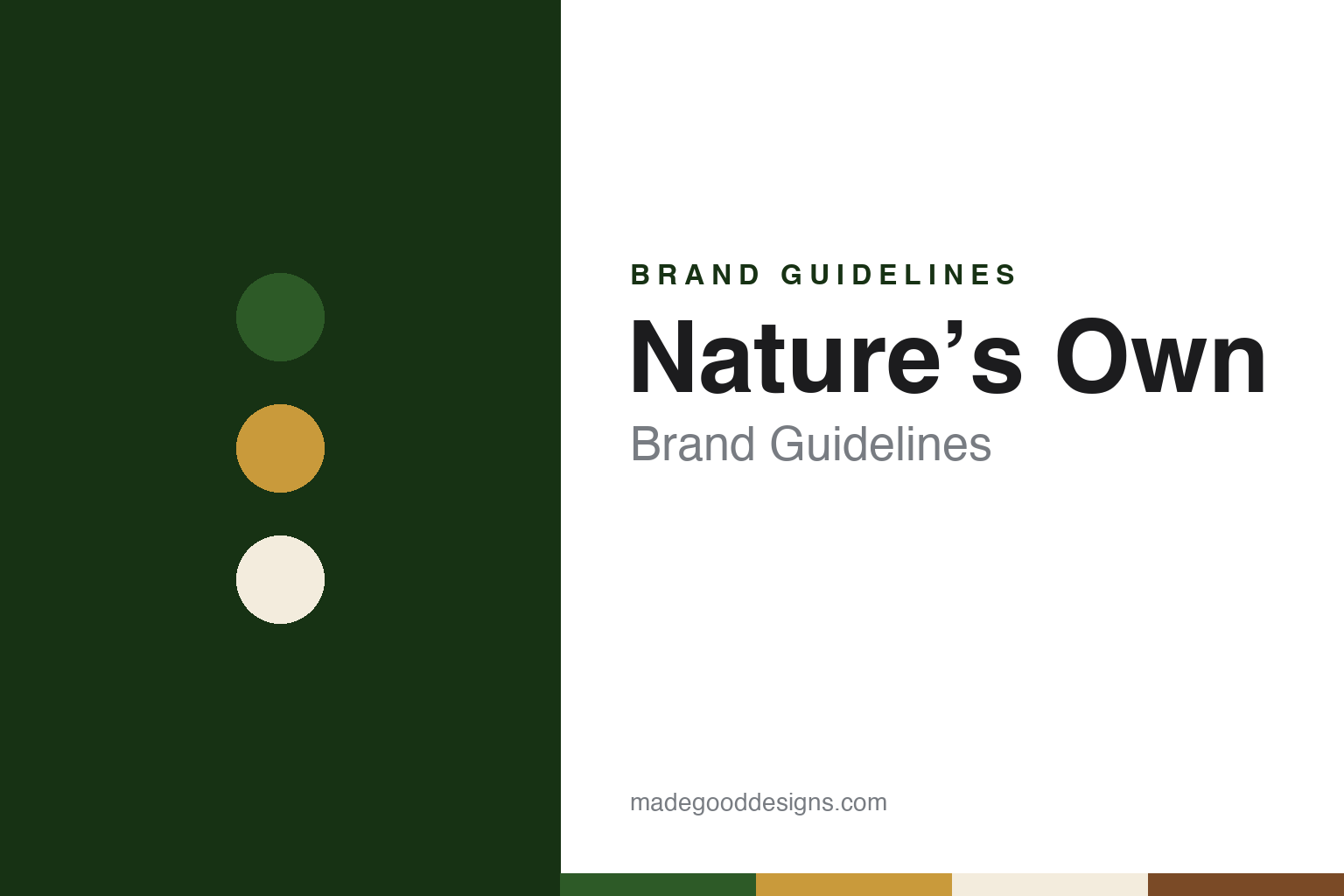
Nature’s Own Brand Guidelines
A Georgia baker’s 1977 bet on whole-grain bread, and a 2026 relaunch.
Aa
Two constants: a field green, wheat gold and flour cream palette and a sturdy bookish serif register. Abstract homage — not a Nature’s Own product or mark; no bag, label or logo is reproduced.
A Georgia baker looks west
A Thomasville bakery, a West Coast trend and a hard first few weeks.
Nature’s Own is an American brand of packaged bread, buns and rolls owned by Flowers Foods, which is headquartered in Thomasville, Georgia. Flowers has owned Nature’s Own since it introduced the brand in 1977.
The owner is much older than the bread. The New Georgia Encyclopedia, in an entry by Christopher Allen Huff first published on 11 November 2005, says the brothers William Howard Flowers and Joseph Hampton Flowers started the Flowers Ice Cream Company in 1914 and, seeing that Thomasville residents needed fresh bread, opened a bakery in 1919. The encyclopedia says the company went public in 1968 as Flowers Industries, and that after selling Keebler in 2001 it spun itself off into a new company called Flowers Foods.
Nature’s Own came out of a trip west. Georgia Trend reported in January 2009, in a feature by Ed Lightsey, that a few years before 1977 Flowers executives visiting the West Coast noticed small local bakeries doing well with darker, whole-grain breads, and the company concluded that such breads would soon reach the Southeast. The magazine quoted George Deese, then Flowers’ chief executive and in 1977 vice president of sales at its Atlanta bakery: “We started out with one little product in Atlanta, Georgia, called Nature’s Own.” Deese told the magazine that the name had appeal, and that from the start the bread had no artificial colours, flavours or preservatives.
Accounts of the launch city differ. The Thomasville Times-Enterprise wrote on 27 December 2014 that Nature’s Own made its debut in Jacksonville, Florida, in 1977, in six varieties that included whole wheat, grainberry and bran ’n honey. Deese, speaking to Georgia Trend, placed the first small test in Atlanta.
The early weeks were difficult. Deese recalled to Georgia Trend that for the first six to ten weeks it seemed Flowers was taking back more bread from stores than it delivered.
Colour
One owner, a growing stable and a premium sub-line.
Flowers’ own history page, as archived in September 2020, dates the debut of Nature’s Own to 1977 and describes it as a line of soft variety breads with whole-grain options and no artificial preservatives, colours or flavours. The same timeline says Flowers gave the company itself a new logo in 1978, the year after Nature’s Own appeared.
The stable around Nature’s Own has grown through acquisitions. Flowers’ timeline lists the purchase of Tasty Baking, the Philadelphia maker of Tastykake, in 2011; the acquisition in 2013 of the Wonder, Merita, Home Pride and Butternut bread brands from the former Hostess Brands; and the purchase in 2015 of Dave’s Killer Bread in Oregon.
The New Georgia Encyclopedia lists Nature’s Own among the breads made by the company’s bakeries division, beside the Sunbeam brand that Flowers has baked under licence from the Quality Bakers of America cooperative since 1942.
Flowers has also stretched the brand upward. A Flowers announcement datelined Thomasville and published by PerishableNews on 24 April 2018 introduced Nature’s Own Perfectly Crafted, a pair of thick-sliced loaves, multigrain and white, described as artisan-inspired, bakery-style bread. Brent Bradshaw, Flowers’ senior vice president for fresh packaged bread, said in the release that everything about the line was special, pointing to the thick slices, the soft texture and a distinctive dusting of flour. The same release repeated the company’s position that Nature’s Own products have had no artificial preservatives, colours or flavours since their debut in 1977.
Typography
Design and documentation.
The seven names in this group are all packaged bread and roll brands, the kind sold from a supermarket shelf in a printed plastic bag. A bread brand’s identity is carried less by the loaf than by that bag: a name, a colour, a window onto the bread inside and a printed panel that has to be read across an aisle in a few seconds.
Because one maker usually sells many breads under a single name, the bag also has to do two jobs at once. It has to look like the family the shopper already knows, and it has to tell one product from its neighbour, so colour, pattern and type often change from bag to bag while the name and the overall layout stay put. Over decades the same bag can be redrawn many times, and its owners can change more than once.
That makes the questions behind each name worth asking plainly: who started it, who owns it now, where its bread is baked and how its bags and logos have changed. Each guide separates what independent sources record from what the company says about itself, and marks plainly what rests only on the company’s own word.
Aa
A sturdy, bookish serif — the calm, wholesome register of a grain-forward bread bag. (Specimen set in Merriweather, a serif STAND-IN; NOT the Nature’s Own logo.)
Real. Soft. Bread.
A 2026 relaunch, new-look bags and an actor as “Breaducator”.
The latest change to the identity came in 2026. Milling Middle East & Africa reported on 30 May 2026 that Flowers Foods had carried out a nationwide refresh of Nature’s Own, bringing new-look packaging and a simpler recipe to the brand’s full range of breads, buns and rolls. The publication said the relaunch ran under a new tagline, “Real. Soft. Bread.”.
The relaunch came with a famous face. Milling Middle East & Africa said Nature’s Own had signed the actor and retired professional wrestler John Cena as its official “Breaducator” for a campaign across several platforms, in which he humorously interrupts grocery shoppers to talk to them about the brand’s ingredients. The same report said Flowers chairman and chief executive A. Ryals McMullian called the recipe change “a big deal” on a 22 May call with analysts about the company’s first-quarter results.
Zacks, the investment research firm, wrote on 27 May 2026 that the relaunch combined fewer, simpler ingredients with upgraded packaging, and that the refreshed range included half loaves aimed at affordability, freshness and changing household habits. Milling Middle East & Africa described the new packaging as refreshed and high-visibility, rolling out across supermarkets, big-box retailers and online grocery channels.
Two ideas have stayed close to the name since the 1970s. The first is the ingredient promise Flowers has repeated since 1977, about artificial preservatives, colours and flavours. The second is the name itself, which George Deese told Georgia Trend was “a wonderful name” from the beginning.
For a design guide, Nature’s Own shows how a brand that has stayed with the baker that created it can still renew itself, by keeping one promise constant while the bag, the recipe and the spokesperson change around it. Compare it with Wonder, the white loaf Flowers bought from Hostess in 2013, and Dave’s Killer Bread, the Oregon organic bread Flowers added in 2015. For this guide we use field green, forest dark, wheat gold, flour cream and crust brown with a serif, an unofficial interpretation; no product or logo is reproduced.
Explore & save
Keep Nature’s Own’s identity on hand — save it to a board in the Made Good inspiration library.
Nature’s Own identity set
Pin the Nature’s Own field green, wheat gold and flour cream palette and the bookish serif register to your own board.


