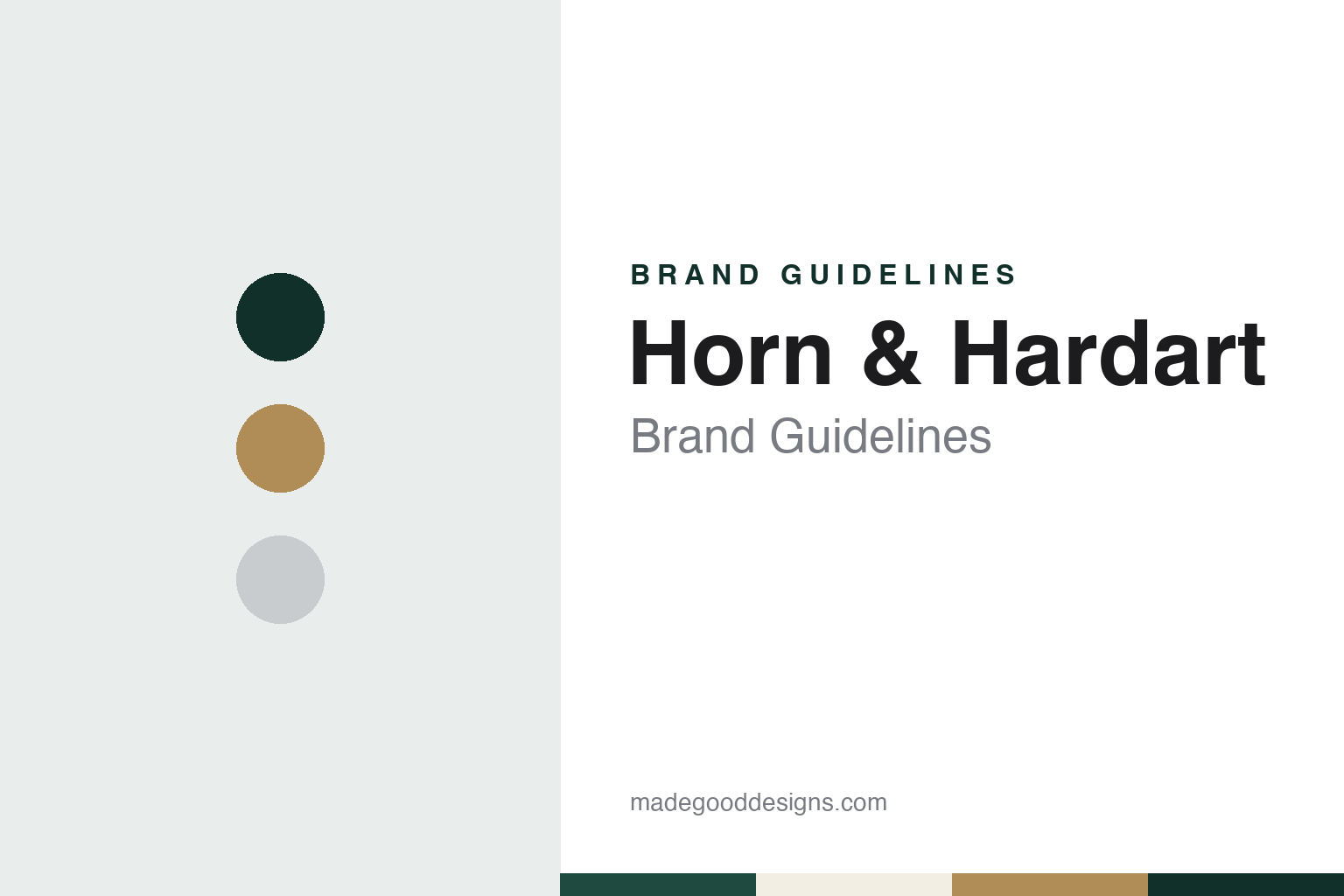
Horn & Hardart Brand Guidelines
The Philadelphia Automat name, from an 1888 lunchroom to a coffee revival.
Aa
Two constants: an Automat green, brass and chrome palette and an Art Deco display register. Abstract homage — not a Horn & Hardart product or mark; no sign, window, spout or logo is reproduced.
Philadelphia
A lunchroom, a coffee and a machine from Berlin.
Horn & Hardart began as a partnership between Joseph Horn and Frank Hardart, who opened a small lunchroom in Philadelphia on 22 December 1888, English Wikipedia says; it had no tables, only a counter with stools. The partners made their name with New Orleans-style coffee, which Hardart promoted as a “gilt-edge” brew, and in 1898 they incorporated as the Horn & Hardart Baking Company. The Encyclopedia of Greater Philadelphia (2013) says the two ran luncheonettes and bakeries in Center City from the start of their partnership in 1888.
The business that made the name famous opened on 9 June 1902 at 818 Chestnut Street: an Automat, a restaurant without waiters in which food sat behind small glass-doored windows, each unlocked by coins. The encyclopedia says the technology was imported from a Berlin manufacturer, and Wired reported in 2008 that the equipment came from Berlin, where waiterless restaurants were already operating. The encyclopedia quotes the Philadelphia Inquirer as saying that Horn and Hardart had solved the city’s “rapid transit luncheon problem.” More Philadelphia Automats followed in 1905, 1907 and 1912, and food preparation moved from kitchens on each site to a central commissary, where board members tested menu items daily.
New York came next. History.com records that an advertisement in The New York Times of 2 July 1912 announced a “New Method of Lunching” at Horn & Hardart’s “Automat Lunch Room” in Times Square, and English Wikipedia dates that opening to the same day, with another near Union Square later that week. In 1924, Wikipedia says, the company opened retail shops selling prepared Automat dishes to take home, under the slogan “Less Work for Mother,” which the encyclopedia describes as the company’s official slogan. By then the name stood for two things at once: a coin-operated dining room and a bakery and food company with its own shops in two cities.
Colour
Marble, chrome, stained glass and dolphin spouts.
The Automat’s identity was its interior. The encyclopedia describes the American Automat as larger and grander than its European models, with Art Deco accents, chrome panelling, stained glass windows and vaulted ceilings. History.com lists marble counters and floors, chrome fixtures, ornately carved ceilings and Art Deco signage, with food served on china and eaten with solid flatware, and says the coffee flowed from silver dolphin spouts that Joseph Horn found in Italy. Women in glass booths at the head of the room changed money into coins and became known as “nickel throwers,” the encyclopedia says, a sight that fascinated the city.
The company spread its name well beyond the dining room. From 1927, English Wikipedia says, it sponsored The Horn and Hardart Children’s Hour, a variety show with a cast of children, initially on WCAU radio in Philadelphia and later on NBC radio in New York; a television version began on WCAU-TV in 1948 and moved to New York the next year. Wired says Irving Berlin’s “Let’s Have Another Cup of Coffee” became the company’s theme song and that Edward Hopper painted the Automat in 1927. The encyclopedia reproduces a Horn & Hardart postcard, a colourful marketing piece that set out the three steps to an Automat meal.
Change came after the Second World War. English Wikipedia says that in 1953 the company split into two independent public corporations, the New York-based Horn & Hardart Company and the Philadelphia-based Horn & Hardart Baking Company. History.com records that the company bought Burger King and Arby’s franchises and the Bojangles’ chain as fast food rose. In May 1969, the encyclopedia says, the original Automat at 818 Chestnut Street was auctioned and its interior donated to the Smithsonian’s National Museum of American History. Greater Philadelphia’s last Automat, in Bala Cynwyd, closed on 12 May 1990, and the last New York Automat, at East 42nd Street and Third Avenue, closed on 9 April 1991, English Wikipedia says. The New York company renamed itself Hanover Direct in 1993 and continued as a catalogue business.
Typography
Design and documentation.
The chains in this group are restaurant names that closed, shrank to a handful of locations or came back under new owners. A restaurant brand lives in more places than a packaged product does: on a pole sign seen from the road, on a menu board and a printed menu, on uniforms, napkins and cups, and in the shape of the building itself, which was often designed so that a passing driver could recognise the chain before reading a word.
That is why so much of a restaurant identity outlasts the business behind it. Buildings are sold and reused with their rooflines still recognisable; signs are taken down and kept; menus, matchbooks and advertising characters survive in collections and in memory. When a name is revived, the new owner usually works from those surviving pieces, so the identity a guest meets today may be a reconstruction of an older one.
Each guide separates what independent sources record from what the company says about itself — who started the chain, who has owned the name, when it closed or came back, and how its signs, logos, mascots and buildings have changed — and marks plainly what rests only on the company’s own word.
Aa
An Art Deco display face — the register of a lit sign over a city lunchroom. (Specimen set in Limelight, a display STAND-IN; NOT the Horn & Hardart logo.)
Horn & Hardart
A name kept in museums, then poured as coffee.
The Automat outlived its restaurants in collections and on screen. Wired reported in 2008 that the National Museum of American History held an elaborately decorated, 35-foot section of the Philadelphia Automat of 1902, with mirrors and marble. English Wikipedia says the New York Public Library’s 2012 exhibition “Lunch Hour NYC” included a fully restored wall of Automat windows, that members of the Hardart family donated the company’s business records — annual reports, operating manuals, photographs and printed material — to the Smithsonian Archives in 2006, and that a documentary, The Automat, directed by Lisa Hurwitz, was released in 2021. Wired says the company closed its last bakery cafe in 2005.
The name then returned as a product. English Wikipedia says the company’s assets were acquired in 2015 as Horn & Hardart Coffee, which recreated a coffee blend under the old name. In a post dated 26 May 2023, chief executive David Arena wrote that Horn & Hardart was returning by reintroducing its coffee in an “Automat Box,” and that his larger aim was to bring the company back in a modern way, including a vision to restore the Automat online and in retail locations. The company now says descendants of co-founder Frank Hardart are directly involved in the business again, and its own history page describes the Automat through two images: rows of small glass windows filled with food, and the ornate dolphin spouts that served coffee.
Those two images are the identity. The coin windows, the dolphin spout, the marble and chrome of the rooms and the Art Deco lettering over the door were all part of the restaurants, and all survive in museums, photographs and memory long after the last Automat closed; the revived company’s own history page returns to the windows and the spouts.
For a design guide, Horn & Hardart shows how an interior and a piece of equipment can become a brand in their own right and carry a name long after the rooms have gone; compare Arby’s, one of the fast-food chains Horn & Hardart once franchised, and Rax Roast Beef, another American restaurant name that has passed through many owners. For this guide we use Automat green, brass and chrome with an Art Deco display serif, an unofficial interpretation; no product or logo is reproduced.
Explore & save
Keep Horn & Hardart’s identity on hand — save it to a board in the Made Good inspiration library.
Horn & Hardart identity set
Pin the Horn & Hardart Automat green, brass and chrome palette and the Art Deco display register to your own board.