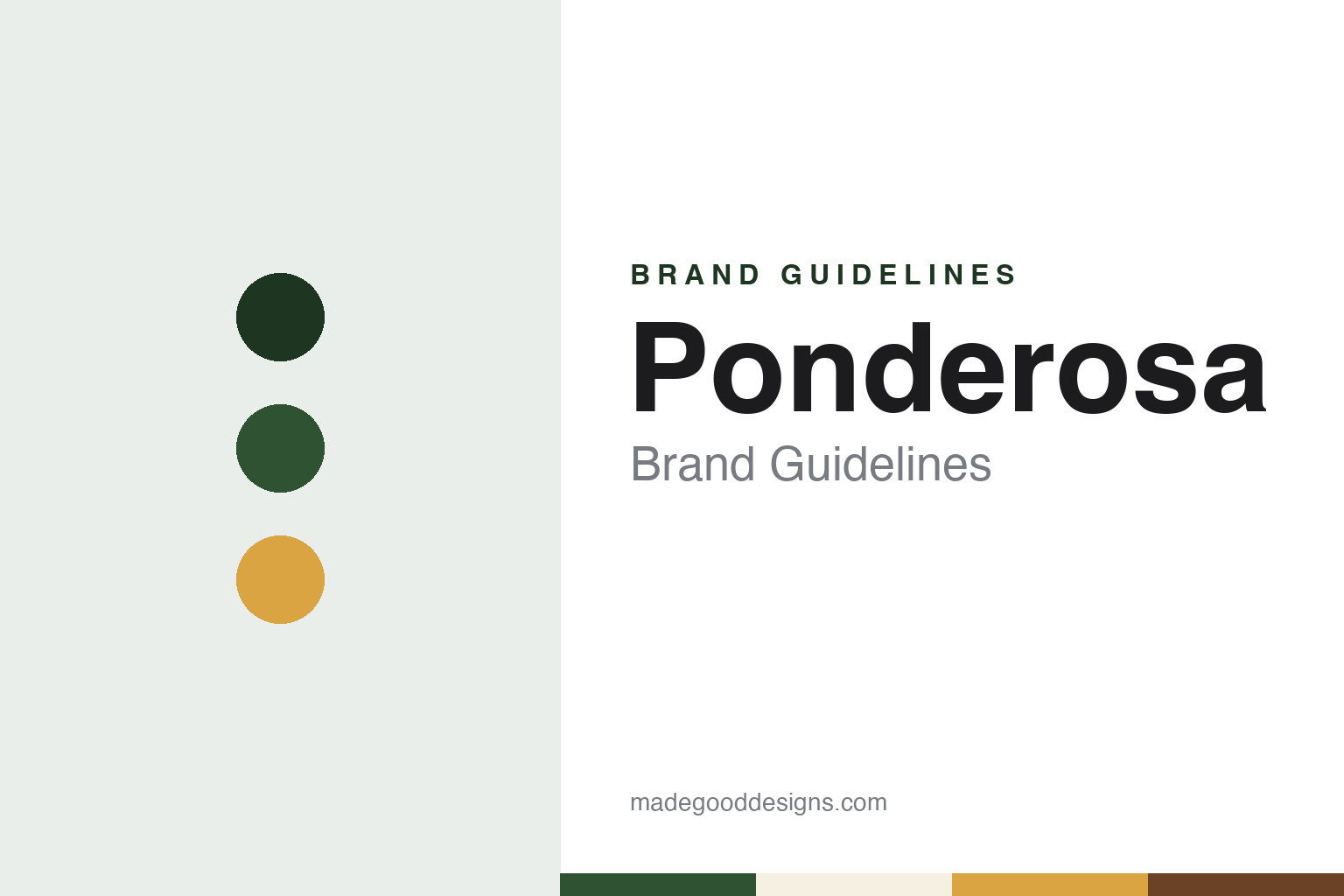
Ponderosa Brand Guidelines
A 1965 Kokomo steak house named for a television ranch.
Aa
Two constants: a pine green, sunset gold and timber brown palette and a ranch slab serif register. Abstract homage — not a Ponderosa product or mark; no sign, star or logo is reproduced.
Kokomo to Dayton
A suburban steak house with a television ranch’s name.
Ponderosa Steakhouse began in Kokomo, Indiana, in 1965. The Dayton Business Journal reported in April 2003 that Charles “Chic” Kleptz, Dan Lasater and a third partner founded the company there with a simple idea: an affordable steak house in the suburbs. The franchisor’s current brand page gives the same year and town for Ponderosa’s founding.
The company did not stay in Indiana for long. The Business Journal says Kleptz moved it to Dayton, Ohio, in 1971, into headquarters near the Salem Mall, and that he retired in 1973, before the company moved its main office into One Aset Centre, a triangular building near Dayton International Airport. The paper described Ponderosa as having had its world headquarters in Dayton during the 1970s, and quoted Kleptz in 2003 as saying he had kept an eye on the chain since retiring, though he had no business connection to it.
The name points to television. English Wikipedia says both Ponderosa and its later sister chain Bonanza took their names from the television western Bonanza, which was set on a ranch called the Ponderosa. The franchisor’s own copy leans on the connection: its brand page invites diners into “Ponderosa and Bonanza country”, promises “the spirit of the old west” and says the company is “continuing the Cartwright family tree”, a reference to the ranching family at the centre of the series.
Bonanza Steakhouse had its own beginnings. The franchisor says Bonanza was founded in 1963 by Dan Blocker, who played Eric “Hoss” Cartwright on the show, and that its opening restaurant was in Westport, Connecticut; Wikipedia adds that the brothers Sam and Charles Wyly bought the small Bonanza chain three years later. For years the two steak houses were separate rivals drawing on the same programme for their names.
Ponderosa also crossed the border. Wikipedia says it was operating in Canada by 1971, and, citing the Winnipeg Free Press, that its last Canadian restaurant closed in November 2010. Over the decades the format shifted as well: the Business Journal said in 2003 that Ponderosa had changed from a steak house into more of a buffet restaurant.
Colour
Metromedia, Homestyle Dining, FAT Brands and a lender group.
Ponderosa passed out of its founders’ hands well before it met Bonanza. The Dayton Business Journal says Metromedia bought the Ponderosa brand in 1988; Wikipedia dates the sale to February 1988 and names the buyer as Metromedia Restaurant Group. In 1989, according to Wikipedia citing The New York Times of 31 August 1989, Ponderosa agreed to buy its rival Bonanza, and Metromedia then owned both chains. The franchisor’s brand page says simply that by 1989 the companies had merged together. Wikipedia says that, because Bonanza and Ponderosa began as separate companies, restaurants in the same area can carry either name.
By 2003, the Business Journal reported, Ponderosa was owned by Plano, Texas-based Metromedia Restaurant Group, which also owned Bonanza, Steak and Ale and Bennigan’s. Wikipedia says the steakhouse parent, Metromedia Steakhouses Company, filed for Chapter 11 protection in 2008 and emerged in 2009 under the name Homestyle Dining LLC, based in Plano.
In 2017 the brands changed hands again. FSR Magazine reported on 1 November 2017 that FAT Brands had completed its acquisition of Homestyle Dining LLC, the parent company of the Ponderosa Steakhouse and Bonanza Steakhouse brands. At the time, the magazine said, FAT Brands’ restaurant brands were Fatburger, Buffalo’s Cafe, Buffalo’s Express and the two steakhouses, and the company said it planned to develop a smaller-format Ponderosa and Bonanza concept, especially for international growth.
In 2026 the brands moved again. Restaurant Dive reported on 21 May 2026 that, after FAT Brands’ Chapter 11 filing in January, a bankruptcy court had approved the sale of its assets, with Ponderosa & Bonanza among the businesses going to a group of lenders known as FBG Bid Co. Retail & Restaurant Facility Business reported on 19 June 2026 that FBG Bid Co. had completed the acquisition of substantially all assets of certain FAT Brands subsidiaries, including Ponderosa and Bonanza Steakhouses, following a sale process approved by the U.S. Bankruptcy Court for the Southern District of Texas.
The new owner has since changed its name. English Wikipedia, citing QSR magazine of 30 September 2026, says FBG Bid Co. rebranded itself as OHG Brands in September 2026 and gives its headquarters as Beverly Hills, California. In October 2026 the franchisor’s website presented itself as OHG Brands, under the line “Original. Honest. Good.”, and listed Ponderosa & Bonanza among its restaurant brands, alongside Fatburger, Johnny Rockets and Round Table Pizza. The steakhouses’ own website, pon-bon.com, continued to list restaurants and offer online ordering at some of them.
Typography
Design and documentation.
The restaurant names in this group grew up along American highways and suburban roads, where a chain had to be recognised from a moving car long before anyone read a menu. In that setting a brand’s identity is carried as much by buildings as by printed matter: a tall pole sign that can be seen from the road, a roof shape repeated from one site to the next, a colour that marks the building at a distance, and a name lettered large enough to read at speed.
Inside, the same identity continues in smaller pieces — the menu board and printed menu, placemats, cups and wrappers, staff uniforms and, for many chains, a character or mascot meant to make the name friendly and easy to remember. Because restaurant chains are often sold, merged, franchised or licensed, those pieces can outlast the company that first commissioned them, and a sign or roof can stay in place long after ownership has changed.
Each guide separates what independent sources record from what the company says about itself — who started the chain, who has owned and franchised it since, and how its name, signs and buildings have changed — and marks plainly what rests only on the company’s own word.
Aa
A ranch slab serif — the register of a timber sign and a buffet card. (Specimen set in Arvo, a slab-serif STAND-IN; NOT the Ponderosa logo.)
Ponderosa
Two names, one ranch and a shared banner.
The Ponderosa identity is built on a borrowed setting. Where many restaurant chains carry a founder’s surname, Ponderosa took the name of a fictional place — by Wikipedia’s account, the ranch at the heart of the television western Bonanza — and its sister chain took the name of the programme itself. Since the late 1980s the two names have belonged to the same owners.
That shared ownership shapes the way the brand presents itself today. The steakhouses’ website is titled Ponderosa & Bonanza Steakhouse, with both names under one banner, and its navigation marks each item with a small star, a western touch that runs through the page; its e-mail club invites diners to “steak your claim”, a pun on the frontier phrase. The franchisor’s brand page frames both restaurants as places where families find “the spirit of the Old West”, and it carries the tagline “Happiness Unlimited & Freedom by the Plateful”.
The format has changed around the name. The Dayton Business Journal’s 2003 description of Ponderosa’s drift from steak house to buffet restaurant sits beside the way the franchisor now describes both concepts: steaks, seafood and sides alongside a help-yourself buffet, with table service. The franchisor describes the two as a legacy brand and invites diners to “eat a steak” and “enjoy the nostalgia”. In 2003 the Business Journal quoted co-founder Kleptz as saying the restaurants’ troubles had more to do with a series of corporate owners than with their locations; since then the brand has passed through Homestyle Dining, FAT Brands and the lender group that became OHG Brands.
For a design guide, Ponderosa shows how a restaurant name drawn from a television setting can outlast the programme’s original run, survive a merger with its own rival and keep its western theme through a succession of owners. Compare it with Sizzler, another American steakhouse chain, and Friendly’s, an American family restaurant chain with its own history of changing owners. For this guide we use pine green, sunset gold and timber brown with a slab serif, an unofficial interpretation; no product or logo is reproduced.
Explore & save
Keep Ponderosa’s identity on hand — save it to a board in the Made Good inspiration library.
Ponderosa identity set
Pin the Ponderosa pine green, sunset gold and timber brown palette and the ranch slab serif register to your own board.

