Hoyts Brand Guidelines
A circus name, a Bourke Street hall and a cinema brand that asks for the bigger screen.
Aa
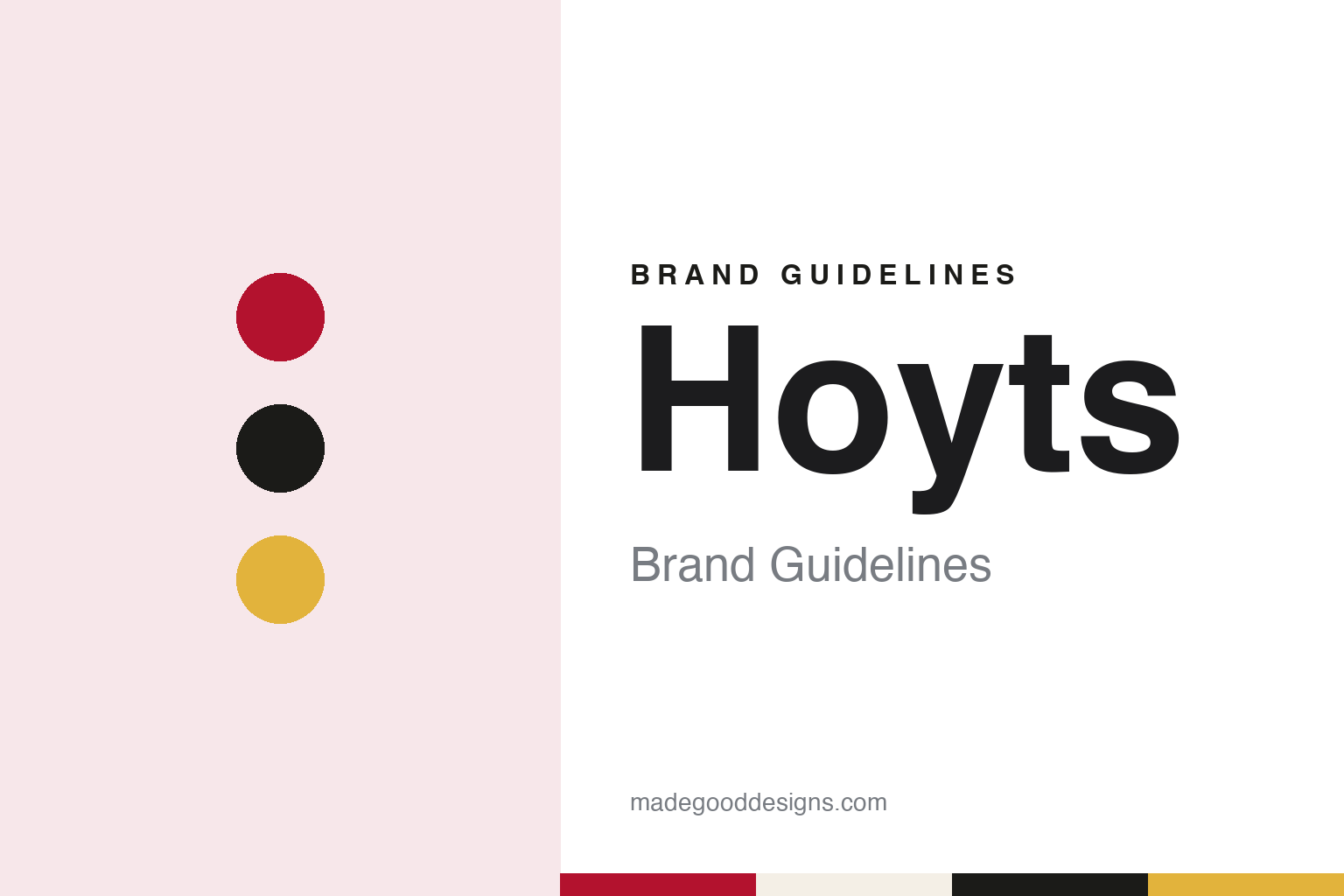
Two constants: a curtain red, marquee gold and screen white palette and a Heavy display sans register. Abstract homage — not a Hoyts asset or mark; no logo, signage, poster or wordmark is reproduced.
A Melbourne dentist and a touring circus
Arthur Russell, Hoyts Circus and St George’s Hall in 1908.
The Hoyts name came from a circus. Cinema Record, the magazine of the Cinema and Theatre Historical Society, marked “Hoyts 90th Year” in its 1998 issue with a history taken from The Story of Hoyts, a 1969 news release from Hoyts Theatres Limited. It says the story begins with a Melbourne dentist, Dr Arthur Russell, who had a yearning for show business and was a capable magician and cornet player. Not long after the turn of the century, it says, a small American circus called “Hoyts Circus” arrived in town, Russell bought a share in it and toured with it as a magician. The tour failed and he went back to dentistry.
The pictures came next. Cinema Record says that in 1908 Russell leased the old St George’s Hall in Bourke Street, Melbourne, and began showing programmes of short pictures. It describes a family show, with Russell on cornet, his wife at the piano and his son on drums. Wikipedia tells the same story and also dates the hall screenings to 1908, adding that the films were silent and the family band accompanied them.
The company name followed the circus name. Cinema Record says St George’s Hall prospered and Russell formed a company he called Hoyts Pictures Pty. Ltd., then rebuilt the old hall and named it Hoyts De Luxe; the Hoyts Esquire Theatre later stood on the same site. Wikipedia dates the opening of Hoyts Picture Palace to 18 September 1909 and says the company was formed at that time. It adds that by the end of the First World War Hoyts had spread into the suburbs of Melbourne and into Sydney, and that the programmes included vaudeville acts, as was usual then.
The company still counts its age from those Melbourne beginnings: its own 2023 announcement of a new brand positioning spoke of “over 113 years” of delivering cinema.
Colour
A 1926 merger, a Hollywood studio and a long run of owners.
The theatre company took its long-term shape in the 1920s. Wikipedia says that in 1926 Hoyts merged with two other companies, Electric Theatres Pty Ltd and Associated Theatres Pty Ltd, to become Hoyts Theatres Limited, and that in 1930 the 20th Century Fox Film Corporation acquired a majority of its shares. That link with a Hollywood studio lasted for half a century: Wikipedia says Fox sold Hoyts in 1982 to Stardawn Investments, a group of four Melbourne businessmen, and that the Fink family became sole owner in 1985.
The decades that followed brought frequent changes of hands. Wikipedia lists a restructure and stock-exchange listing of parts of the group in 1987, expansion into New Zealand and the United States, a move into Chile in 1997, purchase by Kerry Packer’s Consolidated Press Holdings in 1999, the sale of the US cinemas to Regal Entertainment Group in 2003, a sale to Publishing & Broadcasting Limited and West Australian Newspapers in 2005, and purchase by the private equity firm Pacific Equity Partners in 2007. In 2010, it says, Hoyts sold its Chilean business and bought Australian Multiplex Cinemas in Queensland and the Berkeley Cinema Group in New Zealand.
The current owner arrived in two steps. The Hollywood Reporter reported on 3 June 2015 that Wanda Cinema Line, the exhibition arm of China’s Dalian Wanda Group, would buy the Australian cinema operator Hoyts Group, and that the deal included the Val Morgan cinema screen advertising business. The magazine said Wanda chairman Wang Jianlin’s friend Sun Xishuang had bought Hoyts only the previous December, through his company ID Leisure Ventures, from a private equity fund that had owned it since 2007, and that Wanda also owned the American chain AMC Entertainment. Wanda has owned Hoyts since 2015. Wikipedia records that Wanda Film began looking for buyers for Hoyts in April 2023, and that a change of control at Wanda Film’s own parent in December 2023 left any sale uncertain.
The name also reached beyond cinemas. Wikipedia says Hoyts Distribution released films in Australia and New Zealand from 1979, that it was sold to the French company StudioCanal in 2012 and was rebranded under that banner the following year, and that the group runs Val Morgan alongside the cinemas.
Typography
A borrowed circus name, set in capitals.
Many cinema chains do not run a single brand so much as a small family of them. A recliner hall with food brought to the seat, a large-format screen, a room built for children and a seat that moves with the action may each carry its own name, and that name has to sit on the booking page, the ticket, the auditorium door and the trailer before the film. Some chains give these formats a shared prefix or suffix, so that each one reads as part of the house; others license a technology partner’s name and place it beside their own. Either way the designer’s task is to set an order of precedence: which name leads, which follows, and how a format label looks when it appears on its own on a small screen.
Loyalty schemes and memberships add another layer. A membership card, an app account or a points programme often has a name of its own, and for regular visitors it may be the part of the brand they handle again and again, at the box office, at the counter and in their inbox. When a chain buys another circuit, it may keep a familiar local name over the door for years, rename sites one at a time, or move everything to a new name at once, and each choice changes what the signage, the membership and the app need to say. Read this way, a cinema identity is a naming system as much as a logo: a parent mark, a set of format labels, a membership name and, sometimes, a heritage name that is allowed to stay.
Aa
Heavy display sans — a register for cinema names and screen formats. (Specimen set in Archivo Black, a sans STAND-IN; NOT the Hoyts logo or any Hoyts lettering.)
Hoyts
A 2023 positioning about the size of the screen.
The current brand language dates from August 2023. B&T reported on 8 August 2023 that the creative agency Today the Brave had released new work for Hoyts under the line “See the Big Picture”, built around the question of how a cinema brand can show the scale of the big screen when people watch so much content on small ones. The campaign has four genre executions, Zombie, Comedy, Animation and Space, and each short advertisement uses tight close-up frames that show only a fraction of the action. One of them, “Zombie Army”, is narrated by the voice artist Lee Perry. B&T said Hoyts would roll out the campaign and its visual identity until the end of the year, on Foxtel and on catch-up television.
Chief executive Damian Keogh told the magazine that the positioning spoke to the experience of the big screen and also to the “big picture mindset” of the company’s people and business. Today the Brave creative partner Vince Osmond said the brief was a clear problem: how to communicate the big screen on screens that are far smaller. Hoyts’ own release said the change was “more than just a refreshed look and tagline”, named Stephanie Mills, its director of sales, marketing and content, as the executive behind it, and said the four films were shot by Nick Kelly of the production company MOFA.
The company writes its name in capitals in its releases, as HOYTS, and attaches it to its premium formats: Wikipedia lists large screens and surround sound under the Xtremescreen name and dine-in menus under Hoyts Lux, and the company’s 2023 release names D-BOX motion recliners among its offers.
For a design guide, Hoyts shows how a name borrowed from a touring circus in early-twentieth-century Melbourne can outlast a long run of owners and end up as a capitalised marque for screen formats and a campaign about scale. Compare Event Cinemas, another Australian cinema chain, and AMC Theatres, the American chain that Wanda also owned when it bought Hoyts in 2015. For this guide we use curtain red, marquee gold and screen white with a sans, an unofficial interpretation; no product or logo is reproduced.
Explore & save
Keep Hoyts’s identity on hand — save it to a board in the Made Good inspiration library.
Hoyts identity set
Pin the Hoyts curtain red, marquee gold and screen white palette and the Heavy display sans register to your own board.