Indianapolis 500 Brand Guidelines
A proving ground paved in brick, remembered by one strip at the line.
Aa
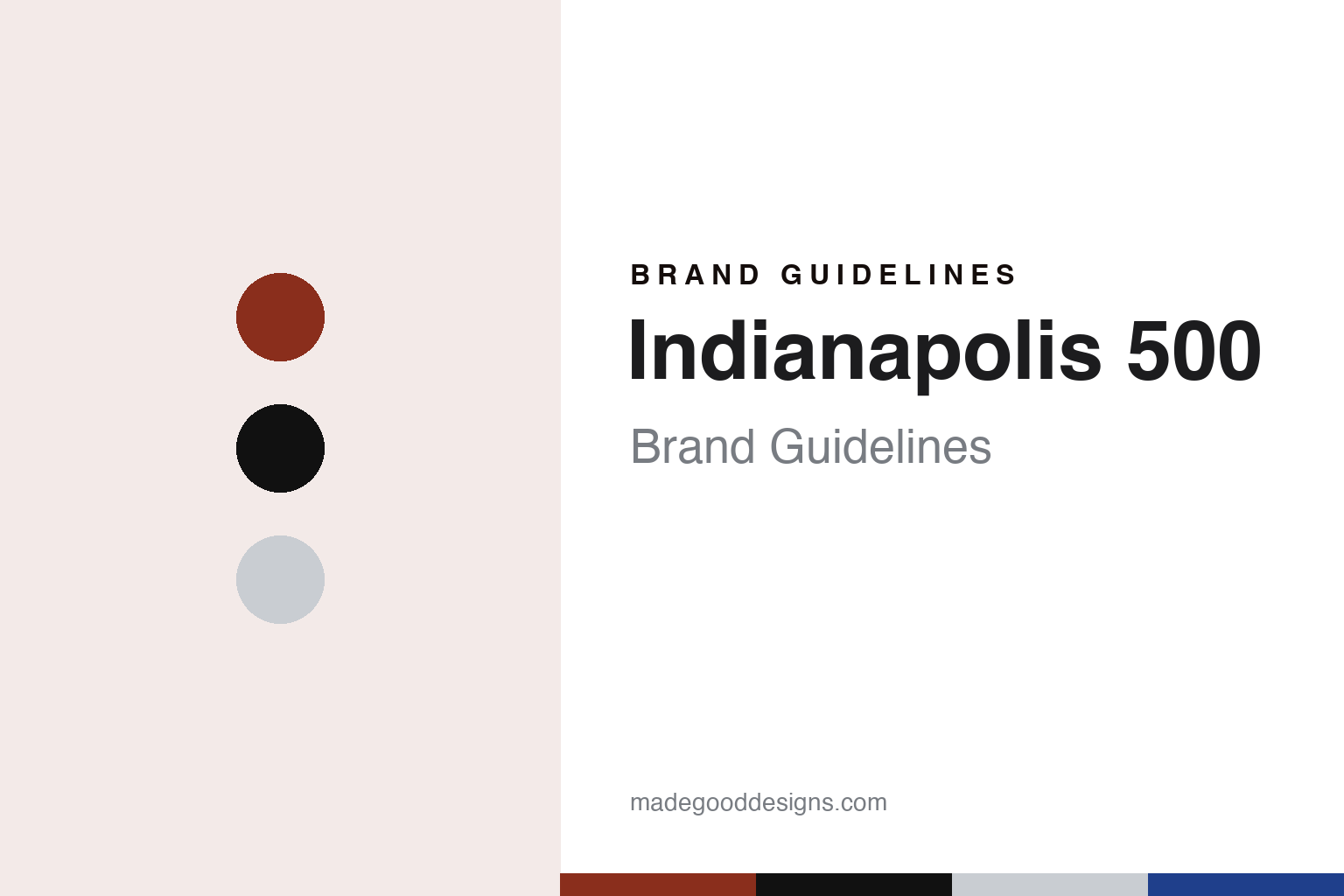
Two constants: a brick red, flag black and sterling silver palette and a condensed sans register for numbers. Abstract homage — not the Indianapolis 500 logo, the wing-and-wheel emblem or any Indianapolis Motor Speedway mark; no logo is reproduced.
Speedway, Indiana
A test track for an industry, then a single long race.
The Speedway was built to test cars. English Wikipedia says the Indianapolis businessman Carl G. Fisher conceived it in 1905, after helping friends who raced in France and concluding that Europe held the upper hand in automobile design. He visited the banked Brooklands circuit outside London in 1907, and in December 1908 he persuaded James A. Allison, Arthur C. Newby and Frank H. Wheeler to join him in buying Pressley Farm, flat farmland outside Indianapolis. The partners incorporated the Indianapolis Motor Speedway Company in March 1909, and construction began that month.
The surface gave the place its nickname. Wikipedia says the track opened in 1909 with a surface of gravel, limestone and tar that broke up badly in its early long races. Fisher and his partners tested paving materials and chose brick, supplied by Indiana manufacturers and laid by hand, and the circuit became known as the Brickyard. The track then concentrated on a single annual event of 500 miles, a distance the owners estimated a car could cover before dark. The race was run on Decoration Day, 30 May 1911, and Ray Harroun took the win in a Marmon “Wasp.”
The name took decades to settle. Wikipedia says the race was advertised as the International 500-Mile Sweepstakes Race from 1911 to 1916, called the Liberty Sweepstakes in 1919, and officially known as the International Sweepstakes from 1920 to 1980, the wording printed on tickets and other material. The public called it “the 500,” the “Indianapolis 500” or the “Indy 500.” For 1981 the race formally became the “65th Indianapolis 500-Mile Race,” with a unique annual logo that almost always includes the ordinal, and since 2016 the official logo has used the colloquial form “Indy 500.”
Ownership has changed hands a few times. Wikipedia says Fisher and Allison sold the Speedway in 1927 to the former racing driver and First World War flying ace Eddie Rickenbacker. ESPN, reporting on 4 November 2019, wrote that the track was dilapidated in 1945 when Tony Hulman bought it and brought racing back after the wartime break. On that November day the Hulman family announced the sale of the Speedway, the IndyCar Series and IMS Productions to Penske Entertainment Corp., a subsidiary of Roger Penske’s Penske Corporation. ESPN said the deal began when Tony George, Tony Hulman’s grandson, approached Penske at a race in California in September, and that it was expected to close in January 2020.
Colour
Bricks to kiss, a bottle of milk and a song.
One strip of the old surface survives. Wikipedia says that in October 1961 the last remaining brick sections of the track were paved over with asphalt, except for a narrow line of bricks at the start-finish line, and the Brickyard became known for its Yard of Bricks. WISH-TV in Indianapolis, publishing a Stacker feature on race traditions in May 2024, described what happens there now: after the race the winner and team kneel at the one-yard span of bricks, one of the track’s earliest surfaces, and kiss them. The habit started at the Speedway’s NASCAR race, the Brickyard 400, when Dale Jarrett and his crew kissed the bricks after winning in 1996, and it took a few years to cross over to the 500.
The milk began by accident. The same WISH-TV feature says that Louis Meyer was photographed drinking buttermilk straight from the bottle in Victory Lane after his win in 1936, and that dairy industry executives saw a marketing opportunity. Milk competed with water as the winner’s drink for years, until in 1956 the dairy industry offered a reward to the winning driver and chief mechanic for drinking milk after the race. The custom has held since, with one notable exception in 1993, when Emerson Fittipaldi chose orange juice in honour of his orange plantation and angered many fans. Today every driver chooses fat-free, two per cent or whole milk before the race so that the Indiana Dairy Association can have the right bottle ready.
Music and words mark the start. WISH-TV says that when the race returned after the Second World War in 1946, organisers asked the Metropolitan Opera singer James Melton to sing “Back Home Again in Indiana,” and the song became part of the prerace programme. The actor Jim Nabors was asked by Speedway owner Tony Hulman to sing it in 1972 and returned regularly until he retired in 2014; since 2017 the singer has been Jim Cornelison, an Indiana University graduate. Wikipedia adds that the Purdue All-American Marching Band has been the host band since 1919.
The command to start engines has changed with the field. WISH-TV says aerial bombs once gave the signal, and that after the war the public address announcer John “Irish” Horan wanted something more. The earliest known instance of him saying something close to “Gentlemen, start your engines” dates from 1951, and the wording was established by 1953. It changed in 1977, when Janet Guthrie qualified, and became “Ladies and gentlemen” as more women made the field. Today the command is “Drivers, start your engines!”
Typography
Bricks, a bottle and a silver cup.
A sporting event is an unusual kind of brand. It has no product on a shelf and often no single owner of the kind a company has; instead it is held together by a name, a date on the calendar and a set of objects and rituals that recur each time it is staged.
Trophies frequently become the mark itself. A cup, a figure or a plate is drawn, simplified and printed on tickets, broadcasts and merchandise, so that the object handed to the winner also works as the event’s signature. Host venues do similar work: a clubhouse, a finish line, a grandstand or a stretch of road is photographed so often that its outline turns into shorthand for the whole occasion.
Traditions add another layer. A jacket, a garland, a particular flower, a colour worn on the day or a song sung before the start can be as recognisable as any wordmark, and organisers tend to protect them carefully. Finally, sponsor naming sits alongside all of this. Presenting partners, official suppliers and naming rights put commercial marks next to the event’s own, and the way an organiser balances or limits them is itself a design decision worth studying.
500
A narrow condensed sans — the register of a pit board, a timing tower and a race ticket. (Specimen set in Barlow Condensed, a sans-serif STAND-IN; NOT the Indy 500 logo lettering.)
Indianapolis 500
A trophy of faces, and a logo that changes every May.
The trophy carries the race’s history in portraits. WISH-TV’s May 2024 feature says the Borg-Warner Trophy is named for the automotive equipment maker that commissioned it, and that it was introduced at the 1936 race. It is an art deco sterling silver cup ringed with sterling sculptures of the winning drivers’ faces. When the original cup ran out of room, a large base was added for later winners. Drivers never take the trophy home; BorgWarner instead gives each winner a miniature replica, known as the “Baby Borg,” with an identical sterling likeness. When Simon Pagenaud won in 2019, the company added a sculpture of his Jack Russell terrier, Norman, to his replica.
The faces are made by hand. WISH-TV reported in May 2016 that the trophy was produced just outside Chicago in the 1930s, and that each year after the race a sculptor creates a new face about the size of a walnut. The sculptor named in that report, William Behrends of North Carolina, works through clay, ceramic and wax before the face is cast in sterling silver, and each likeness takes about three months. The face is completed over the summer and unveiled at a ceremony at the Speedway in December, after which the trophy travels during the winter. A BorgWarner representative told the station that the helmet styles in the portraits change over the years, from open-face helmets to closed ones.
The race logo is redrawn each year. Wikipedia says that since 1981 the race has been advertised with a unique annual logo, usually including the ordinal of that year’s running, and that since 2016 the official logo has used the short form “Indy 500.” The Speedway’s architecture also feeds its imagery: Wikipedia says that in 1998 Tony George arranged for Formula One to return to the United States, and that a two-year renovation added an infield road course, new pit garages and a new Pagoda building containing race control and the media centre.
Ownership is now part of a larger racing group. Under Penske Entertainment, which ESPN reported in November 2019 would take over the Speedway, the IndyCar Series and the production company from the Hulman family, the race and the series that runs it sit under one owner. ESPN quoted Penske recalling that he saw the race as a teenager in 1951, when his father obtained tickets and they travelled from Cleveland.
For a design guide, the Indianapolis 500 shows how a track surface, a drink and a trophy of faces can become the visual language of a race, while the logo itself is redrawn every year. Compare NASCAR, whose Brickyard 400 began the custom of kissing the bricks, and Formula 1, which came to the Speedway’s infield road course after that renovation. For this guide we use brick red, flag black and sterling silver with a condensed sans, an unofficial interpretation; no product or logo is reproduced.
Explore & save
Keep Indianapolis 500’s identity on hand — save it to a board in the Made Good inspiration library.
Indianapolis 500 identity set
Pin the Indy-inspired brick red, flag black and sterling silver palette and the condensed sans register to your own board.