Inkscape Brand Guidelines
Four developers, a renamed codebase and a mountain on the toolbar.
Aa
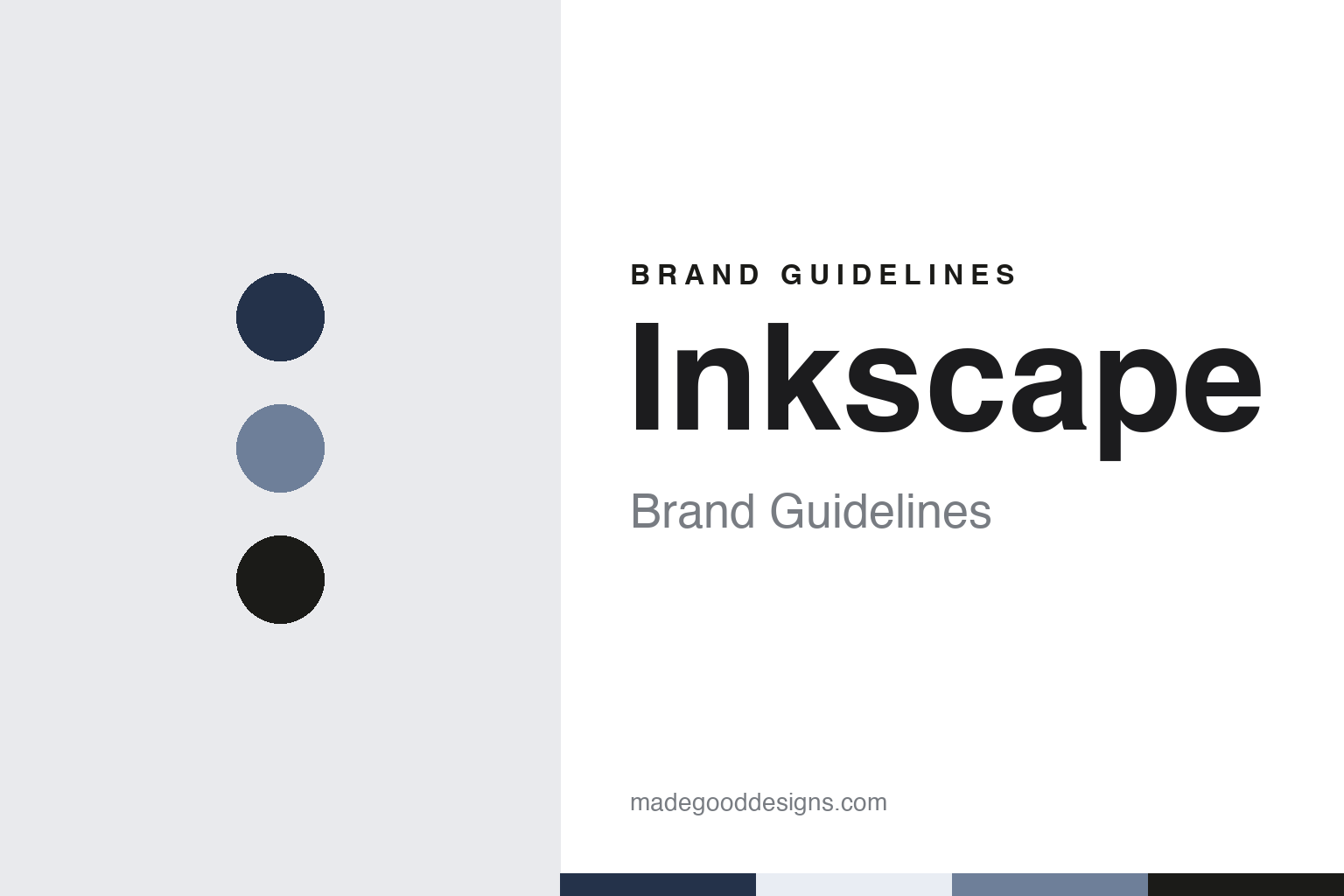
Two constants: a night ink, mountain slate and snow line palette and a bookish serif register. Abstract homage — not an Inkscape asset or mark; no logo, icon or wordmark is reproduced.
A fork with a new name
From Sodipodi to Inkscape in 2003.
Inkscape began as a new name for an existing codebase. On 6 November 2003, developer Bryce Harrington posted a message to the mailing list of the Sodipodi vector drawing project, saying that he and three colleagues, Nathan Hurst, Ted Gould and the developer known as MenTaLguY, had decided to take the Sodipodi code in their own direction. They had tried to do this inside Sodipodi, he wrote, but wanted a new project structure that gave them the freedom to explore approaches very different from the original.
The same message named the result. The four had reworked the Sodipodi codebase so that it would build with a C++ compiler, and had renamed it Inkscape. They had set up a project on SourceForge and a new website at inkscape.org. Wikipedia says Sodipodi itself had been developed since 1999 and was based on Raph Levien’s GNOME Illustration Application, known as Gill, and that the new project moved the code from C to C++ and adopted the C++ bindings of the GTK toolkit.
The goal was set out as a short list. Harrington’s announcement said the team wanted a fully SVG-compliant two-dimensional graphics editor, with full support for SVG, XML and CSS2, a core written in C++, an interface built with GTK that followed the GNOME Human Interface Guidelines, and an emphasis on a small core with modular extensions for features. It also promised an open, community-oriented development process that welcomed experimentation, and a preference for widely used third-party libraries such as Cairo, libcroco and Pango over custom code.
Releases followed quickly. Wikipedia lists the opening Inkscape release, version 0.35, as 11 November 2003, based on Sodipodi 0.32 with new keyboard shortcuts, and version 0.36 a month later, on 11 December 2003, with a redesigned interface. Harrington and Gould signed several of those early announcements on the project’s own mailing list. The Inkscape website’s FAQ, quoted by Wikipedia, still tells the story the same way: the project was started as a fork of Sodipodi in late 2003 by those four developers.
Colour
A long road to version 1.0.
For many years Inkscape kept a version number below one. Wikipedia’s release table runs from 0.35 in 2003 through a long series of 0.4x releases to the 0.92 series. Along the way, it says, Inkscape fully implemented the SVG 1.1 standard in version 0.91. The project took part in Google Summer of Code from 2005, moved its source code from SourceForge to Launchpad at the end of November 2007, and moved again to GitLab in June 2017.
Version 1.0 arrived on 4 May 2020. The project’s own announcement that day said the release came after a little over three years in development and was built by a team of volunteers. It credited teamwork at a 2018 hackfest in Boston for starting the move to a newer version of the GTK interface toolkit, GTK+3, which brought better support for high-resolution screens. The release was available for Linux, Windows and macOS, with the macOS build labelled as a preview; the announcement noted that it no longer needed the XQuartz layer on the Mac.
The 1.x series has kept a steady rhythm. When version 1.2 came out, The Register reported on 17 May 2022, in an article by Richard Speed, that the release added support for documents with multiple pages, a feature the team itself said users had been asking for over the previous few years. The article listed a merged Layers and Objects dialog, a new tiling path effect, an improved gradient editor and better integration with macOS, including a disk image for Macs with Apple’s M1 chips, and observed that after 1.0 Inkscape seemed to be settling into an annual cadence.
Wikipedia’s table bears that out. It lists version 1.1 on 24 May 2021, 1.2 on 16 May 2022, 1.3 on 23 July 2023 and 1.4 on 13 October 2024. Throughout, SVG has remained the program’s native format, with other formats imported into SVG or exported from it, and the software is released under the GNU General Public License, version 2 or later.
Typography
Wordmarks, symbols and screens.
Design software carries its identity in places a printed product never has to. The app icon does the heaviest work: it sits in a dock or on a taskbar at a few dozen pixels, beside dozens of rivals, so it tends toward a single shape, one or two colours and a letterform or emblem that still reads when it is shrunk to the size of a fingernail.
The splash screen is the second stage: the image that fills the wait while a program loads. Some studios use it for artwork made with the software itself, changing it with each release, so the splash becomes a kind of dated record of the product’s look. Mascots appear more often in community-built and open-source projects, where a character can stand in for a volunteer team that has no corporate logo to lean on.
Version naming is part of the system too, whether it uses plain numbers, years or code names. Commercial vendors usually fold a product into a parent brand’s typeface and colour rules; open-source projects tend to keep looser, community-maintained marks. The palettes shown here are our interpretation, not official colours.
Aa
A bookish serif — after the Linux Libertine wordmark the project names. (Specimen set in Libre Baskerville, a serif STAND-IN; NOT the Inkscape logo, wordmark or Linux Libertine itself.)
Inkscape
A mountain, a tagline and a trademark policy.
Inkscape publishes a short branding page on inkscape.org, and it is unusually specific about words. The project says the name Inkscape should be capitalised normally, not with a second capital letter in the middle, and written as one word; it lists spellings such as “Ink Scape”, “InkScape” and “Inkspace” as incorrect. The name is trademarked. So is the tagline, “Draw Freely.”, and the page asks users to watch its capitals and not to forget the full stop.
The symbol is described plainly. The branding page calls Inkscape’s logo the Mountain Graphic Logo and says there are two official variants: the original, slightly glossy three-dimensional version and a simplified flat version. The flat logo comes in a two-colour form and in one-colour forms for dark and light use. The page also names the type behind the lockup: the word Inkscape is set in Linux Libertine, an open-source serif, while the tagline uses Euphoria Script, which the project describes as the handwriting font used for “Draw Freely.”
Ownership of the marks is set out in the same place. The trademark policy on inkscape.org says the Inkscape Project is a member project of Software Freedom Conservancy, a non-profit, and that Conservancy holds rights in the marks on the project’s behalf. The stated aim is to make the identity of the editor and its free and open-source nature clear to everyone, while preventing uses that could confuse people about where the software came from. The policy asks for a trademark symbol after the opening prominent mention of the name in graphical materials, and waives that in email, online discussion and academic papers.
For a design guide, Inkscape shows how a volunteer project can keep a tight verbal identity, with a fixed spelling, a tagline with its own punctuation and two named typefaces, while letting its mountain mark move from glossy to flat. Compare Adobe, whose software spans vector and image editing, and Affinity, another family of design apps. For this guide we use night ink, mountain slate and snow line with a serif, an unofficial interpretation; no product or logo is reproduced.
Explore & save
Keep Inkscape’s identity on hand — save it to a board in the Made Good inspiration library.
Inkscape identity set
Pin the Inkscape night ink, mountain slate and snow line palette and the bookish serif register to your own board.