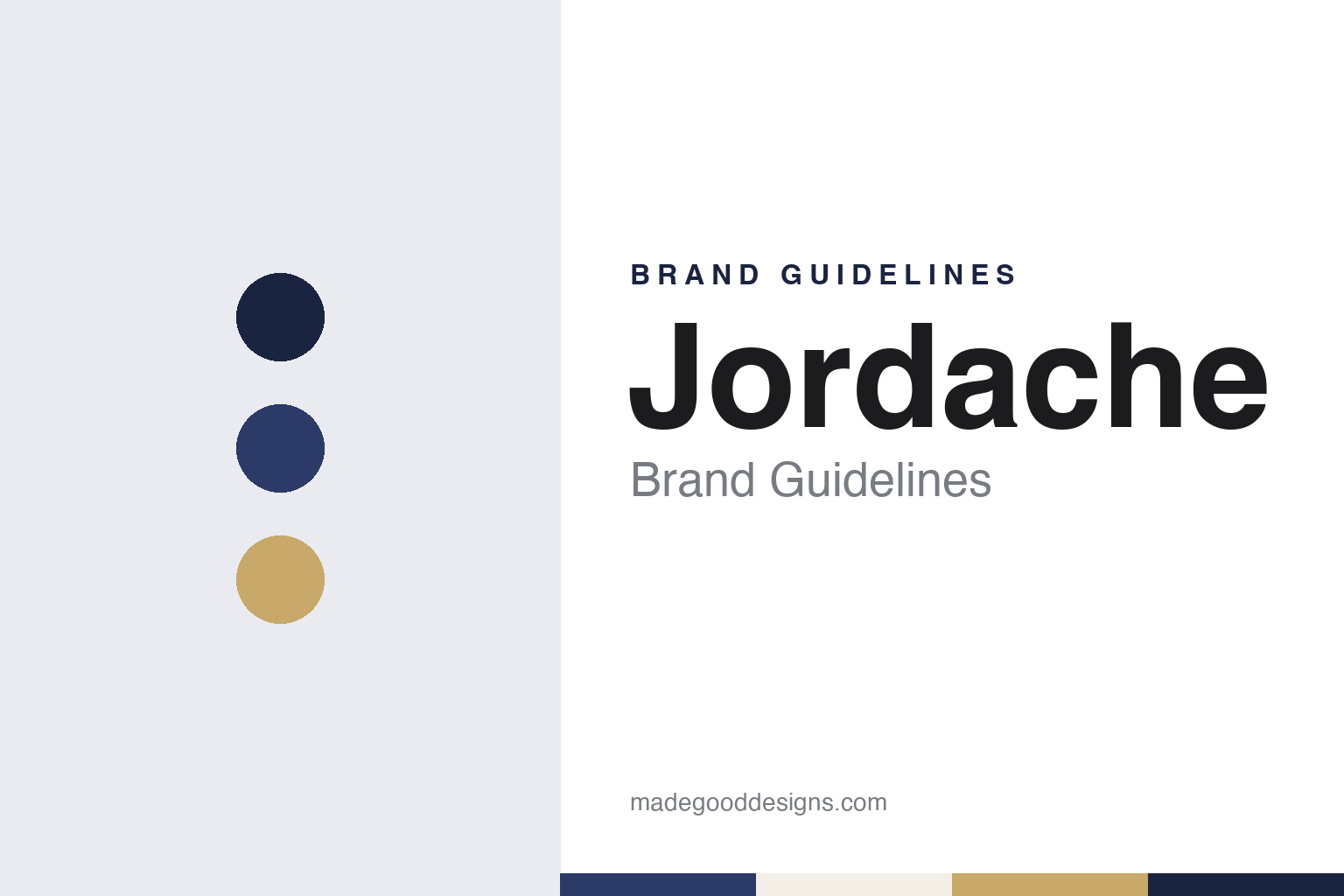
Jordache Brand Guidelines
The Nakash brothers’ horse-head jeans from New York.
Aa
Two constants: a rinse indigo, patch gold and surf foam palette and a high-contrast fashion serif register. Abstract homage — not a Jordache product or mark; no horse’s head, patch or logo is reproduced.
Jordache Jeans
Brothers, a shop in Brooklyn and a coined name.
Jordache grew out of a family retail business in New York. The International Directory of Company Histories (St. James Press, 1998) records that Joe Nakash, who had come to New York from Israel, brought over his brothers Ralph and Avi in 1966, and that by 1969 the three had opened a discount store selling brand-name jeans, later growing it into a small chain in Brooklyn and Queens. In an NPR interview in August 2012, the Bloomberg Businessweek writer Matthew Boyle placed the brothers’ storefront in the Bushwick neighbourhood of Brooklyn and said a denim manufacturer used to visit to see what was selling.
The turn came in the summer of 1977. The directory and Boyle both describe the brothers’ store being burned during the citywide power failure of that year, and both say the insurance settlement funded the move from selling other companies’ jeans to making their own. The company was incorporated in 1978 as Jordache Jeans Inc., according to the directory, and English Wikipedia, drawing on the same directory, says the line had form-fitting silhouettes for men and women, a horse-head logo and back-pocket stitching from the start.
The name itself is a construction. The directory calls it a loose acronym of the brothers’ first names, with a French-sounding ending taken from the end of their surname and pronounced “ash”; Wikipedia gives the same derivation as a contraction of Joe, Ralph and Avi Nakash. The directory adds that the brothers had been looking at the European jeans market, where denim was cut closer to the body and treated as fashion, and that their samples were made in Hong Kong.
From those beginnings the business was run as a family company. The directory names Ralph Nakash as chairman of the parent company in the late 1990s, with headquarters in Manhattan’s garment district, and describes a manufacturing arm, Ditto Apparel, in Colfax, Louisiana, alongside suppliers abroad. Boyle told NPR in 2012 that he had spoken to members of the second generation, Steve and his cousin Shaul, who were by then involved in the group.
Colour
Licences, a joint venture and a move to mass retail.
Advertising carried the brand into licensing. The directory records a 1980 licence with Burlington for home furnishings — bed and bath goods and kitchen textiles — and says the company was soon licensing its name and horse’s-head logo for products ranging from hosiery and lingerie to children’s dolls. By early 1983, it says, an affiliated shipping company, Yama Maritime, was running cargo ships that carried the same horse’s head. Wikipedia lists the licensed goods of 1989 as including children’s socks, women’s outerwear, jewellery, dresses, luggage and umbrellas.
The company also bought and backed other labels. In 1983, the directory says, Jordache bought the Maurice Sasson brand name and set up a subsidiary, Bronco Ltd., with Maurice Sasson as its president and chief designer. The same year it took a half-share in the Beverly Hills jeans maker Guess; after years of litigation between the two families, the directory records that the dispute was settled in May 1990, with the Nakashes returning their Guess stock and Jordache taking full ownership of a jointly owned label, Gasoline.
The 1990s took the brand into mass retail. The directory describes the purchase of the Heck’s discount store chain in 1990, a fragrance called Looks in 1991, and a licensee’s line of Jordache Baby nappies in 1994. Boyle told NPR in 2012 that in 1995, as the designer-jeans craze faded, the family moved much of the jeans business to Walmart, and that around the same time it began making private-label jeans for other brands in its own factories.
Jordache Enterprises remains privately held by the Nakash family. Wikipedia lists its apparel brands as including Jordache, Earl Jeans, Maurice Sasson and Gasoline, and describes a group that also reaches into real estate, hotels and aviation in the United States and Israel. In October 2018 Sourcing Journal reported a premium anniversary collection, designed by Benjamin Talley Smith and launched at Barneys and Kith; Jordache president Liz Berlinger told the publication it was produced in Los Angeles.
Typography
Design and documentation.
A pair of jeans carries its brand in a handful of small places rather than across one large surface. The stitched shape on a back pocket, the patch sewn above it on the waistband, the buttons and rivets at the stress points and the woven tab or label at a seam are the parts a shopper can recognise from across a room, long before a logo is close enough to read.
Each of those places works differently as identity. Back-pocket stitching is drawn in thread, so it reads as a line and a silhouette rather than as a word. A waistband patch, in leather, card or a printed substitute, is where a name, a symbol and sometimes a picture sit together, much like a small label. Metal hardware is stamped, so it holds lettering in relief at a very small size. Advertising then sets all of this in motion, giving a name a voice, a slogan and a setting.
Each guide in this group looks at those parts in turn — who started the brand, who owns it now, how its marks and advertising have been recorded — and keeps what independent sources document apart from what the company says about itself.
Aa
A high-contrast fashion serif — the register of a magazine spread and a back-pocket label. (Specimen set in Bodoni Moda, a serif STAND-IN; NOT the Jordache logo.)
Jordache
A horse’s head, a rider in the surf and a jingle.
The Jordache identity was built in a single advertising push. The directory says the brothers launched a television and print campaign in January 1979, paid for with their own money and a bank loan. The television spot showed an apparently topless blonde woman in tight Jordache jeans riding a horse through the surf; a young man, also in jeans, vaults onto the horse and the two ride off, while the soundtrack rises to the words “You got the look I want to know better.” The national networks rejected the spot, the directory says, but independent New York stations ran it, and Time reported on the campaign in September 1979.
The horse in the commercial matched the horse’s head on the label, and that pairing — an animal mark and a line of song — became the brand’s core. The directory says the company followed the spot with full-colour advertising in Playboy, Vogue and Harper’s Bazaar, and that one print image was reshot after The New York Times declined to run it. A 1986 television series took a different line, with teenagers talking to camera about their lives rather than modelling the jeans; that campaign was also turned down by the networks, the directory says.
The jingle has outlived the era. In 1997, the directory records, Jordache relaunched television and print advertising with a rescored version of the original “You Got the Look” theme, directed by Ralph Nakash’s son Shaul, and NPR opened its 2012 segment with the same song. The company’s own website now carries the line “You’ve got the look” as a trademarked tagline and names a jeans style “The 1978” after the founding year. Wikipedia also records that a Jordache-branded blimp, on its way to a promotional event, crashed at Lakehurst, New Jersey, on 8 October 1980.
For a design guide, Jordache shows how a family business turned a horse’s head, a back-pocket stitch and one line of song into a mark that could be licensed well beyond jeans and revived decades later. Compare it with Levi’s, the jeans maker whose standard denim the designer labels of the late 1970s were cut against, in the directory’s account, and Guess, the label it once part-owned. For this guide we use rinse indigo, patch gold and surf foam with a serif, an unofficial interpretation; no product or logo is reproduced.
Explore & save
Keep Jordache’s identity on hand — save it to a board in the Made Good inspiration library.
Jordache identity set
Pin the Jordache rinse indigo, patch gold and surf foam palette and the high-contrast fashion serif register to your own board.


