MGA Entertainment Brand Guidelines
Isaac Larian’s Los Angeles toy company behind Bratz and L.O.L. Surprise!
Aa
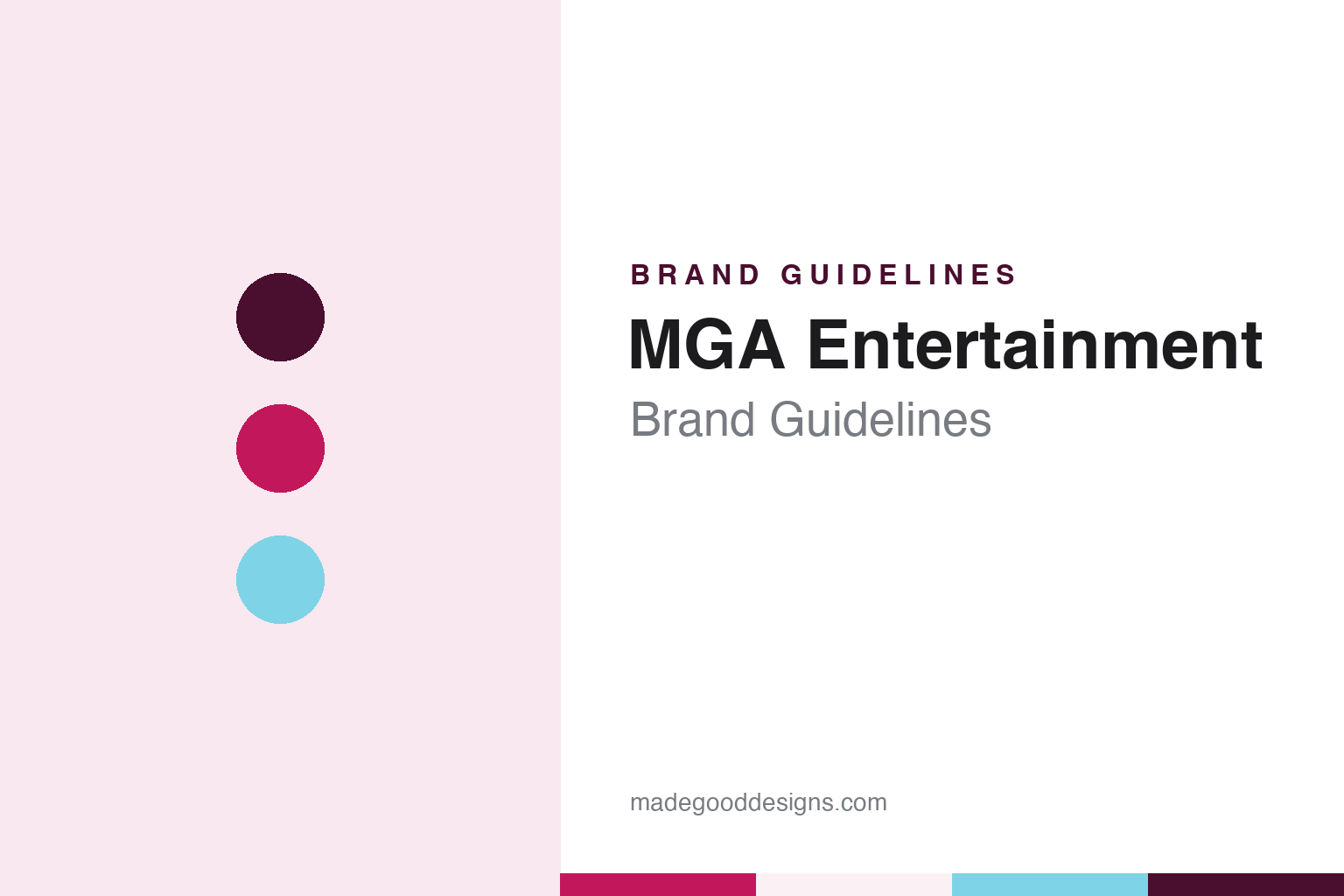
Two constants: a doll-box magenta, unboxing aqua and blush white palette and a rounded showroom sans register. Abstract homage — not an MGA product or mark; no doll, box or logo is reproduced.
Micro Games of America
Brass giftware, handheld games and a new name.
MGA Entertainment is the company Isaac Larian built in Los Angeles. In a 2007 interview with the Jewish Journal, Larian said he had studied civil engineering and planned to return to Iran to work as an engineer until the 1979 revolution changed those plans; instead he started a business selling brass giftware from the back of his car. Forbes, in a profile published on 30 October 2013, said Larian and his brother went into business as importer-exporters in 1979, selling brass figurines from South Korea.
Handheld electronic games came next. Forbes placed that move in the early 1980s, when the brothers repackaged and sold Nintendo’s Game & Watch handhelds; Larian, in the 2007 interview, said the business went into toys in 1987, when it became a distributor for Nintendo Game & Watch. The company’s own history page compresses both stages, saying it had its start in 1979 as Micro Games of America, distributing Game & Watch and other handheld LCD games in the United States. The initials of that name are the “MGA” the company still carries.
Licensing gave the business its next footing. Larian told the Jewish Journal that in 1993 the company became a licensee for Power Rangers, which he said put it on the map as a toy company. Forbes said a struggling inventor brought Larian a design for a talking doll in 1996, and that the result, Singing Bouncy Baby, became a hit in 1997. The company says it changed its name to MGA Entertainment in 1997 with the introduction of Singing Bouncy Baby, its first doll brand, and that name has stayed in place since.
The company remains privately held, with Larian as its founder and chief executive, and through most of its history it was associated with the San Fernando Valley; Forbes described it in 2013 as MGA Entertainment “of Van Nuys”.
Colour
Fashion dolls, a preschool brand and a campus.
The doll line that made MGA widely known followed four years after the name change. Forbes reported that in September 2000 Larian saw a sketch by Carter Bryant, a freelance designer, for a big-headed, full-lipped doll, and that he was persuaded partly by his young daughter’s reaction to it. The result was Bratz, which the company dates to 2001. In 2004 Mattel sued MGA, alleging that Bryant had conceived Bratz while on Mattel’s payroll, Forbes reported in 2013, and the dispute ran through a series of court rulings in California over the following years.
MGA added an established brand in 2006. The company says it acquired Little Tikes that year, adding preschool and outdoor toys to its portfolio, and English Wikipedia says the purchase from Newell Rubbermaid was made in September 2006. The same year, Wikipedia says, MGA took a minority stake in the German doll maker Zapf Creation, with a distribution arrangement on each side of the Atlantic, and in 2023 it was announced that MGA would acquire the rest of the company.
New in-house lines followed through the 2010s and 2020s. Wikipedia records Moxie Girlz in 2009 and Lalaloopsy, rag-doll characters with the tagline “Sew Magical, Sew Cute”, in 2010. The company dates the launch of L.O.L. Surprise!, a collectible doll line built around blind unboxing, to December 2016, the Rainbow High fashion dolls to 2020, and the Miniverse miniature collectibles to 2022. In 2022, the company says, it established MGA Studios and acquired Pixel Zoo Animation Studios in Australia, bringing animation for its characters in-house.
The company’s home changed in 2019. The Los Angeles Daily News reported on 16 August 2019 that Larian had opened MGA’s 24-acre North American headquarters in Chatsworth to local leaders and reporters the previous evening. The campus, set in a former Los Angeles Times building in an industrial part of Chatsworth, was described as a “live-work-and-play” complex with apartments, offices, a preschool, dining and a yoga studio.
Typography
Design and documentation.
A toy company’s name usually reaches people indirectly. Children meet the characters, the dolls and the games first, and the maker’s mark sits in a corner of the box, on the base of a figure or on the back of the instructions. For many toy makers the corporate logo works more like a signature than a headline, a small, repeatable sign that has to sit beside a crowd of louder product names without competing with them.
The places where that mark does its main work are mostly trade settings: the cover of a dealer catalogue, the spine of a retail display, the stand or showroom at a toy fair where buyers see a season’s range before it reaches shops. A company that changes owners, merges with a rival or licenses its name may carry several versions of its mark across those settings at once, and older boxes keep earlier versions in circulation long after a redesign.
Each guide follows the company rather than any single toy: who founded it and where, who has owned it since, how its name and mark have changed, and which lines it is remembered for, with the company’s own account marked as its own.
Aa
A rounded showroom sans — the register of a toy-fair stand and a doll-box back panel. (Specimen set in Poppins, a sans-serif STAND-IN; NOT the MGA logo.)
MGA
Three initials behind a row of louder names.
The MGA identity is built on an abbreviation. The three letters began as the initials of Micro Games of America, the name the company gives for its start in handheld games, and they survived the 1997 change to MGA Entertainment, so the corporate name still records a business the company long ago moved beyond. English Wikipedia illustrates the company with a logo it captions as in use since 2019, the year MGA moved into its Chatsworth campus.
As with many toy companies, the corporate mark is rarely the loudest thing on a shelf. Customers meet MGA through its product brands — Bratz, L.O.L. Surprise!, Rainbow High, Little Tikes — each with its own lettering, colours and characters, and the MGA name usually appears as a maker’s mark on packaging, in trade advertising and on the company’s own sites. The company frames itself around those brands: its history page says its brands are created by its employees in-house, and it presents its timeline as a sequence of launches rather than of corporate events.
For a design guide, MGA Entertainment shows how a toy company can let a short set of initials carry its corporate identity while its product brands do the visual shouting, and how a name taken from an early business in handheld games can outlast that business by decades. Compare it with Bratz, the fashion doll line the company dates to 2001, and L.O.L. Surprise!, the unboxing doll line it launched in 2016. For this guide we use doll-box magenta, unboxing aqua and blush white with a sans, an unofficial interpretation; no product or logo is reproduced.
Explore & save
Keep MGA Entertainment’s identity on hand — save it to a board in the Made Good inspiration library.
MGA Entertainment identity set
Pin the MGA doll-box magenta, unboxing aqua and blush white palette and the rounded showroom sans register to your own board.