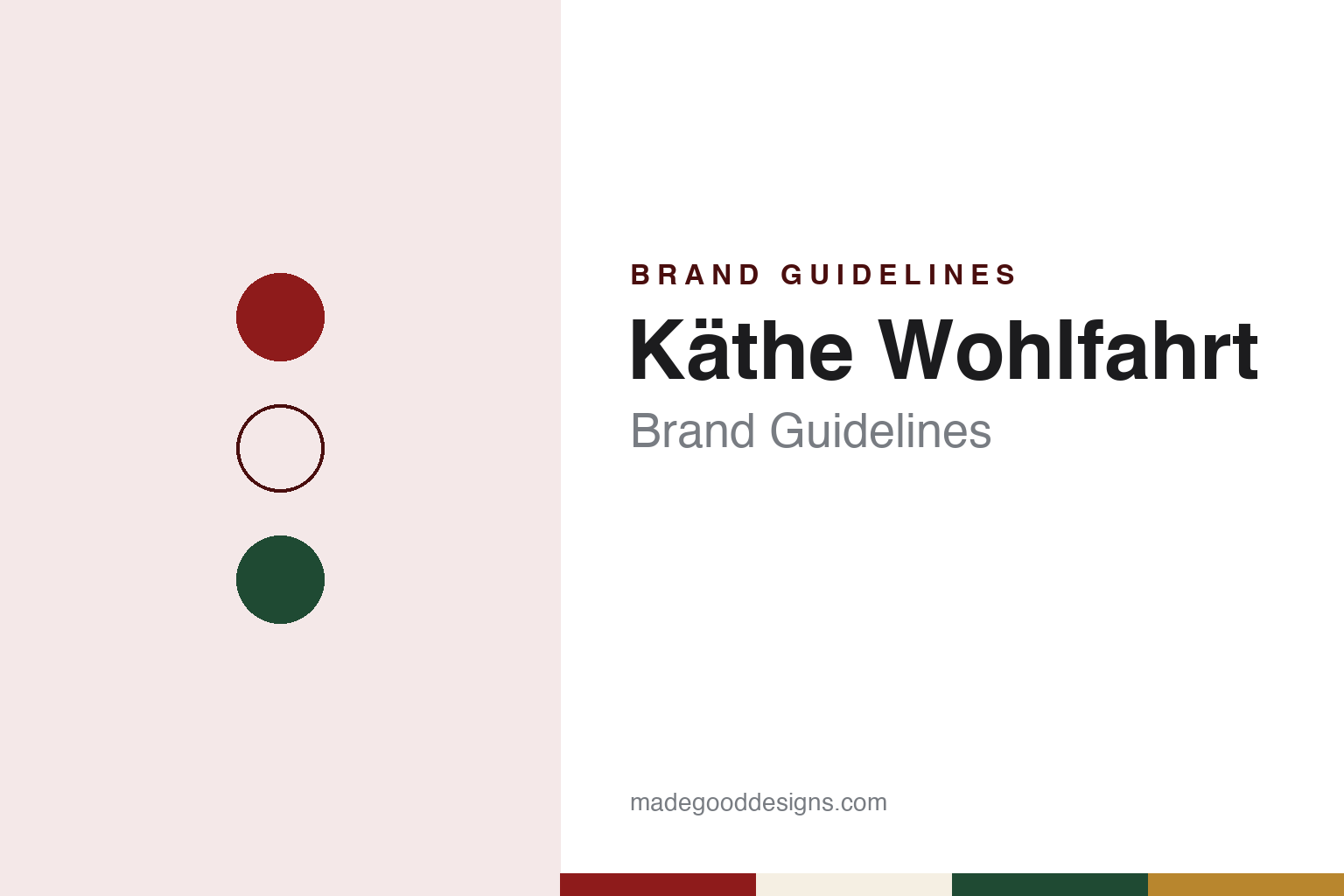
Käthe Wohlfahrt Brand Guidelines
A Christmas shop in a medieval Bavarian town, open all year round.
Aa
Two constants: a red, cream, fir-green and gilt palette and a classical old-style serif register. Abstract homage — not a Käthe Wohlfahrt product or mark; no ornament, shopfront or logo is reproduced.
A music box and a market stall
A couple near Stuttgart, a Christmas gift for friends and a business named after the wife.
Käthe Wohlfahrt is a German retailer of Christmas decorations, and its story starts not in the Bavarian town most visitors associate with it but in Herrenberg, near Stuttgart. English Wikipedia says the company was founded in 1964 in Herrenberg by the husband-and-wife couple Wilhelm and Käthe Wohlfahrt, and that it was later taken over by their son, Harald Wohlfahrt.
German Wikipedia gives a fuller account of how it began. It says the couple had brought a Christmas music box with them from their home region of Saxony when they settled in Stuttgart. When an American family they were friends with spent Christmas 1963 at the Wohlfahrts’ home, the music box caught their interest, and Wilhelm decided to give them one of their own. According to the same article, the only dealer he could find would sell him nothing smaller than a set of music boxes, because the Christmas season was already over, so he bought the set, gave one to his friends and set about selling the rest.
German Wikipedia says his first attempt, selling the remaining music boxes to other officers’ families at an American barracks, was stopped by the military police, who pointed him instead towards a charity bazaar, where he sold the rest. That, the article says, led the couple to go into business on their own, offering a steadily growing range of Christmas goods at weekly markets, before founding their own company in Herrenberg in 1964.
The name on the door was Käthe’s. German Wikipedia explains that the firm was named after Käthe Wohlfahrt because Wilhelm was still employed at the time by a computer manufacturer. The decision gave the business a personal, first-name-and-surname brand that it has kept ever since: the company is still trading as Käthe Wohlfahrt, and the name itself, rather than any symbol, is the most recognisable part of its identity.
The goods the couple started with set the tone for what followed. The music box at the centre of the story was a piece of Christmas folk craft from the Erzgebirge tradition of Saxony, and German Wikipedia says that when the Wohlfahrts later opened their first specialist shop, its range of Erzgebirge Christmas music boxes included a successor model of the nativity music box they had given their American friends.
Colour
A move to Rothenburg, a museum of Christmas and a family firm.
The move that defined the brand came in 1977, when, according to both English and German Wikipedia, the company moved from Herrenberg to the medieval town of Rothenburg ob der Tauber in Bavaria. German Wikipedia says the first specialist Christmas shop opened there under the name “Käthe Wohlfahrts Christkindlmarkt”, and that more Christmas shops followed in the years after.
Rothenburg remains the company’s head office. English Wikipedia says the main shop is open all year round and houses a Christmas museum and a Christmas exhibition, and that the range includes candles, Christmas-tree decorations, nativity scenes and nutcrackers. German Wikipedia dates the opening of the Deutsches Weihnachtsmuseum, the German Christmas Museum, which presents the history of Christmas in Germany, to 29 September 2000.
Käthe Wohlfahrt is a retailer first, but it also designs its own goods. German Wikipedia says that in 1991 the company began building its own product lines under the name “Rothenburger Weihnachtswerkstatt”. The company’s own website in October 2026 described the Rothenburger Weihnachts-Werkstatt as its in-house development department, designing ornaments since 1991, and marked the line’s anniversary that year. The same site, in October 2026, also carried glass tree ornaments made under licence from other brands alongside its own designs, and mentioned a new shop in Munich.
The shop network extends well beyond Rothenburg. English Wikipedia lists shops in Nuremberg, Bamberg, Oberammergau, Berlin, Heidelberg and Rüdesheim am Rhein, as well as branches in Riquewihr in France, Bruges in Belgium, Barcelona in Spain, on Stonegate in York in England and in Stillwater, Minnesota, in the United States. It adds that the company runs stalls at Christmas markets, and that Kathe Wohlfahrt of America has operated seasonal stores at Christmas markets in several US cities and in Vancouver. English Wikipedia also notes that a visit to the Rothenburg shop is often included in tours of Germany and Europe.
The business has stayed in the family. German Wikipedia says Harald Wohlfahrt, the founders’ son, took over its management in 2001. The same article says the pandemic restrictions of 2020, which cancelled Christmas markets and closed shops, led the company to apply for protective-shield proceedings (a German court-supervised restructuring) in December 2020; it says the proceedings ended in 2021, that some shops in Germany were closed under the restructuring plan, and that the company remained in family hands with Rothenburg as its centre.
Typography
Design and documentation.
Makers of Christmas ornaments and decorations work in a trade shaped by the calendar. Most of what they sell is chosen in a short season, yet it is meant to last: a glass bauble, a turned wooden figure or a painted box may come out of storage every winter for decades, and a household often builds its collection slowly, one piece at a time.
That long life gives names in this field a particular weight. A maker’s mark, a printed box or a familiar shop sign can come to stand for a whole tradition of craft, from glassblowing at the lamp to woodturning and hand-painting, even when the business behind it is small, has passed between families or now sources its pieces in more than one place.
Each guide sets out what dated, independent sources record and what a company says about itself — where and when it began, who runs or owns it now, where its pieces are made, and how its labels, packaging and shopfronts present it — and marks plainly what rests only on the company’s own account.
Aa
A classical old-style serif in the spirit of an old-town shop sign and a printed Christmas catalogue. (Specimen set in Cormorant Garamond, a serif STAND-IN; NOT the Käthe Wohlfahrt logo.)
Käthe Wohlfahrt
A name, a town and a shop that never closes for the season.
Käthe Wohlfahrt’s identity rests on three things that are all documented: a founder’s name, a place and a format. The name is the brand: German Wikipedia records that the firm was called after Käthe Wohlfahrt in 1964, and the company still trades under her full name, in German and in English, on its shops and its website.
The place is Rothenburg ob der Tauber. Since 1977 the company has been based in the walled Bavarian town, and the main shop, with the Deutsches Weihnachtsmuseum inside it, is the address that English Wikipedia says draws tour groups from abroad. The town’s medieval setting does much of the visual work for the brand, and the company has carried the place name into its own product line, the Rothenburger Weihnachts-Werkstatt.
The format is the year-round Christmas shop. English Wikipedia says the Rothenburg shop is open all year, and the same model of a shop given over entirely to Christmas has been repeated in other German towns and abroad, from Bruges and Riquewihr to York and Stillwater, Minnesota. Seasonal stalls at Christmas markets extend it further.
The range the shops carry is broad. English Wikipedia lists candles, Christmas-tree decorations, nativity scenes and nutcrackers, and German Wikipedia adds glass baubles and incense cones. Several of those categories are German folk crafts with makers of their own, among them the blown-glass ornaments of houses such as Inge-Glas and the turned and carved wooden figures of the Erzgebirge, and the company’s website in October 2026 had a separate brands section alongside its own designs. The music box at the start of the story, an Erzgebirge piece from the founders’ home region, is a reminder that the retailer grew out of that craft tradition rather than alongside it.
The company has also documented its own subject. German Wikipedia lists a book on nutcrackers, Nussknacker Gestalt und Geschichte, published by Käthe Wohlfahrt in Rothenburg in 2003, and a Rothenburg Christmas book by Susanne Rick published by Pattloch in Munich in 2004.
For a design guide, Käthe Wohlfahrt shows how a retailer can build an identity from a personal name, a single historic town and a format that runs all year; compare Christian Ulbricht and Old World Christmas. For this guide we use Rothenburg red, candle cream, fir green and gilt with a classical serif, an unofficial interpretation; no product or logo is reproduced.
Explore & save
Keep Käthe Wohlfahrt’s identity on hand — save it to a board in the Made Good inspiration library.
Käthe Wohlfahrt identity set
Pin the Käthe Wohlfahrt red, cream, fir-green and gilt palette and the classical serif register to your own board.