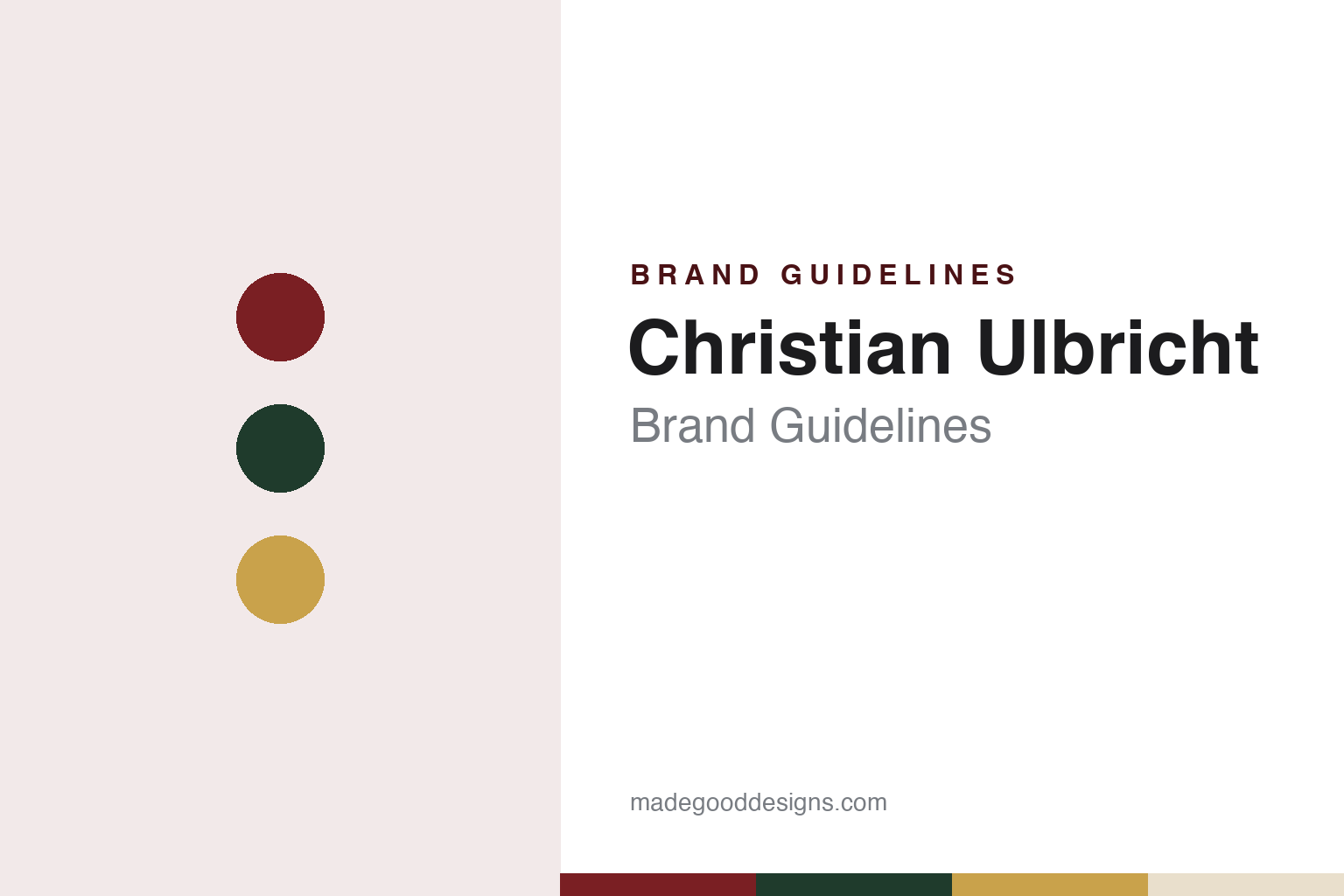
Christian Ulbricht Brand Guidelines
Nutcrackers, smoking men and a family firm with two homes, one in the Erzgebirge and one on the Danube.
Aa
Two constants: a nutcracker red, fir green and gilt palette and a display serif register. Abstract homage — not a Christian Ulbricht product or mark; no figure, label or logo is reproduced.
A workshop in Seiffen
Miners’ descendants, a toy village and a firm founded in 1928.
Christian Ulbricht traces its story to Seiffen, a village in the Erzgebirge, the Ore Mountains on the border between Saxony and Bohemia. The company’s own history page says the family’s ancestors were miners in the region and that, as the silver ore ran out, they turned to carving and wood turning, and finally to running businesses of their own.
In 1928, the company says, Christian Ulbricht’s father, Otto Ulbricht, founded a firm in Seiffen under the name “Otto Ulbricht – Werkstätten für feine Holzarbeiten und Spielwaren”, workshops for fine woodwork and toys. Gunther Ulbricht, the founder’s grandson and the company’s managing director, gave the same founding year in an interview with the German business magazine Wirtschaftsforum, describing the family firm as having made fine wooden pieces from the start.
The products belong to a regional craft that is older than the company. On its page about nutcrackers and smokers, the firm says nutcrackers have been made in the Erzgebirge since the eighteenth century, and that their stern, grim faces were meant to mirror the authorities of the day, so that the nobility had to work for ordinary people by cracking their nuts. Over time, the company says, the Erzgebirge nutcracker became mainly a decorative figure, though it still works as a tool.
The Räuchermann, or smoking man, followed. The company says these incense smokers took their subjects from ordinary working life, beginning with craftsmen and trades, in contrast with the kings, hussars and soldiers of the nutcracker tradition. Both figure types remain at the centre of the range, alongside Christmas pyramids, candle arches, angels, miniatures and tree ornaments.
Seiffen remains the company’s home in its own telling. Its page on craft and homeland calls the village “Spielzeugdorf”, the toy village, and the spa resort of Seiffen in the heart of the Erzgebirge, and invites visitors to see it for themselves, especially at Christmas.
Colour
Expropriation, a new start on the Danube and a return after reunification.
The Seiffen business did not survive the post-war division of Germany in family hands. The company says that the Second World War and the expropriation that followed under the communist authorities brought the end of the Seiffen firm, and that Otto Ulbricht decided to leave for the West with his family. In the Wirtschaftsforum interview, Gunther Ulbricht said that after the war the Seiffen works were expropriated, and that his family therefore decided to start a new company in West Germany.
That new start took place in Lauingen an der Donau, a small former ducal town on the Danube in Bavaria, where, the company says, Otto Ulbricht refounded the firm. Lauingen-made figures have since become part of the Erzgebirge story themselves. The Saxon newspaper Freie Presse reported on 28 March 2025 that three nutcrackers from Lauingen an der Donau had found their way to the toy museum in Seiffen, noting that their makers came from the Erzgebirge.
German reunification in 1990 reopened the road home. The company says that after reunification Christian Ulbricht, Otto’s son, was able to buy back the former works in Seiffen, and that a newly built factory there was inaugurated in 1997. Gunther Ulbricht told Wirtschaftsforum that the family had only been able to buy back its old Seiffen business after reunification, and that it had grown since. He described a company with two locations, one in Seiffen and one in Lauingen an der Donau.
The firm has stayed with the family. According to its history page, when Christian Ulbricht retired he handed the business to his children Ines and Gunther. Since Ines Ulbricht left in 2022, the company says, it has been run by Gunther together with his own children, Kathrin and Steffen. The operating company in Seiffen trades as Seiffener Nußknackerhaus Christian Ulbricht GmbH & Co. KG.
On design, Gunther Ulbricht told Wirtschaftsforum that the company uses no external designers and develops all of its models in house, and that customers at trade fairs ask specifically for the year’s new pieces. The company says each piece is handmade in its workshops.
Typography
Design and documentation.
Makers of Christmas ornaments and decorations work in a trade shaped by the calendar. Most of what they sell is chosen in a short season, yet it is meant to last: a glass bauble, a turned wooden figure or a painted box may come out of storage every winter for decades, and a household often builds its collection slowly, one piece at a time.
That long life gives names in this field a particular weight. A maker’s mark, a printed box or a familiar shop sign can come to stand for a whole tradition of craft, from glassblowing at the lamp to woodturning and hand-painting, even when the business behind it is small, has passed between families or now sources its pieces in more than one place.
Each guide sets out what dated, independent sources record and what a company says about itself — where and when it began, who runs or owns it now, where its pieces are made, and how its labels, packaging and shopfronts present it — and marks plainly what rests only on the company’s own account.
Aa
A display serif in the spirit of turned and painted woodwork. (Specimen set in Playfair Display, a serif STAND-IN; NOT the Christian Ulbricht logo.)
Christian Ulbricht
A family name that works as a signature.
Christian Ulbricht’s identity rests on a person’s name. The firm Otto Ulbricht founded in 1928 carried his own name; the business that returned to Seiffen after reunification carries his son’s. That choice makes the brand a family signature, and the company leans into it in a literal way.
In the Wirtschaftsforum interview, Gunther Ulbricht said the company’s premium-series nutcrackers go to the United States, where collectors bring their figures to shops to have them signed, and that he gives signing sessions there himself, acting as an ambassador for the nutcrackers. The signature goes on the base. The company’s website in October 2026 had its own USA Signing Tour section with tour dates, and a range marking 250 years of the USA.
The catalogue itself is organised by figure type and size. The website groups nutcrackers into lines such as XL, Premium, Klassik and Minis, and does the same for smoking men, alongside families of figures with their own names, among them the Wichtel gnomes and the Schlafmützen. Seasonal sections cover Christmas, Easter, Halloween and the Día de los Muertos, so that the same carved, painted register is stretched across the whole year.
The visual language is that of the Erzgebirge tradition: turned bodies, painted uniforms, fur beards and the fierce nutcracker face the company traces to the eighteenth century. What distinguishes the firm’s own story is geography. Its history runs from Seiffen to Lauingen and back, and the website presents Seiffen, the toy village, as home while the company keeps its Bavarian site.
For a design guide, Christian Ulbricht shows how a founder’s and a son’s name, signed on a figure’s base, can do the work of a logo for collectors. Compare another Erzgebirge nutcracker family in our Steinbach Nutcrackers brand guidelines and the angel figures of Grünhainichen in our Wendt & Kühn brand guidelines. For this guide we use nutcracker red, fir green, gilt and limewood with a serif, an unofficial interpretation; no product or logo is reproduced.
Explore & save
Keep Christian Ulbricht’s identity on hand — save it to a board in the Made Good inspiration library.
Christian Ulbricht identity set
Pin the Christian Ulbricht nutcracker-red, fir-green and gilt palette and the display serif register to your own board.