Krebs Glas Lauscha Brand Guidelines
A glassblowing town, a refounded works and a family name on both sides of the Atlantic.
Aa
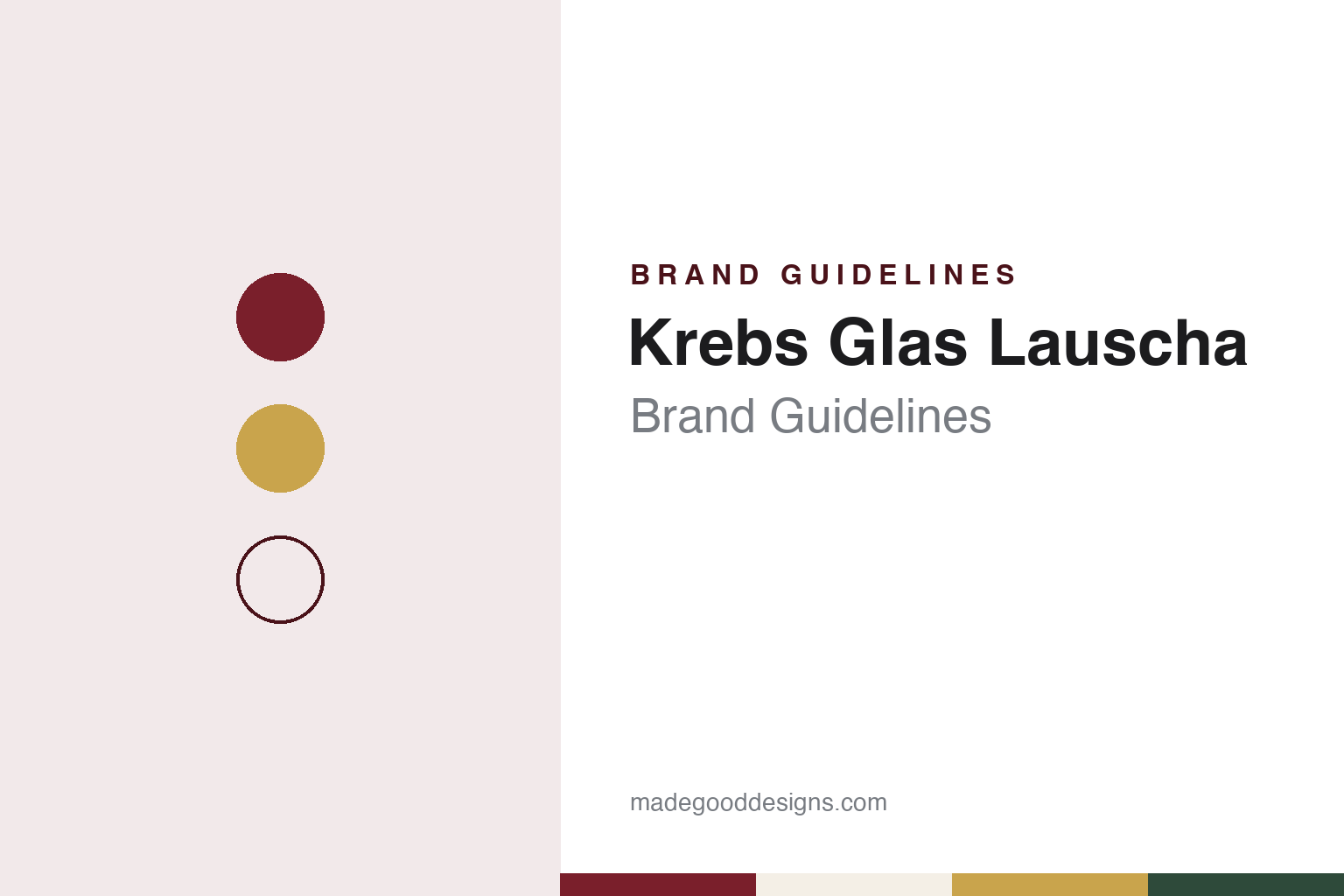
Two constants: a bauble red, gilded gold and frosted white palette and a high-contrast festive serif register. Abstract homage — not a Krebs Glas Lauscha product or mark; no ornament, box or logo is reproduced.
A company refounded in a glass town
A Bavarian glassblowing family, a phone call and the Treuhand.
Krebs Glas Lauscha is a Christmas ornament company in Lauscha, a small town in the Thuringian Forest whose name has long been tied to glass. German Wikipedia records that the town grew up around a glassworks, for which the glassmakers Hans Greiner and Christoph Müller received a hereditary concession in 1597, and that lamp-blown glass beads, figures and animals were made there in the eighteenth century before glass tree decorations followed in the nineteenth. The company bearing the Krebs name belongs to a much later chapter of that history.
Its story is told in a profile by Dorothea Heintze published by evangelisch.de on 12 December 2018. The article names Michael Krebs as managing director of Krebs Glas Lauscha GmbH and describes his parents as descendants of a glassblowing family from Rosenheim in Bavaria who had come to Thuringia. During the years of the German Democratic Republic, the article says, Lauscha’s ornament trade was gathered into the state-owned VEB Thüringer Glasschmuck. English Wikipedia’s article on Christmas ornaments likewise records that the East German state took most of Lauscha’s glassworks into public ownership and that most firms were re-established as private companies after the fall of the Berlin Wall.
Michael Krebs was then running his own business in Schongau, in Bavaria, when, as evangelisch.de tells it, a phone call asked him to come and help. The Treuhand, the agency that handled East German state enterprises after reunification, had split up the large works and wanted to sell it piece by piece. In the negotiations, the article says, the former East German manager and the new West German manager sat side by side and jointly chose to spin off and refound the business. The former manager was Gerd Ross, who came from the family that had owned the glassworks before the GDR era and had later been sales director of the state enterprise. Krebs told the magazine that he could never have managed it without that support, and he moved to Lauscha with his family.
Colour
From its own furnaces to a network of glass workshops.
The new company did not keep its original shape for long. evangelisch.de reported in 2018 that the business later went through insolvency, a period Michael Krebs described to the magazine as a sad time.
Where the ornaments are made today is set out in the same article. Krebs Glas Lauscha has given up its own production, it said, and instead orders baubles, Father Christmas figures and other tree decorations from a handful of workshops in Germany and Romania. One of them is close by: the article describes a Lauscha glassblower, Veit Hoch, whose workshop still produces mostly for Krebs, so that a new product idea can be tried out a few metres from the company’s showroom. Krebs also works with a creative team, the article says, and described himself as a team player who relies on the expertise of his specialists.
An earlier record shows the kind of glass the Krebs name was attached to in the years after reunification. In 1993 the Victoria and Albert Museum in London accepted a group of Christmas decorations “given by the makers”, catalogued under the maker name Krebsglas and the place Lauscha. The museum describes them as hand-blown and hand-decorated glass: a red bell finished with gold paint and silver glitter, an eight-pointed blue star with a central disc of cherubs, a fir cone in brown and green glass, a clear ball with snowflakes picked out in glitter, and a half-figure of a child painted in gold, blue and red. For some pieces the catalogue notes that they were made from moulds possibly dating from about 1900.
The family name also reaches beyond Germany. According to evangelisch.de, the business known in Lauscha as Krebs is called Christmas by Krebs in Atlanta, where it is run by the family of Michael Krebs’s brother, and there is also a branch in Hong Kong. English Wikipedia describes Krebs Glas Lauscha as part of the Krebs family of companies.
Typography
Design and documentation.
Makers of Christmas ornaments and decorations work in a trade shaped by the calendar. Most of what they sell is chosen in a short season, yet it is meant to last: a glass bauble, a turned wooden figure or a painted box may come out of storage every winter for decades, and a household often builds its collection slowly, one piece at a time.
That long life gives names in this field a particular weight. A maker’s mark, a printed box or a familiar shop sign can come to stand for a whole tradition of craft, from glassblowing at the lamp to woodturning and hand-painting, even when the business behind it is small, has passed between families or now sources its pieces in more than one place.
Each guide sets out what dated, independent sources record and what a company says about itself — where and when it began, who runs or owns it now, where its pieces are made, and how its labels, packaging and shopfronts present it — and marks plainly what rests only on the company’s own account.
Aa
A high-contrast serif with a festive, engraved feel, in the spirit of printed ornament boxes and old trade cards. (Specimen set in Playfair Display, a serif STAND-IN; NOT the Krebs Glas Lauscha logo.)
Krebs Glas Lauscha
A place name doing the work of a brand.
The most important part of the Krebs Glas Lauscha name is its second half. By putting the town into the company name, the business ties itself to Lauscha’s centuries of glassmaking, which German Wikipedia traces back to the glassworks concession of 1597 and to the lamp-blown beads and figures of the eighteenth century. The word “Glas” states the material plainly, and the family name in front of it identifies the people who refounded the business after reunification.
The products carry much of the visual identity. The pieces the company gave to the Victoria and Albert Museum in 1993 show the vocabulary: coloured and clear blown glass, gold and silver paint, glitter, stars, bells, fir cones and figures, some of them shaped in moulds that the museum says may date from about 1900.
The company’s showroom in Lauscha, where evangelisch.de photographed Michael Krebs in 2018 holding his favourite figure, is part of the same picture. So is the distinction between the German GmbH and Christmas by Krebs in the United States: the shared family name links two businesses that trade under different names in different markets, and a design guide should keep them apart.
For a design guide, Krebs Glas Lauscha shows how a Christmas glass company can let a place name, a material and a family name carry its identity, with the ornaments themselves supplying colour and pattern. Compare a fellow German glass ornament house in our Inge-Glas brand guidelines and an American glass ornament company in our Christopher Radko brand guidelines. For this guide we use bauble red, gilded gold and frosted white with a serif, an unofficial interpretation; no product or logo is reproduced.
Explore & save
Keep Krebs Glas Lauscha’s identity on hand — save it to a board in the Made Good inspiration library.
Krebs Glas Lauscha identity set
Pin the Krebs Glas Lauscha bauble-red, gilded-gold and frosted-white palette and the festive serif register to your own board.