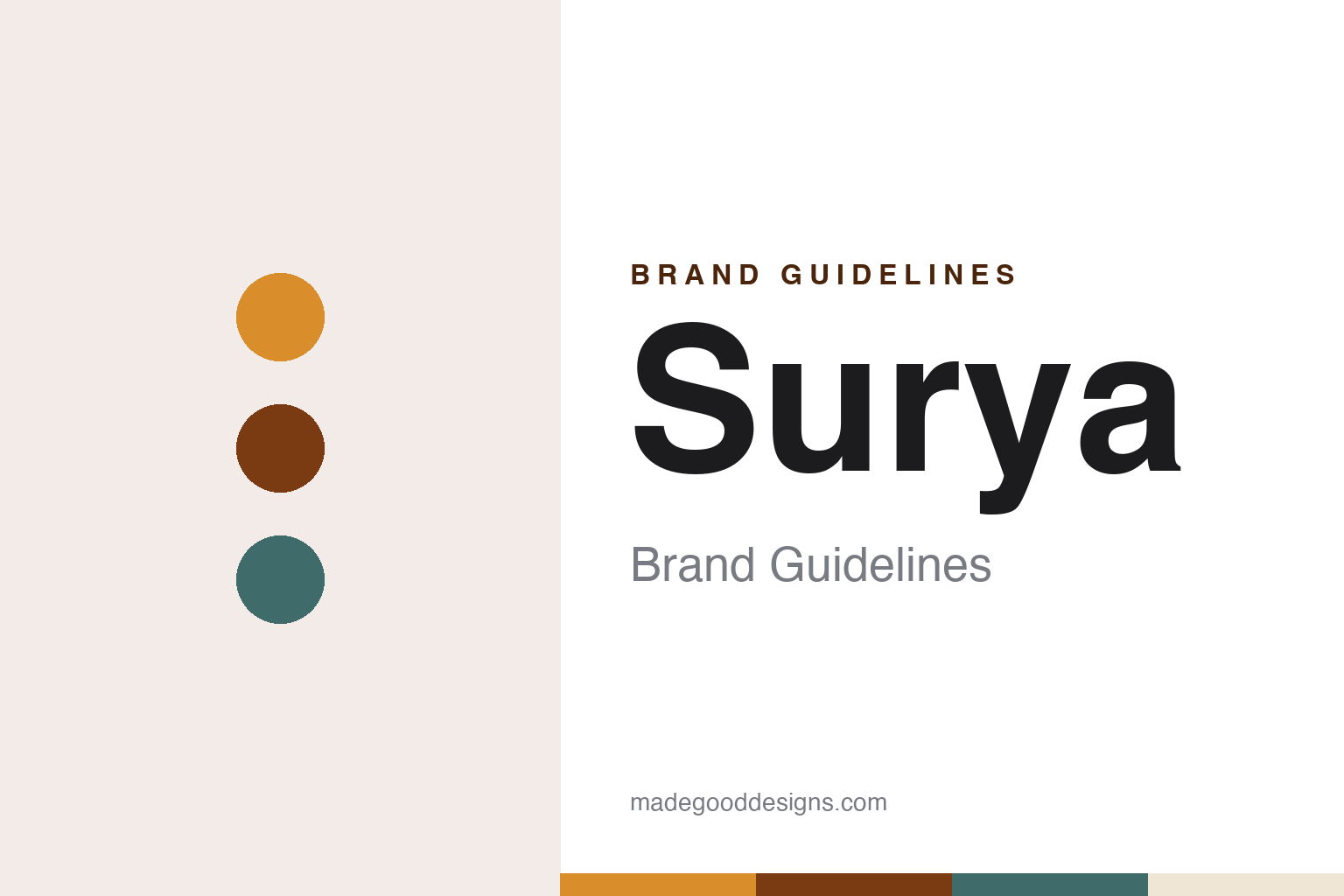
Surya Brand Guidelines
A chance meeting in North India, a US division and a rug name that outgrew rugs.
Aa
Two constants: a saffron, burnt sienna, teal and natural wool palette and a clean geometric sans register. Abstract homage — not a Surya product or mark; no rug, label or logo is reproduced.
A chance meeting and a small rug supplier
Hand-knotted rugs, a department-store buyer and a founder’s name.
Surya began in 1976 in North India. The company’s own account, on the About page of its website, says that a chance encounter there between a buyer from the Federated Group — now Macy’s — and Surya Tiwari led to the creation of Surya Rugs, which started out as a small supplier of hand-knotted rugs. The company shares its founder’s first name.
The company says that Surya Tiwari came to see how important it was to have more direct contact with customers. Its answer, in the company’s telling, was to establish a division in the United States in 1986. From then on the business worked on two sides of the trade: close to the weavers and suppliers on one side, and close to the American stores that bought from it on the other.
The next generation took charge in the 2000s. The company says that Surya Tiwari appointed his son, Satya Tiwari, as president in 2006. The trade publication Rug News gave a different date in a June 2008 interview, reporting that Satya Tiwari had been named president of Surya in May 2004. Both accounts agree that the founder’s son took the presidency and that the business changed shape under his leadership.
By 2008 the company was based in Georgia. Rug News carried its 2008 interview under a Calhoun, Georgia dateline, and reported that in March 2006 Surya had moved into a new distribution centre and executive offices in Calhoun, with a second facility opened next door in March 2008. Satya Tiwari told the magazine that the company strongly emphasised fresh inventory.
Colour
A new president, new categories and a shorter name.
The change in direction under Satya Tiwari is set out in detail in that 2008 Rug News interview. The magazine listed the projects he had launched since becoming president: expanding the line to include coordinated wall art, throws, pillows and other decorative accessories; hiring sales, marketing, merchandising and product-development staff; opening and expanding offices and distribution space in Calhoun; and adding new showrooms in New York and Las Vegas.
Licensing was part of the plan as well. Rug News reported new licensing programmes with B. Smith, Bob Mackie and Cabana Joe, bringing outside names onto Surya products. The company was also planning further categories, with lighting due to be added in the autumn of 2008 and tabletop items the following year.
Satya Tiwari described the selling idea behind the expansion in terms of colour. He told the magazine that rugs are an integral part of decorating, and that Surya emphasised merchandising its different products together according to colour palettes, an approach he said furniture stores understood immediately. The company was developing point-of-purchase material to show retailers how to display its products together, and had hired a visual merchandising specialist to work with staff, sales representatives and customers.
The most visible change to the identity followed from that plan. In the same June 2008 report, Rug News wrote that, preparing for a future in which rugs would be a smaller share of its business, the company was dropping “Rug” from its name, and would from then on be known simply as Surya.
The company’s current website reflects how far that went. In May 2026 its About page described an assortment of rugs, textiles, furniture, wall decor and lighting chosen for easy coordination, and the site listed Global Views and Mitchell Gold + Bob Williams alongside Surya as its brands. The company also says it works with artisans who make rugs and textiles by hand, and that it aims to preserve the traditions and techniques of that craft.
Typography
Design and documentation.
The brands in this group all make or sell rugs and carpets for the home. Rug and carpet brands in general sit at many different points in the trade, from family firms that still carry a founder’s name to labels that now belong to much larger flooring or furnishing groups, and a single name can cover hand-knotted, hand-tufted, flatwoven and machine-made pieces in wool, cotton, jute or synthetic fibre.
A rug brand’s identity is usually carried less by one design than by a name, a catalogue of patterns and the place or tradition those patterns point to, because the company behind the name may have changed hands, moved its weaving elsewhere or grown far beyond the mill or showroom where it started. That makes the questions behind each name worth asking plainly: who started it, who owns it now, and where and how its rugs are actually made.
Each guide separates what independent sources record from what the company says about itself — its founding story, its owners over time, where its rugs are woven and how its collections have changed — and marks plainly what rests only on the company’s own word.
Aa
A clean geometric sans suited to a broad, catalogue-led home range. (Specimen set in Jost, a sans STAND-IN; NOT the Surya logo.)
Surya
A single word that now covers a whole room.
Surya’s identity is built on a name with a clear origin. It is the first name of the founder, Surya Tiwari, who, in the company’s account, began supplying hand-knotted rugs from North India in 1976. For three decades the full name, Surya Rugs, described exactly what the company sold.
The 2008 decision reported by Rug News to drop “Rug” from the name was a statement of intent. It turned a product description into a single-word brand that could sit on wall art, pillows, throws and lighting as comfortably as on a rug. The new categories, the showrooms in New York and Las Vegas, and the licensing programmes with outside names all pointed in the same direction, toward a home furnishings company rather than a rug importer.
Colour is the thread that ties the range together in the company’s own explanation. Satya Tiwari’s description of merchandising products by colour palette, and the company’s current language about effortless coordination across rugs, textiles, furniture, wall decor and lighting, both present Surya as a source for a whole room. The family story remains part of how it introduces itself, with its About page tracing the business from the 1976 meeting in North India through the 1986 US division to the founder’s son as president.
For a design guide, Surya shows how a founder’s name can be freed from its first product and stretched across a much wider range, with colour coordination doing the work of holding it together. Compare another American rug company in our Loloi brand guidelines and a rug maker built on hand-knotted weaving in India in our Jaipur Rugs brand guidelines. For this guide we use saffron, burnt sienna, teal and natural wool with a sans, an unofficial interpretation; no product or logo is reproduced.
Explore & save
Keep Surya’s identity on hand — save it to a board in the Made Good inspiration library.
Surya identity set
Pin the Surya saffron, sienna, teal and wool palette and the clean geometric sans register to your own board.