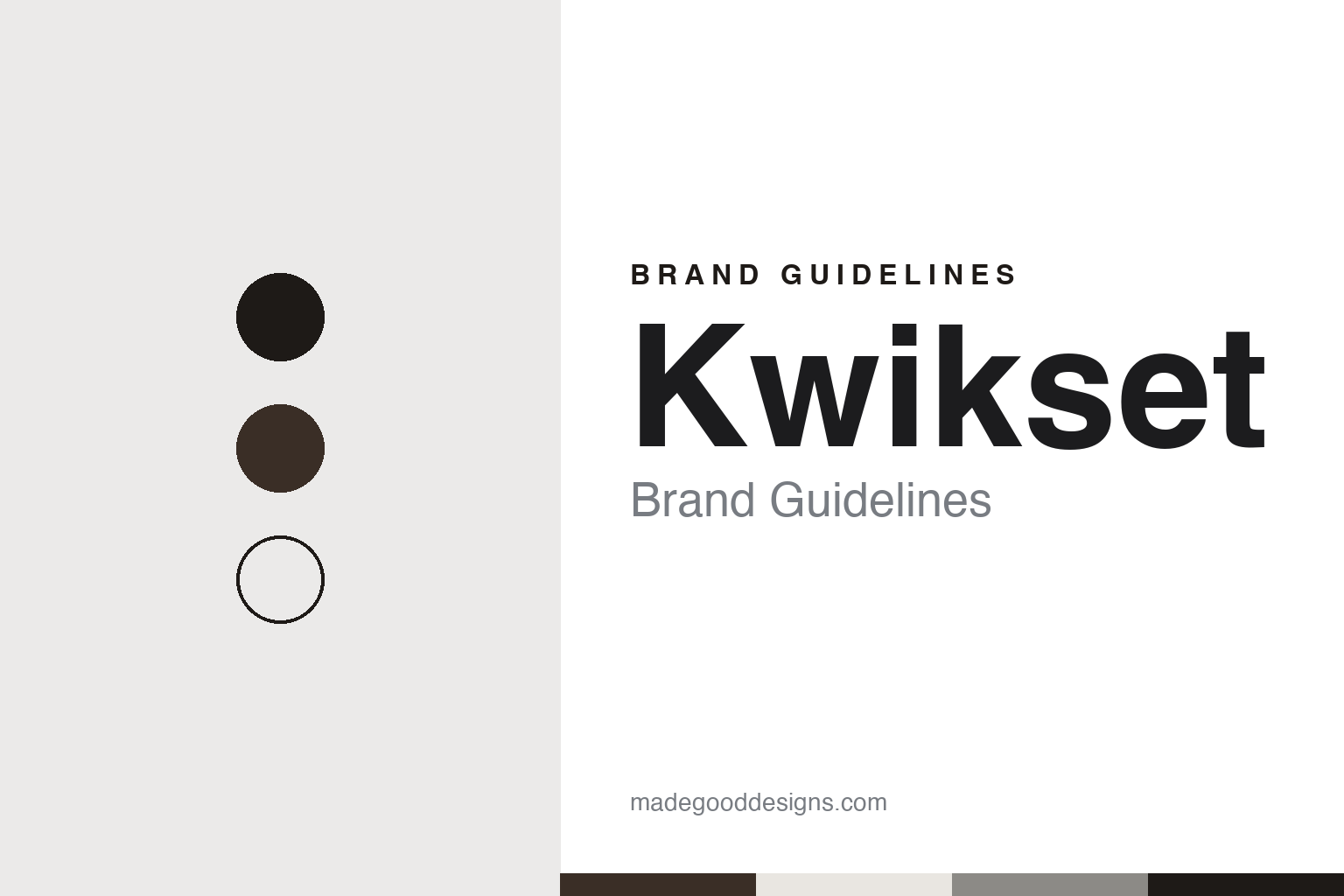
Kwikset Brand Guidelines
The tubular lock from Southern California.
Aa
Two constants: a bronze, pewter and nickel palette and a builder’s sans register. Abstract homage — not a Kwikset product or mark; no lock, key, logo or packaging is reproduced.
Gateway Manufacturing
Two partners and a lock that went in quickly.
Kwikset began in Southern California just after the Second World War. The company dates itself to 1946 and names its founders as Adolf Schoepe and Karl Reinhard; English Wikipedia spells the second partner’s name Karl Rhinehart, so the two spellings are given here side by side. According to Wikipedia, the business was first called Gateway Manufacturing Company and was set up in South Gate, in Los Angeles County, making locks under the Kwikset name.
The name came from that product. Kwikset says its first product was a tubular lock, and that it was called “Kwikset” to stress how quickly it could be installed.
In 1948 the company moved to Anaheim, Wikipedia says; Kwikset’s own timeline records a new factory that year, built to supply the post-war housing boom with a lockset that was fast and dependable to fit. Wikipedia says Rhinehart retired in 1952 and that Schoepe sold the business in 1957 to the American Hardware Corporation of New Britain, Connecticut, which Kwikset says ran it as a subsidiary while the parent concentrated on commercial and industrial locks.
The late 1950s and 1960s added more of the brand’s details. Kwikset says it introduced its “K” key design in 1958, along with a plastic coating for its brass and bronze finishes; in 1960 it began supplying free-standing point-of-purchase displays to hardware shops; and in 1964 it introduced “Kwik-See” clear packaging, so buyers could see the lock inside the pack. The same year, American Hardware merged with the Emhart Manufacturing Corporation.
Colour
Finishes, tiers and a re-keyable cylinder.
Kwikset’s design history is largely a history of finishes, collections and product tiers rather than of named designers. In 1992, according to both the company and Wikipedia, it launched the Titan line, which the company describes as higher-quality than the entry-level locksets it had made for residential construction. In 1998 Titan added a sub-brand, The Society Brass Collection, aimed at custom-home builders and remodellers; the company says Society Brass was relaunched in 2000 as a separate line with new packaging and a national print campaign built around three words: finish, design and craftsmanship.
In 2002, Kwikset says, it reorganised its range into three named tiers — Kwikset Security, Kwikset Maximum Security and Kwikset UltraMax Security — and Titan was renamed UltraMax. Wikipedia describes the higher line being renamed “Signature Series” around 2005, while the company’s timeline says popular Society Brass styles became the UltraMax Signatures line that year. The same period brought new finish names to the shelf: Venetian Bronze in 2004, followed in 2005 by Rustic Pewter and Iron Black, and “Architecturally Inspired Collections” coordinated with Price Pfister faucets and bath accessories.
The technology names came next. Kwikset says it launched SmartKey, a cylinder that the owner can re-key without taking the lock off the door, in 2007, together with the SmartScan fingerprint lock, and the SmartCode keypad deadbolt in 2008. In 2009 it says SmartKey was made standard across its keyed entry products sold in boxes. Wikipedia notes that after Kwikset and Weiser came under the same owner, Weiser locks adopted SmartKey and Kwikset keyways.
The current website groups its range under smart locks, keyed locks and door handles, and lists SmartKey Security, Kwikslide sliding thumbpieces and the Halifax lit door handle among its innovations. The company says its products are sold through retailers and distributors in the United States, Canada, Mexico and Australia.
Typography
Hardware and the home.
Door hardware and lock brands sit at an unusual point in a house: they are handled every day, yet most people could not name the company that made the knob in their own hand. A single name can cover a decorative lever, a deadbolt, a hinge and a cabinet pull, and it can be sold through builders, architects, showrooms and hardware stores as well as directly to homeowners.
A hardware brand’s identity is usually carried less by a logo than by the objects themselves — the shape of a backplate, the profile of a knob, the names given to finishes and collections — because the company behind the name may have changed hands, merged with sister brands or moved its production since it started. That makes the plain questions worth asking: who started it, who owns it now, and where its hardware is made and finished.
Each guide separates what independent sources record from what the company says about itself — its founding story, its owners over time, where its hardware is made and how its look has changed — and marks plainly what rests only on the company’s own word.
Aa
A plain, sturdy sans for a builder’s brand. (Specimen set in Archivo, a sans STAND-IN; NOT the Kwikset logo.)
Kwikset
From Emhart to Assa Abloy.
Kwikset has changed owners several times without changing its name. Black & Decker bought Emhart, and with it Kwikset, in 1989, according to both the company and Wikipedia. In 1999, the company says, Kwikset and Price Pfister were grouped into Black & Decker’s Hardware and Home Improvement Group, which built a new headquarters in Lake Forest, California, in 2001; in October 2003 Black & Decker added Baldwin and Weiser, bought from Masco.
When Stanley bought Black & Decker in March 2010, Kwikset became part of the Hardware and Home Improvement (HHI) group of Stanley Black & Decker, Wikipedia says. On 9 October 2012 The Wall Street Journal reported that Spectrum Brands had agreed to buy that division. Assa Abloy, the Swedish lock group, announced on 8 September 2021 that it would buy HHI from Spectrum, and completed the purchase on 20 June 2023, according to Wikipedia; Assa Abloy has owned Kwikset since then. Kwikset’s website describes it today as part of the HHI division of Assa Abloy, headquartered in Orange County, California.
Where the locks are made has moved over the decades. Wikipedia says Kwikset once had plants in Anaheim, in Bristow, Oklahoma, and in Waynesboro, Georgia, and that from 1996 these were closed as work was consolidated at Mexicali, Mexico; it lists current facilities in Denison, Texas, Charlotte, North Carolina, and Mexicali, with a further facility in China. Kwikset’s timeline says its Denison plant also made parts for Price Pfister faucets and Black & Decker tools. Assa Abloy’s English Wikipedia entry says the HHI division has manufacturing in the United States, Mexico, Taiwan, China and the Philippines.
For a design guide, Kwikset shows how a hardware brand can be built from a product name, a key shape and a set of finish names rather than a famous designer. Compare Baldwin Hardware, its sister brand under the same owner, and Schlage, another American lock brand. For this guide we use bronze brown, pewter grey and satin nickel with a sans, an unofficial interpretation; no product or logo is reproduced.
Explore & save
Keep Kwikset’s identity on hand — save it to a board in the Made Good inspiration library.
Kwikset identity set
Pin the Kwikset bronze, pewter and nickel palette and the builder’s sans register to your own board.