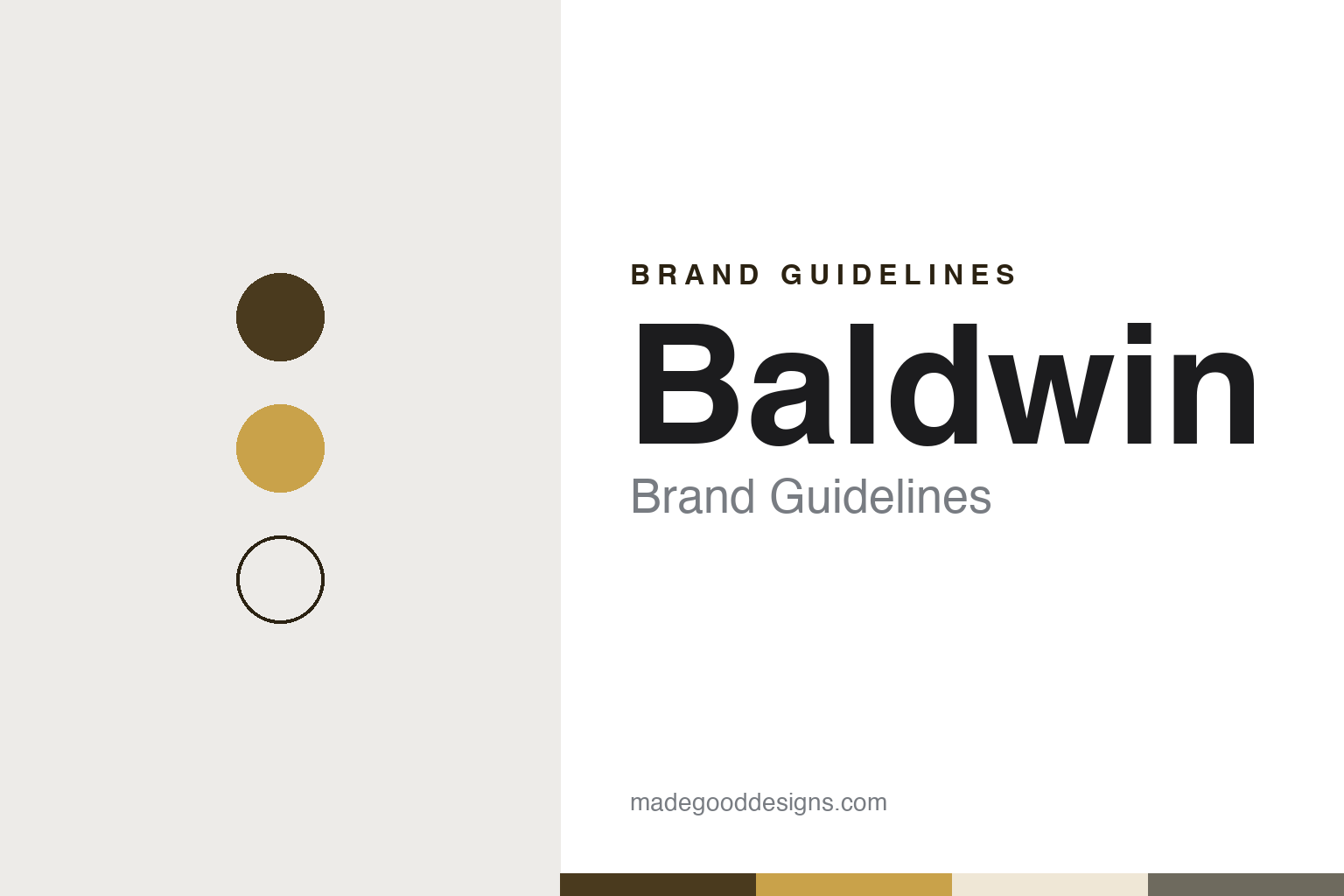
Baldwin Brand Guidelines
A Reading brass forge, a founder’s story and a run of corporate owners — with the polished knob at the centre throughout.
Aa
Two constants: a dark bronze, polished brass and parchment palette and a classical high-contrast serif register. Abstract homage — not a Baldwin product or mark; no knob, lever, package or logo is reproduced.
Brass from Reading
Severin Fayerman, 1946 and a forge in Pennsylvania.
Baldwin is an American maker of decorative door hardware — knobs, levers, roses, entry handlesets, locks and cabinet hardware — sold under the name Baldwin Hardware. The company tells its origin in two closely related sentences on its own website. Its “Our Story” page says Baldwin “began its legacy” with “the arrival to America in 1946 of Severin Fayerman and his family.” Its “Baldwin Past & Present” page puts it more directly: Severin Fayerman founded Baldwin Hardware in 1946. We give both as the company’s own account.
The same page places those beginnings in Reading, Pennsylvania, and Reading is the town most closely tied to the name. When Black & Decker announced in October 2003 that it had bought the business, the press release described Baldwin Hardware Corporation as “headquartered in Reading, Pa.”
The company’s account of what set it apart is about material and finish. Baldwin says Fayerman was committed to solid brass construction, “exacting engineering” and hand-finished surfaces, and that the hardware was “designed to be felt as much as seen.” That is the company’s language, and it frames the brand as a maker of objects for architects, designers and builders rather than for the hardware aisle.
Its “How It’s Made” page walks through the making of a door knob in five steps. A billet of brass is cut from bar stock; the heated billet is forged by being pounded into a die; a stamping press trims away the thin skirt of metal the forge leaves behind; an abrasive belt grinds off the oxidation; and polishing wheels finish the surface in two stages, the second using jeweler’s rouge. Baldwin contrasts heat forging with casting, which it calls the simpler technique, and says forging produces stronger, heavier pieces. The page says the hardware comes in more than twenty finishes, from glossy to matte and smooth to textured.
Colour
A knob, a finish and a portfolio name.
Baldwin’s identity is carried by the object itself. The company organises its range by style — contemporary, transitional, rustic and traditional — and by finish, so that a buyer chooses a shape first and a metal tone second.
Over the shape-and-finish grid sits a set of portfolio names. In October 2026 the website groups the range into the Estate series, the Reserve series and Estate Quick Ship. The names do the work a sub-brand would do elsewhere: Estate signals the forged-brass line the company describes on its “How It’s Made” page, while the Quick Ship name tells a builder that a selection can be delivered faster.
In running copy the company writes its name with a registered-trademark sign, as “Baldwin® Hardware.” Its product menus run from cabinet hardware and door locks and handlesets to knobs, levers and roses, pocket and multipoint hardware, and general hardware, and it runs a lock designer on its website and a trade ordering portal called Baldwin Express. The palette in this guide is our interpretation of the material the company photographs most: polished brass, darkened bronze and the cream of the paper and plaster behind them.
The register of the writing matches the photographs. Phrases on the history page such as “the most enduring design lives in the details” and “true luxury is never loud, but always exacting” are written for architects and interior designers, the audience the company says Fayerman aimed for from the start. Its “Our Story” page sums up the promise as “bold, handcrafted quality for the distinguished home.”
Typography
Design and documentation.
Door hardware and lock brands sit at an unusual point in a house: they are handled every day, yet most people could not name the company that made the knob in their own hand. A single name can cover a decorative lever, a deadbolt, a hinge and a cabinet pull, and it can be sold through builders, architects, showrooms and hardware stores as well as directly to homeowners.
A hardware brand’s identity is usually carried less by a logo than by the objects themselves — the shape of a backplate, the profile of a knob, the names given to finishes and collections — because the company behind the name may have changed hands, merged with sister brands or moved its production since it started. That makes the plain questions worth asking: who started it, who owns it now, and where its hardware is made and finished.
Each guide separates what independent sources record from what the company says about itself — its founding story, its owners over time, where its hardware is made and how its look has changed — and marks plainly what rests only on the company’s own word.
Aa
A classical high-contrast serif — the register of a brass-hardware catalogue. (Specimen set in Playfair Display, a serif STAND-IN; NOT the Baldwin logo.)
From Masco to ASSA ABLOY
A run of owners, and a plant that closed.
Baldwin has been part of larger groups for decades. On 1 October 2003 Masco Corporation and The Black & Decker Corporation announced that Black & Decker had finalised the purchase of Baldwin Hardware Corporation and Weiser Lock from Masco; the sale had closed on 30 September 2003. The deal put Baldwin inside a much larger tools and hardware group.
By 2012 that group was Stanley Black & Decker, and its hardware business changed hands next. Spectrum Brands said in a release dated 8 April 2013 that its purchase of Stanley Black & Decker’s Hardware & Home Improvement group had closed on 17 December 2012, and it listed Baldwin among the group’s brands with Kwikset, Weiser, National Hardware, Stanley, FANAL, Pfister and EZSET.
The Reading factory did not last through those years. In 2011 the city’s mayor, Thomas McMahon, told NPR’s All Things Considered that Baldwin Hardware had announced it would be leaving the city. The U.S. Environmental Protection Agency, in a release dated 9 November 2015, said the Reading plant had made door, bathroom and lighting hardware until manufacturing operations ceased in 2014, that Baldwin was by then headquartered in Lake Forest, California, and that the site was sold in the summer of 2015.
The latest owner is Swedish. ASSA ABLOY completed its acquisition of Spectrum Brands’ Hardware and Home Improvement division on 20 June 2023, as Security Journal Americas reported on 26 June 2023, and ASSA ABLOY has owned Baldwin since then; the Baldwin website’s footer carries an ASSA ABLOY copyright line.
For a design guide, Baldwin shows how a hardware brand can keep one material and one founding town at the centre of its story through a long run of corporate owners. Compare Kwikset, its stablemate in the same hardware group, and Schlage. For this guide we use dark bronze, polished brass and parchment with a serif, an unofficial interpretation; no product or logo is reproduced.
Explore & save
Keep Baldwin’s identity on hand — save it to a board in the Made Good inspiration library.
Baldwin identity set
Pin the Baldwin bronze, brass and parchment palette and the classical serif register to your own board.