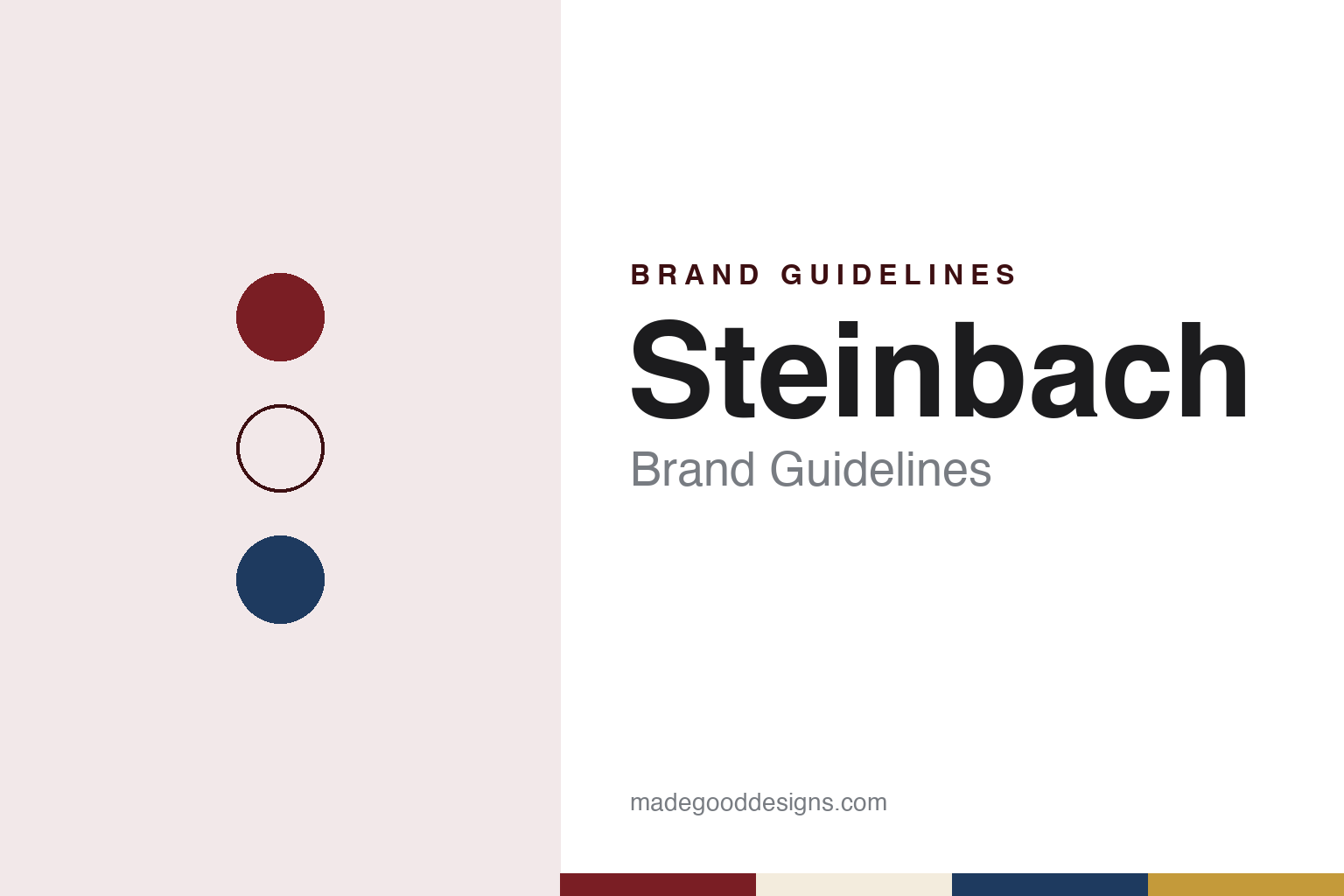
Steinbach Brand Guidelines
Hand-turned wooden nutcrackers, a family name and a long road back to the Erzgebirge.
Aa
Two constants: a red, cream, blue and brass palette and a transitional book serif register. Abstract homage — not a Steinbach product or mark; no nutcracker, label or logo is reproduced.
From the Erzgebirge to Hohenhameln
A family of figure-makers, a lost workshop and a fresh start near Hanover.
Steinbach is a family name in German wooden Christmas figures, known for its nutcrackers. Its roots are in the Erzgebirge, the Ore Mountains on the border of Saxony, where wood-turning and figure-making grew up as a folk craft. Deutsche Handwerks Zeitung, in a report by Ulrich Steudel published on 2 July 2026, says the Steinbach family worked in the Erzgebirge as “Männelmacher”, the regional term for makers of small wooden figures.
The Second World War broke that link. Deutsche Handwerks Zeitung says that after the war the family started again in Hohenhameln, near Hanover in Lower Saxony. German Wikipedia’s article on Hohenhameln says the long-established company Steinbach had its head office there, and that it produced wooden goods by hand for Christmas and other seasons, among them nutcrackers, incense smokers and music boxes. The same article says the wood came mainly from the nearby Hämeler Wald, because hardwood from broad-leaved trees was preferred.
The move west shaped the brand’s market as much as its address. Deutsche Handwerks Zeitung says Christian Steinbach, who led the company, made contacts with American soldiers in the 1950s, and it quotes the company’s current owner, Rico Paul, as saying that Christian Steinbach opened up the American market over decades. The report also quotes Paul as saying that high-quality handwork is very highly valued in America.
Steinbach’s pieces are collectables rather than kitchen tools: hand-turned, hand-painted wooden figures, many of them in the soldier-and-king tradition of the Erzgebirge nutcracker, and many others drawn from popular characters and themes. The company’s website in October 2026 grouped its range into nutcrackers, ornaments, incense smokers, incense cones and gift sets.
By the time of its crisis, Steinbach was still a family firm in Hohenhameln. Fortune, in a report by Michal Addady dated 12 October 2015, named Karla Steinbach as the member of the family then running the business.
Colour
An insolvency in 2015, a new owner and a return to the mountains.
In October 2015 the company filed for insolvency. German Wikipedia’s Hohenhameln article records the filing in that month, and Fortune, reporting on 12 October 2015 and citing the Associated Press, said Steinbach had officially filed for bankruptcy.
The brand survived under a new owner. Deutsche Handwerks Zeitung says Rico Paul, from Dresden, revived the company after the insolvency, persuaded the creditors to back his plan and kept the Erzgebirge site. The report describes the business today as Steinbach Volkskunst, with its administrative seat in Dresden, its production in Marienberg in the Erzgebirge and a showroom in Atlanta in the United States.
That puts the making of Steinbach figures back in the region the family came from. The company’s own website in October 2026 described Steinbach Volkskunst GmbH as a maker from Marienberg in the Erzgebirge and said that the whole production process, from creation and sampling to final manufacture, takes place in its works in Marienberg. The same site carried the labels “Original Erzgebirge” and “Handmade in Germany”, and the company says its nutcrackers are made by hand.
The American connection that Christian Steinbach began remains central. Deutsche Handwerks Zeitung says a Steinbach LLC was founded in Atlanta some years ago, and that since late 2025 the German company has supplied goods to the Atlanta business, which sells them on to customers in the United States; the report says the change was meant to ease problems with tariffs. It also says most of the company’s sales now go through its own online shop.
The result is a brand with two home towns in its history. Steinbach’s post-war decades belong to Hohenhameln, a municipality near Hanover, while its present production belongs to Marienberg, in the same mountains where the family’s figure-making began.
Typography
Design and documentation.
Makers of Christmas ornaments and decorations work in a trade shaped by the calendar. Most of what they sell is chosen in a short season, yet it is meant to last: a glass bauble, a turned wooden figure or a painted box may come out of storage every winter for decades, and a household often builds its collection slowly, one piece at a time.
That long life gives names in this field a particular weight. A maker’s mark, a printed box or a familiar shop sign can come to stand for a whole tradition of craft, from glassblowing at the lamp to woodturning and hand-painting, even when the business behind it is small, has passed between families or now sources its pieces in more than one place.
Each guide sets out what dated, independent sources record and what a company says about itself — where and when it began, who runs or owns it now, where its pieces are made, and how its labels, packaging and shopfronts present it — and marks plainly what rests only on the company’s own account.
Aa
A transitional book serif in the spirit of a collector’s label and a printed certificate. (Specimen set in Libre Baskerville, a serif STAND-IN; NOT the Steinbach logo.)
Steinbach
A family name, a craft region and a figure with a moving jaw.
Steinbach’s identity rests on its name, its region and its figure. The name is a family surname, carried from the Erzgebirge to Hohenhameln and through the 2015 insolvency into the present company, Steinbach Volkskunst. The company’s own website in October 2026 put the name front and centre and ran a Steinbach Club for collectors.
The region is the Erzgebirge. For decades after the war the company made its figures in Hohenhameln, in Lower Saxony, but the current owner’s decision to keep production in Marienberg, documented by Deutsche Handwerks Zeitung in July 2026, lets the brand use the regional labels “Original Erzgebirge” and “Handmade in Germany” on its website.
The figure is the nutcracker. The Erzgebirge nutcracker is a turned wooden figure, often a soldier, king or other uniformed character, whose lever-operated jaw cracks nuts, and it is the format at the centre of Steinbach’s range. The company’s range in October 2026 also included incense smokers and smaller figures and ornaments, the other staples of Erzgebirge Christmas craft, as well as gift sets and incense cones.
The American market runs through the brand’s history. Christian Steinbach’s contacts with American soldiers in the 1950s, described by Deutsche Handwerks Zeitung, are the reason the name is familiar to collectors in the United States, and the Atlanta showroom and Steinbach LLC described in the same report keep that link in place. For another view of how German-style Christmas figures reach American buyers, see the New York importer Kurt Adler.
For a design guide, Steinbach shows how a family name and a regional craft label can carry a brand through relocation, insolvency and a change of ownership; compare Christian Ulbricht and Käthe Wohlfahrt. For this guide we use uniform red, limewood cream, tunic blue and brass with a transitional serif, an unofficial interpretation; no product or logo is reproduced.
Explore & save
Keep Steinbach’s identity on hand — save it to a board in the Made Good inspiration library.
Steinbach identity set
Pin the Steinbach red, cream, blue and brass palette and the transitional serif register to your own board.