Wendt & Kühn Brand Guidelines
Green wings, eleven white dots and a half-timbered house in the Erzgebirge.
Aa
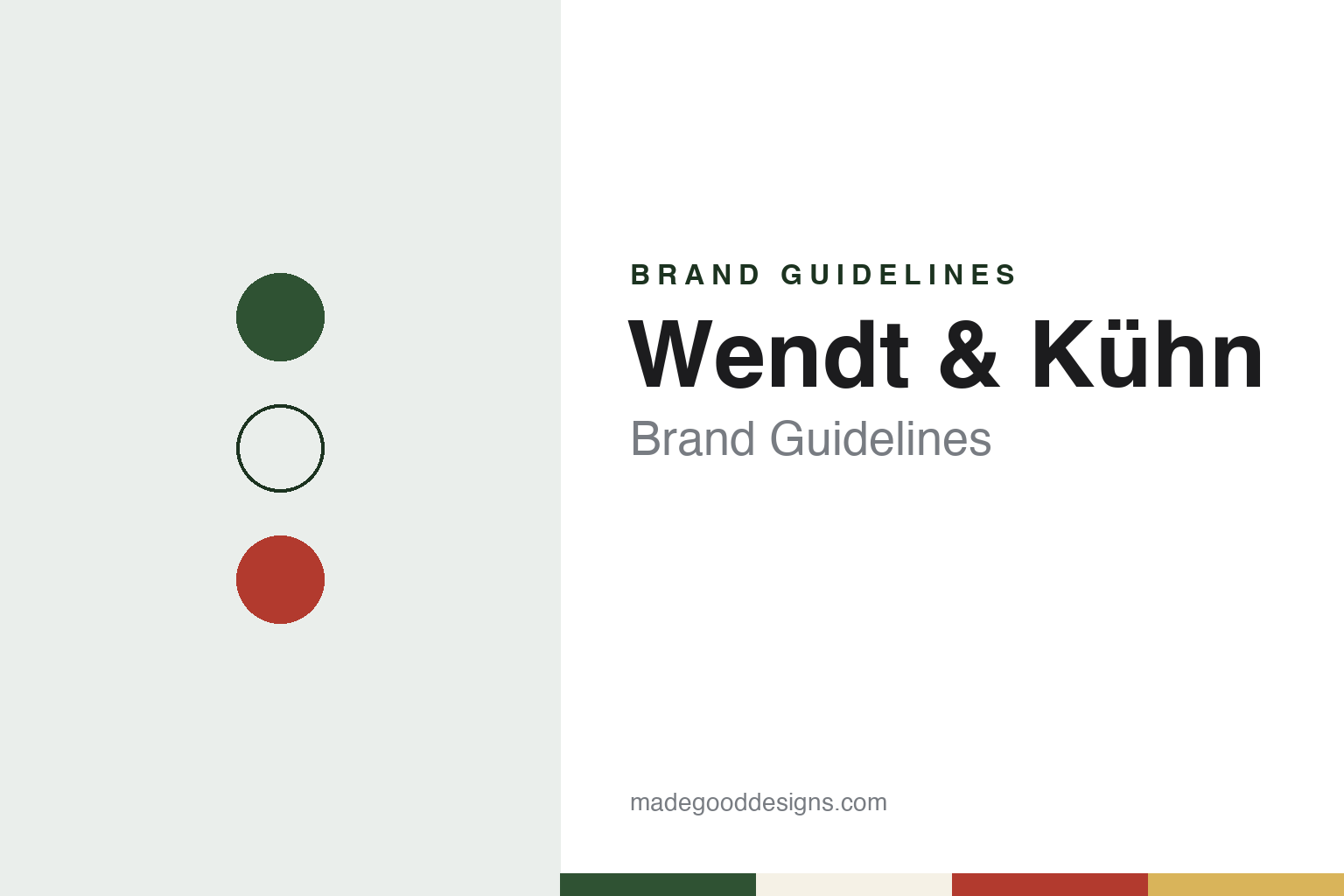
Two constants: a wing green, dot white and robe red palette and a soft old-style serif register. Abstract homage — not a Wendt & Kühn product or mark; no figure, label or logo is reproduced.
Two Margaretes in Grünhainichen
A Dresden-trained founder, a bought toy house and angels from 1923.
Wendt & Kühn was founded on 1 October 1915 in Grünhainichen, a village in the Erzgebirge in Saxony, by Margarete “Grete” Wendt and Margarete Kühn. German Wikipedia says that in the same year Grete Wendt, with her parents’ support, bought the toy and mail-order house Carl Weber, built around 1830, and turned it into a manufactory. In the spring of 1916 the young firm showed its work at the Leipzig fair, and Wikipedia says the pieces drew wide attention, including from the Deutscher Werkbund.
The partnership in the name did not last long. Wikipedia says Grete Wendt’s brother Johannes joined as co-owner in 1919 to look after the accounts, and that in 1920 Margarete Kühn left the firm after her marriage. The name Wendt & Kühn was kept because it was already well known. Also in 1920, Wikipedia says, the firm hired Olga “Olly” Sommer, a graduate of the Dresden school of applied arts, as a designer; she married Johannes Wendt in 1930.
Grete Wendt’s figures predate the firm. Wikipedia lists the Beerenkinder, a group of berry children, from 1913, and an angel she made in 1914 for her brother, sent to him at the front at Christmas, which Wikipedia says has shaped the look of the figures ever since. Her figures were assembled from several turned shapes, Wikipedia notes, which gave them more life than the board-armed figures common at the time. In the early years the firm also made painted chip boxes to designs by Margarete Kühn.
The defining design came in 1923. Wikipedia says Grete Wendt designed three angels as a Christmas gift, one with a torch, one with a violin and one with a flute, with green wings and eleven white dots. They have been in the firm’s catalogue since 1925 and are protected as a trademark under the name Grünhainichener Engel. Most of the figure and music-box designs, Wikipedia says, date from the 1920s and 1930s, among them Olly Sommer’s Margaritenengel, or daisy angels.
Colour
A half-expropriation, a nationalised works and a family return.
The firm’s twentieth century followed the politics of eastern Germany. German Wikipedia says that in 1946, following the referendum in Saxony, half of the firm was expropriated, and that Margarete Wendt was able to buy back the nationalised share on 4 June 1947. Hans Wendt joined in 1954 and took over the management in 1957, according to Wikipedia.
In 1972 the company was fully nationalised and renamed VEB Werk-Kunst Grünhainichen. Wikipedia notes a detail that matters for a design guide: the initials “W-K” survived the change, now standing for Werk-Kunst as well as for Wendt & Kühn. Hans Wendt continued to run the works as its director, while Grete Wendt left after the nationalisation. From 1981, Wikipedia says, VEB Werk-Kunst was part of the Kombinat Erzgebirgische Volkskunst, the state combine for Erzgebirge folk art.
The business returned to private hands on 1 July 1990, when, Wikipedia says, Hans Wendt restarted it as Wendt & Kühn KG in Grünhainichen. His son Tobias Wendt joined in October 1997 and led the company from 1 January 2002 to the end of 2010. Since then, according to Wikipedia, it has been run by Florian Wendt and Claudia Baer, née Wendt.
The company has stayed in the building Grete Wendt bought. Wikipedia says its headquarters is still the half-timbered house acquired shortly after the founding, and that the figures are made by hand in the firm’s workshops in Grünhainichen, following the original designs of Grete Wendt and Olly Wendt. For the firm’s centenary, Wikipedia says, the Museum für Sächsische Volkskunst in Dresden’s Jägerhof held an exhibition from 20 June 2015 to 10 January 2016, and the company opened a visitor space in the ground floor of the house on 3 October 2015, showing the craft from forest to display case.
The figures have also travelled as gifts of state. Wikipedia says that in 2016 Federal President Joachim Gauck presented an angel orchestra of Wendt & Kühn angels to Emperor Akihito, Empress Michiko and Crown Prince Naruhito during his state visit to Japan.
Typography
Design and documentation.
Makers of Christmas ornaments and decorations work in a trade shaped by the calendar. Most of what they sell is chosen in a short season, yet it is meant to last: a glass bauble, a turned wooden figure or a painted box may come out of storage every winter for decades, and a household often builds its collection slowly, one piece at a time.
That long life gives names in this field a particular weight. A maker’s mark, a printed box or a familiar shop sign can come to stand for a whole tradition of craft, from glassblowing at the lamp to woodturning and hand-painting, even when the business behind it is small, has passed between families or now sources its pieces in more than one place.
Each guide sets out what dated, independent sources record and what a company says about itself — where and when it began, who runs or owns it now, where its pieces are made, and how its labels, packaging and shopfronts present it — and marks plainly what rests only on the company’s own account.
Aa
A soft old-style serif in the spirit of a Dresden-trained, hand-painted house style. (Specimen set in Cormorant Garamond, a serif STAND-IN; NOT the Wendt & Kühn logo.)
Wendt & Kühn
Eleven dots that do the work of a logo.
Wendt & Kühn’s identity rests on a small, repeatable detail. The eleven white dots on the green wings of the 1923 angels are, in German Wikipedia’s words, the feature that above all makes up the Wendt & Kühn brand. Because the angels are protected as Grünhainichener Engel, the dots and green wings work much as a mark would: a buyer can recognise the maker from across a room without reading a label.
The name is the second constant. It kept Margarete Kühn’s surname after she left in 1920, and its initials outlived the firm’s own nationalisation, reappearing in 1972 as the “W-K” of VEB Werk-Kunst. When the company was reprivatised in 1990 it took back the full name of Wendt & Kühn.
The figures themselves form a consistent house style. They are built from turned wooden shapes, a choice Wikipedia credits to Grete Wendt, and painted in clear colours, with the angels usually shown as musicians. Wikipedia names other long-running families in the range, among them the Margaritenengel, the Blumenkinder and music boxes, and notes collector editions such as the annual Engel-Goldedition, issued since 2009, and Klangfarbe Weiß, since 2015. New pieces, Wikipedia says, are still made to the founders’ original designs.
Place completes the identity. The half-timbered house in Grünhainichen has been the firm’s home since 1915, and Wikipedia says a large music box with typical Wendt & Kühn figures decorates the village centre each Christmas.
For a design guide, Wendt & Kühn shows how a single painted detail, repeated on every angel, can carry a brand more surely than any wordmark. Compare the nutcracker family of Seiffen and Lauingen in our Christian Ulbricht brand guidelines and a Christmas retailer that sells Erzgebirge woodwork in our Käthe Wohlfahrt brand guidelines. For this guide we use wing green, dot white, robe red and candle gold with a serif, an unofficial interpretation; no product or logo is reproduced.
Explore & save
Keep Wendt & Kühn’s identity on hand — save it to a board in the Made Good inspiration library.
Wendt & Kühn identity set
Pin the Wendt & Kühn wing-green, dot-white and robe-red palette and the soft old-style serif register to your own board.