King’s College London Brand Guidelines
Two red lions, a crowned anchor and a lamp on a silver chief.
Aa
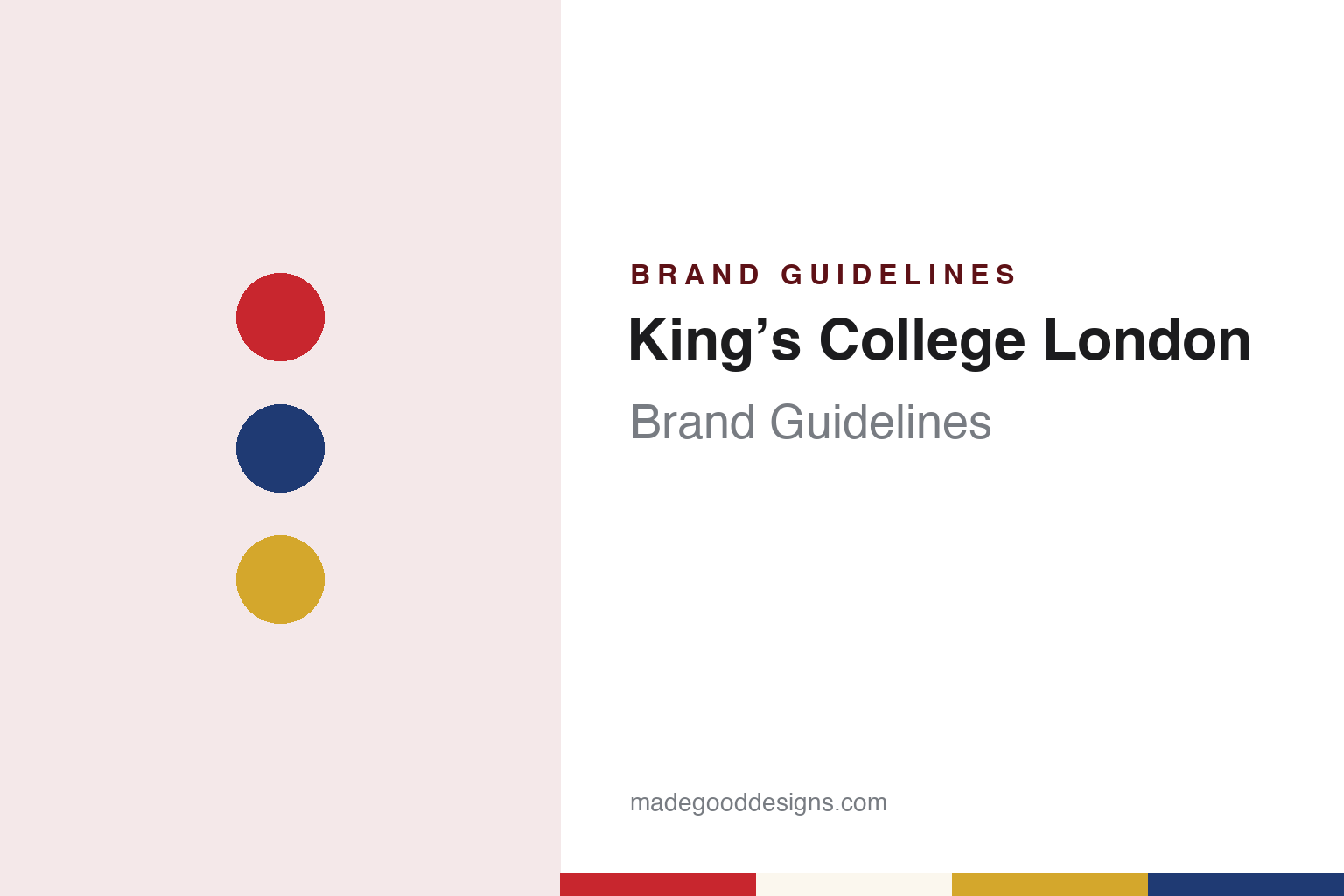
Two constants: a lion red, azure and gold palette drawn from the tinctures of the arms and a chartered serif register. Abstract homage — not a King’s College London mark; no arms, lion, logo or wordmark is reproduced.
A charter of 1829
Named for a king, backed by a duke.
King’s College London was established by royal charter in 1829 under the patronage of King George IV and the Duke of Wellington, English Wikipedia says, and it takes its name from the king’s patronage. Its founding was a response to the theological controversy around London University, the secular institution set up in Bloomsbury in 1826 that later became University College London. King’s was founded on Anglican lines, and Wikipedia notes that attendance at chapel was compulsory in its early years.
The founding year also brought a duel. Wellington, then Prime Minister, was backing an Anglican King’s College at the same time as he supported the Roman Catholic Relief Act, and the Earl of Winchilsea challenged his sincerity in print. When Winchilsea refused to retract, the two met in a duel in Battersea Fields on 21 March 1829; Winchilsea did not fire, and Wellington fired wide, Wikipedia records. In 1836 King’s became one of the two founding colleges of the University of London, alongside University College.
The college’s home gave it a setting as well as a name. The Strand Campus is built around the Grade I listed King’s Building, constructed for the college in 1831 to designs by Sir Robert Smirke, which stands beside Somerset House and shares its frontage along the Thames. The college chapel inside it was redesigned in 1864 by Sir George Gilbert Scott. Later growth added the east wing of Somerset House, and in 2015 King’s took a 50-year lease on the Aldwych Quarter site that includes Bush House, occupied since 2017.
The institution’s name has carried through several legal changes. In July 2006 the Privy Council granted King’s its own degree-awarding powers, which it began using for students starting in September 2007, Wikipedia says. After the University of London Act 2018 allowed member institutions to become universities in their own right, King’s applied for university status in 2019, and a supplemental charter granting it was sealed on 18 May 2023. Through all of this the name stayed King’s College London, informally shortened to King’s or KCL.
Colour
From the king’s own arms to a grant of its own.
The college’s earliest heraldry was borrowed. The coat of arms displayed on the 1829 charter is that of George IV, English Wikipedia says: the royal arms with an inescutcheon of the House of Hanover, with supporters that embody the college motto, Sancte et sapienter. No correspondence about the choice of these arms is believed to survive, either in the college archives or at the College of Arms, and over the years a variety of unofficial adaptations were used.
The arms in use today are much newer. They came into use in October 1989, following the 1985 mergers with Queen Elizabeth College and Chelsea College, and incorporate aspects of those colleges’ heraldry; royal assent for the use of a royal crown followed on 21 March 1995, Wikipedia records. In plain terms, the shield is gold with a vertical band of blue down the centre. On the band is a gold anchor topped by a royal crown, and on either side stands a red lion rampant, the two lions turned to face each other. Across the top runs a silver band carrying an ancient lamp, lit in gold, between two blazing hearths.
The crest above the helm continues the theme. Rising from a jewelled gold coronet set on a book is a red demi-lion holding a Rod of Aesculapius, the staff with a single serpent associated with medicine. The historic supporters, kept from the older arms, are a female figure dressed in blue and silver holding a gold cross, and a male figure in a long blue coat holding a book. The tinctures of the current shield, gold, blue, red and silver, are the source of the palette used in this guide.
The medical schools brought their own heraldry. St Thomas’s Hospital Medical School was granted its own coat of arms in 1949, yet continued to use the hospital’s arms, and Guy’s Medical School decided in 1954 to keep using Guy’s Hospital’s arms rather than apply for new ones. After the two schools, merged as UMDS since 1982, joined King’s in 1998, the shields of Guy’s and St Thomas’ hospitals continued to be used alongside the King’s shield in the medical schools’ publications and graduation materials, Wikipedia says.
Typography
Arms, lions, motto and type.
Many university marks borrow their imagery from the natural world. A leaf, a flower or a tree stands in for growth and continuity, and a cluster of stars can tie an institution to the sky above its home country. These motifs suit identity work because they reduce well: a single leaf or a handful of points can be drawn as a crisp outline that survives on a lanyard, a web favicon or an embroidered scarf, while the fuller heraldic version stays on degree certificates and ceremonial banners.
Latin mottos play a similar role in text form. A short phrase set in capitals beneath a shield signals continuity with older academic traditions, and designers often keep it on formal documents while dropping it from everyday digital layouts where space is tight.
Buildings and gateways also become symbols. A gate, a tower or a quadrangle that appears in photographs year after year can turn into a shorthand for the whole institution, sometimes appearing in merchandise, alumni publications and social media long before it enters any official logo. Colour completes the system: a named school colour gives teams, gowns and printed matter a shared thread even when the emblem itself changes.
Aa
A chartered serif — the register of a royal charter and a chapel plaque. (Specimen set in Libre Caslon Text, a serif STAND-IN; NOT the King’s College London logo or its typeface.)
King’s College London
A lion mascot and a name that stayed.
The lion on the shield has a living counterpart. Reggie the Lion is the official mascot of the King’s College London Students’ Union, and he arrived through the college’s rivalry with University College. In the early twentieth century that rivalry centred on mascots, Wikipedia says: UCL had Phineas, a wooden tobacconist’s figure of a kilted Highlander taken from a shop in Tottenham Court Road in 1900, while King’s had a giant beer bottle. In 1923 the bottle was replaced by Reggie, who made his debut at a King’s–UCL sporting rag in December 1923, guarded by engineering students armed with T-squares.
Reggie now exists in several forms. The original is on display in the undercroft of the union’s Bush House base on the Strand Campus, a papier-mâché version stands outside the Great Hall, another guards a common room in the Somerset House East Wing, and a small sterling silver Reggie is displayed at graduation ceremonies, Wikipedia records. The lion appears twice over, as the two red lions of the arms and as the union’s mascot.
The name itself was briefly in play. In December 2014 King’s announced plans to present itself as “King’s London” with a new minimalist logo while keeping its legal name, and after consultation forums with Principal Ed Byrne, reported by the student newspaper Roar News on 13 January 2015, the plans were dropped that month.
For a design guide, King’s College London shows how a college can move from borrowed royal arms to a grant built from its own mergers, with a lion that runs from the shield to the students’ union mascot; compare University College London, the secular rival whose founding prompted King’s, and the University of Oxford for another identity built on arms and a single dark blue. For this guide we use lion red, azure and gold with a serif, an unofficial interpretation; no product or logo is reproduced.
Explore & save
Keep King’s College London’s identity on hand — save it to a board in the Made Good inspiration library.
King’s College London identity set
Pin the lion red, azure and gold palette and the chartered serif register to your own board.