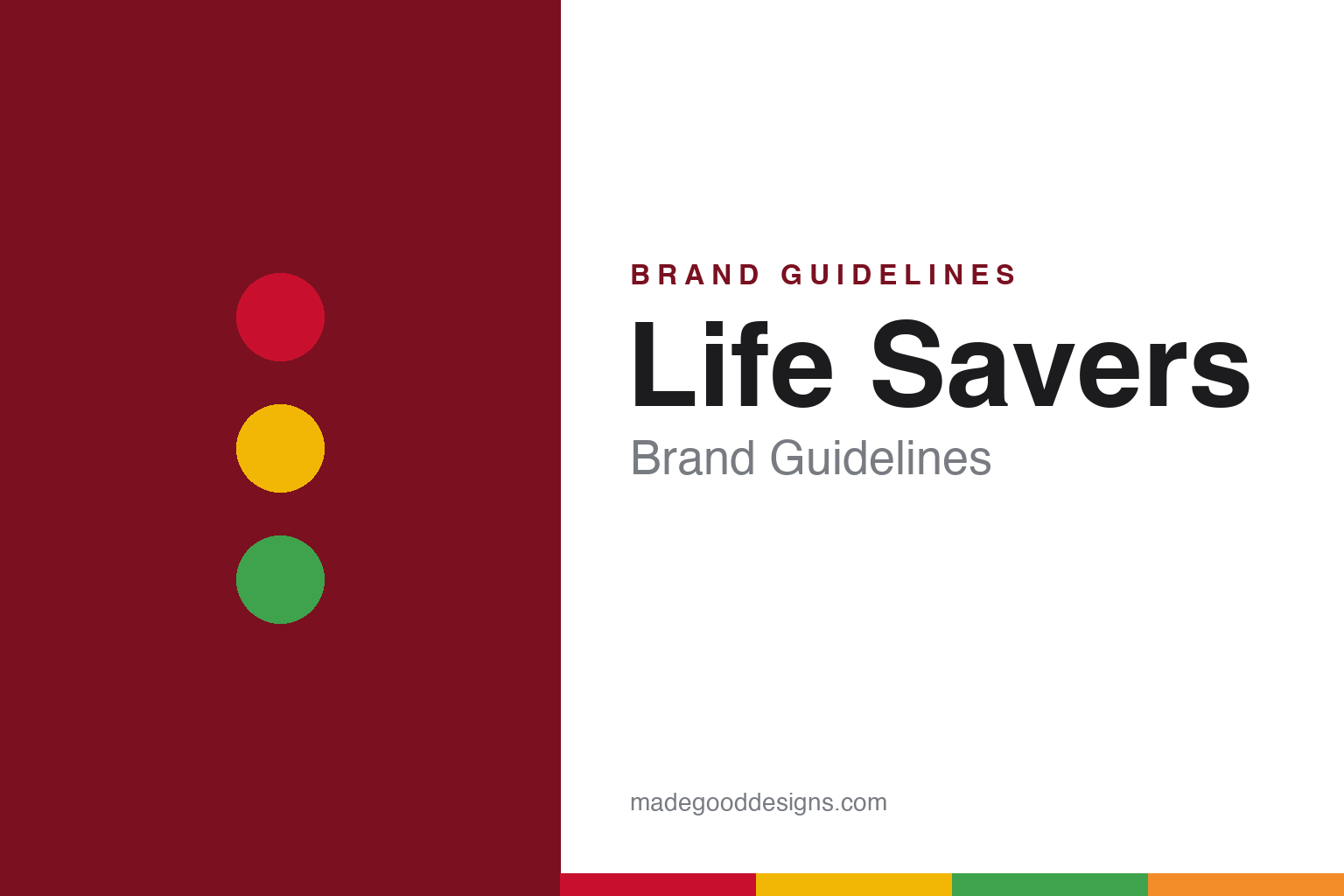
Life Savers Brand Guidelines
A summer mint with a hole in the middle, sold by the roll.
Aa
Two constants: a cherry, pineapple, lime and foil-silver palette and a rounded sans register. Abstract homage — not a Life Savers product or mark; no roll, wrapper or logo is reproduced.
A mint for the summer
From a pill press in Ohio to a foil roll by the till.
Life Savers began as a chocolate maker’s answer to hot weather. Ohio History Central, the Ohio Historical Society’s online encyclopedia, says Clarence A. Crane spent his youth in Garrettsville, Ohio, where his father produced maple sugar, and that he created the candy because his chocolates sold poorly in the summer months, when they melted in the heat. To make it, the encyclopedia says, he used a machine pharmacists used to make round, flat pills and punched a hole in the middle, so that the candy resembled a life preserver. He called it Life Savers. English Wikipedia dates the candy to 1912 and adds that mints of the time were usually square, because they were pressed in sheets and sliced. In a press release dated 11 April 2012, marking the centenary, the Wm. Wrigley Jr. Company said Crane made the original Pep-O-Mint flavour in the summer of 1912 as a candy that could withstand the heat.
The early packs were modest. Ohio History Central says Crane sold the peppermint candy as a breath mint, with the line “For That Stormy Breath” on the packaging, and that he packed it in cardboard tubes whose wrapper showed a sailor tossing a young woman a life preserver. In 1913, the encyclopedia says, Crane sold the rights to two New York candy makers, who wrapped the mints in foil tubes to keep them fresh. Wikipedia names them as Edward John Noble of Gouverneur, New York, and his partner J. Roy Allen, who began selling Pep-O-Mint Life Savers under their own company. Ohio History Central says Crane formed the Crane Chocolate Company in 1916, headquartered in Cleveland, and no longer made Life Savers after 1913.
Wikipedia says the foil wrapping was done by hand until 1919, when machinery was developed by Noble’s brother Robert Peckham Noble, a Purdue-trained engineer who designed the company’s plants and led it for decades. Tinfoil gave way to aluminium foil in 1925. Noble put the rolls next to the cash registers of saloons, cigar stores, drug stores, barber shops and restaurants; Ohio History Central says saloon owners were a target because customers wanted to freshen their breath after drinking and smoking.
Colour
Beech-Nut, Squibb, Nabisco, Kraft, Wrigley, Mars.
The flavours came in a run of hyphenated names. Wikipedia lists Wint-O-Green, Cl-O-Ve, Lic-O-Rice, Cinn-O-Mon, Vi-O-Let and Choc-O-Late as mints developed by 1919, and a research post by the U.S. National Archives at Chicago, published on 19 October 2012, dates Wint O Green to 1918. Wikipedia says the company began making solid fruit drops in 1921 and, from 1925, fruit drops with a hole, sold as the “fruit drop with the hole” in orange, lemon and lime, each in its own roll and, unlike the opaque white mints, clear in appearance. The Five Flavor roll, with pineapple, lime, orange, cherry and lemon in one pack, followed in 1935, according to both Wikipedia and the National Archives post; Wikipedia says the line-up was changed in the United States in 2003 and that the original mix is still sold in Canada. In 1947, the National Archives post says, the Life Savers Corporation sued the Curtiss Candy Company in Chicago for trademark infringement over a fruit-drop wrapper, citing its “distinctive package design and color scheme”.
Ownership then moved through a series of larger companies. Wikipedia’s timeline says Life Savers merged with Beech-Nut in 1956, that Beech-Nut Life Savers merged with Squibb in 1968, and that Nabisco Brands acquired Life Savers from E.R. Squibb in 1981. Kraft acquired Nabisco in 2000. In Canada the business took its own path: the timeline lists Hershey Canada in 1987, Beta Brands in 1996 and Kraft again in 2001. Wrigley acquired the US Life Savers business in 2004, and Mars acquired Wrigley in 2008; Mars has owned Life Savers through Wrigley since 2008. Elsewhere the rights are split. Australian Food News reported on 18 July 2018 that Darrell Lea was buying the Life Savers brand in Australia and New Zealand from Nestlé and would move manufacturing from New Zealand to its Sydney factory.
Where the candy is made has changed several times. Wikipedia says the company made Life Savers in Port Chester, New York, from 1920 until 1984, in a building with a Life Savers motif cast into its cornice, later converted to apartments and added to the National Register of Historic Places in 1985. Production then sat in Holland, Michigan. The Los Angeles Times reported on 20 March 2002 that Kraft was closing the Holland plant and moving production to Canada, where sugar was cheaper; Wikipedia names the new location as Montreal. In its 2012 release, Wrigley said Life Savers mints were produced at its factory in Chattanooga, Tennessee.
Typography
Design and documentation.
The candies in this group are American sweets whose identity lives on the outside of the pack. A candy brand’s look is carried by small, cheap and much-handled things: a twist wrapper in a single strong colour, a paper roll of identical pieces, a narrow cardboard box sized for a cinema counter, or a bar wrapper read in a second at a checkout.
Wrapper colour often signals a flavour before any words are read, and a roll pack or theatre box can become as recognisable as the name printed on it. Some wrappers carry more than a name, with jokes, riddles or slogans printed where a label would usually sit, so the packaging becomes part of the product.
Many American candy names have also outlived the companies that created them, passing between owners over the decades while keeping their names and packs. Each guide separates what independent sources record from what the company says about itself — who started the candy, who owns it now, where it is made and how its packaging has changed — and marks plainly what rests only on the company’s own word.
Aa
A rounded sans — the soft, friendly register of a candy roll. (Specimen set in Fredoka, a rounded sans STAND-IN; NOT the Life Savers logo.)
A part of living
A ring, a roll and a jingle.
The shape is the name. Wikipedia and Ohio History Central both tie “Life Savers” to the candy’s resemblance to a ring-style life preserver, and Wikipedia notes that the brand is styled in capitals as LIFE SAVERS. The pack carried the idea from the start: Crane’s cardboard tube showed a sailor throwing a life preserver, and Noble’s foil roll turned the candy into a stack of rings sealed in paper and metal. Wikipedia describes the range of mints and fruit candies as known for its paper-wrapped aluminium-foil rolls. The National Archives post, describing the 1947 case, notes that Life Savers had registered a candy-wrapper design as a trademark and quotes the court’s comparison of the two rivals’ rolls, including the way “Life Savers Five Flavors” was printed across the whole roll so it would be visible in any position.
The brand also travelled. Wikipedia says that during the Second World War other candy makers donated their sugar rations to keep Life Savers in production so the candies could be shared with the armed forces, a story Wrigley repeated in its 2012 centenary release. Wikipedia adds that the British firm Rowntree’s, which had earlier made Life Savers under licence, began making a similar ring-shaped mint called Polo in 1947, after that licence was withdrawn.
In advertising, one line attached to the brand is “Life Savers, a Part of Living”. Wikipedia says the jingle was composed by Larry Hambro with lyrics by John “Jack” Keil, creative director at the Dancer Fitzgerald Sample agency, with vocals by Billie Hughes and production by Phil Ramone; the television campaign built around it showed everyday moments that ended with a Life Saver shared between people. Wrigley picked up the same theme of sharing in 2012, when its centenary campaign, Connect for a Cause, asked people to enter codes from specially marked anniversary packs. The range has kept growing around the ring: Wikipedia dates Gummi Savers to 1992, Life Saver Minis to 1996, Creme Savers to 1998 and Fusions to 2001, and says Wrigley brought back early mint flavours such as Wint-O-Green.
For a design guide, Life Savers shows how a single shape can serve as product, name and packaging idea at once, and how a coloured stack in a foil roll became the thing a rival had to be kept from copying. Compare it with Polo, the British mint with a hole, and Altoids, another mint sold in a pocket pack. For this guide we use cherry red, pineapple and lime on foil silver with a rounded sans, an unofficial interpretation; no product or logo is reproduced.
Explore & save
Keep Life Savers’s identity on hand — save it to a board in the Made Good inspiration library.
Life Savers identity set
Pin the Life Savers cherry, pineapple, lime and foil-silver palette and the rounded sans register to your own board.