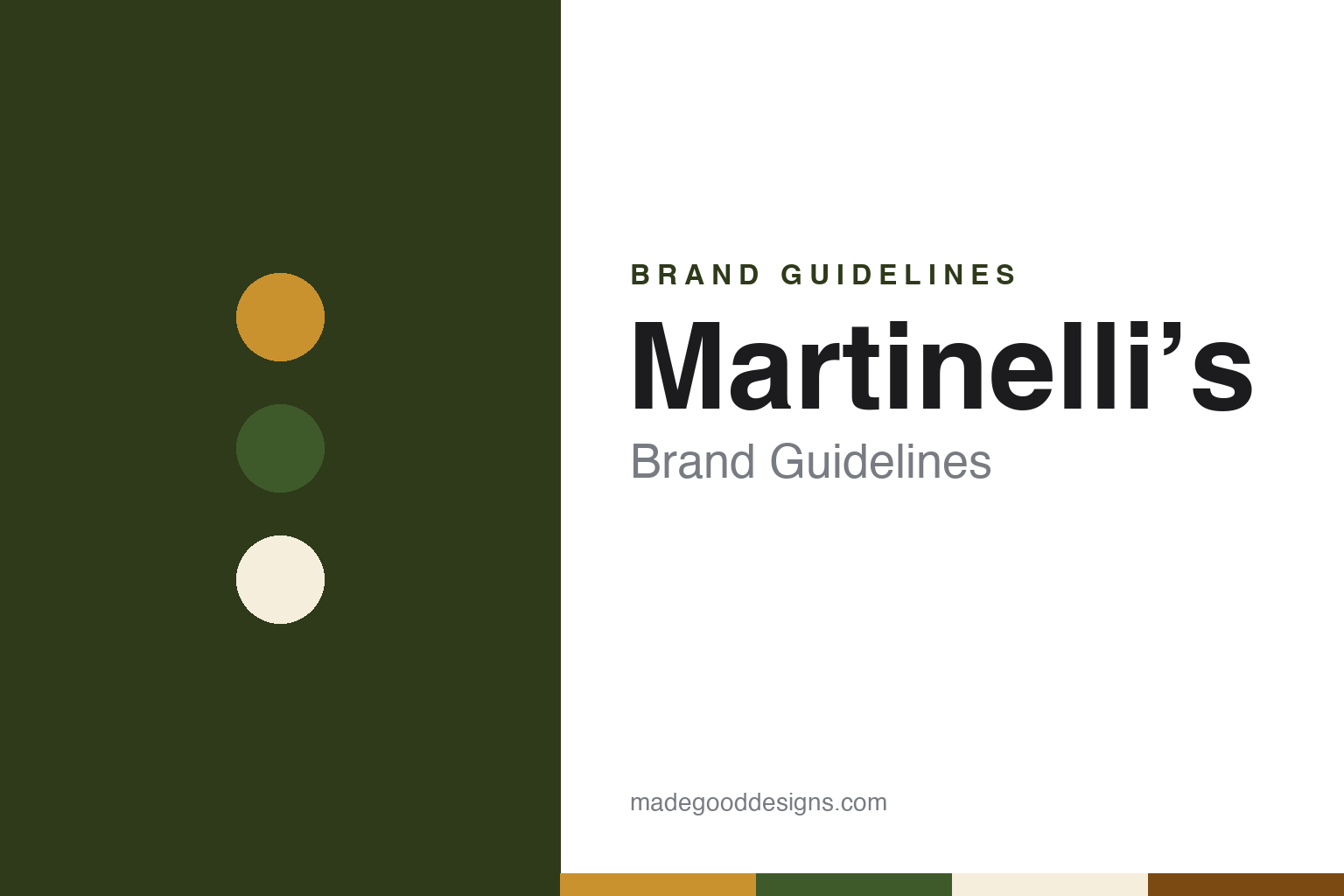
Martinelli’s Brand Guidelines
A Swiss family, a Watsonville orchard and juice in a glass apple.
Aa
Two constants: an apple gold, bottle green and label cream palette and a heritage serif register. Abstract homage — not a Martinelli’s product or mark; no bottle, label or logo is reproduced.
Two brothers in the Pajaro Valley
A Swiss immigrant, an apple orchard, a soda works and a fermented cider.
Martinelli’s is the brand name of S. Martinelli & Company, a maker of non-alcoholic sparkling cider and apple juice based in Watsonville, California, in the Pajaro Valley near Monterey Bay. The company dates its founding to 1868, and SFGATE gave the same year in September 2018. The founder was a Swiss immigrant whom the company calls Stephen G. Martinelli; SFGATE has spelled his given name Stefano (2018) and Stephano (2021).
The company’s own history, posted on its website in March 2019, says two brothers from Switzerland, Louis and Stephen Martinelli, settled in the Pajaro Valley in the 1850s. Louis, the company says, came to California with the Gold Rush, found no gold and planted an apple orchard in Watsonville; his younger brother Stephen followed. SFGATE reported in November 2021 that Stephano emigrated in the late 1850s, moved onto the farm of his brother, whom the paper named Luigi, and earned a living in the soda business before turning to apples.
The cider at the start was alcoholic. The company says Stephen drew on what he had learned making Champagne in France in his youth to make a bottled, fermented apple cider for the people of Watsonville, which established S. Martinelli & Co. It also sold soda: a company post from March 2018 says the sign on its building read “S. Martinelli’s Soda & Cider Works”, and that the range included soda water, ginger ale and sarsaparilla. The company dates a photograph of that building to about 1885, and SFGATE’s 2021 report said the Watsonville plant was built in the mid-1880s.
Prohibition changed the product. According to the company, cities in California began outlawing alcohol around 1917, and Stephen G. Martinelli Jr., the founder’s son, developed a pasteurised, non-alcoholic version of the family cider; apple juice and sparkling juice without alcohol went on sale around that year. SFGATE wrote in 2021 that the founder’s eldest son, Stephen, learned how to pasteurise unfermented apple juice with the help of a food-technology professor at the University of California, Berkeley. The hard cider came back in 1933, after repeal.
Colour
Four generations of one family, a sold soda line and a revived hard cider.
Martinelli’s has stayed with the family. English Wikipedia describes S. Martinelli & Company as privately held by descendants of the founders. The company says Stephen C. Martinelli, the third generation, joined the business in 1955 and became president in 1964, and that he invested in rebuilding the company’s East Beach plant in Watsonville during the 1960s. It says the family sold its soda business in 1957 to concentrate on sparkling cider and apple juice.
The fourth generation followed. SFGATE described John Martinelli in November 2021 as chairman of the board of S. Martinelli & Company and as the fourth-generation family operator. The company credits him with broadening the range in the late 1980s, beginning with an apple-cranberry blend and moving on to sparkling apple blends such as apple-mango, apple-peach and apple-pear. In a 2018 press release quoted by SFGATE, Gun Ruder was named as president of S. Martinelli & Company.
The plant is in Watsonville. SFGATE reported in 2021 that the company upgraded its Watsonville plant in 2018 and 2019, a period in which, John Martinelli said, a new computer system put the organisation under great strain and the company pulled back on marketing and advertising. The company says its juice is pressed from apples grown in the United States, and it has written about its ties to local Pajaro Valley growers of varieties such as the Newtown Pippin.
Alcohol has come and gone. SFGATE reported in 2018 that the hard cider was pulled from production in 1978 because of low sales; its 2021 report gave the year as 1977. For the company’s 150th anniversary in 2018 it revived the drink as 1868 Hard Cider. SFGATE said Dan Gordon of the San Jose brewery Gordon Biersch partnered with John Martinelli and that the brewery produced and bottled the cider for Martinelli’s; in 2021 John Martinelli told the paper that the company makes the juice and the brewery ferments and bottles it.
Typography
Design and documentation.
Juice brands in general reach the shelf in a handful of familiar containers: glass bottles, plastic bottles, paperboard cartons, cans and small pouches or boxes made for a lunchbox. Each container shapes what a brand can do with its identity. A bottle can carry a moulded shape, an embossed name or a neck label; a carton offers flat panels that work almost like a printed poster; a can wraps its graphics around a cylinder that is usually seen from one side at a time.
Because the liquid inside often looks much alike from one brand to the next, the label tends to do the work of telling them apart: the name, the colours, a drawing of fruit or vegetables, and sometimes a story about the family, the farm or the town where the business began. Some juice names stay with the family that started them, while others change hands more than once over the decades.
Each guide sets out what independent sources record about the brand — who founded it, who owns it now, where its juice is made and how its labels and containers have changed — and marks plainly what rests only on the company’s own word.
Aa
A high-contrast heritage serif — the register of a nineteenth-century cider label. (Specimen set in Playfair Display, a serif STAND-IN; NOT the Martinelli’s logo.)
A glass apple and a champagne shape
Hand-painted labels, a 1933 bottle, the “Old Timer” and a plastic apple on TikTok.
Bottles carry much of the identity. In an August 2020 post the company says its sparkling cider began in a champagne-style bottle, and that early bottles had colourful hand-painted labels and travelled in wooden crates. In 1933, it says, it patented the design of an apple-shaped bottle for its juice, known as the “Golden Apple”, and paired it with the slogan “Drink Your Apple A Day”. The company describes the bottle as a rounded apple shape with embossed leaves, and says the shape and the slogan both remain part of the brand. SFGATE reported in 2021 that the founder’s son Stephen introduced half-gallon and gallon glass vessels shaped like an apple.
The present sparkling cider in a 750 mL champagne-style bottle dates from the 1960s, according to the company, which recalls the line “Bubbly enough for a celebration… delightfully non-alcoholic”. It now sells sparkling apple-cranberry, apple-grape and blush blends in champagne-style bottles too, some in single-serve sizes.
A family member drew one of its labels. The company says Stephen C. Martinelli was an artist who helped design labels over the years, and that in the 1960s he created a hard-cider label with an illustration known as the “Old Timer”, a nod to the Gold Rush. SFGATE reported in 2018 that John Martinelli’s father, a graphic designer, made that image in the 1960s for large-format hard-cider bottles, and that it returned on the 1868 Hard Cider label.
A plastic version brought the bottle new attention. The company says it introduced a recyclable PET apple-shaped bottle for schools, sports events, swimming pools and other places on the go, while it says glass bottles remain its main packaging. SFGATE wrote in November 2021 that the plastic bottle had been on sale for about 15 years when, in 2020, people on TikTok began filming themselves biting into it to hear whether it crunched like an apple. John Martinelli told the paper the bottle has two layers of plastic with an oxygen barrier between them, and that when it is dented the middle layer delaminates and squeaks. The company says it does not encourage people to chew plastic.
For a design guide, Martinelli’s shows how two container shapes, a glass apple and a champagne-style bottle, can carry a family name while the label art around them changes. Compare it with Welch’s, another American juice name with roots in non-alcoholic drinking, and Ocean Spray, another juice brand that drew attention on TikTok. For this guide we use apple gold, bottle green, crate brown and label cream with a serif, an unofficial interpretation; no product or logo is reproduced.
Explore & save
Keep Martinelli’s’s identity on hand — save it to a board in the Made Good inspiration library.
Martinelli’s identity set
Pin the Martinelli’s apple gold, bottle green and label cream palette and the heritage serif register to your own board.

