Herr’s Brand Guidelines
A Lancaster chip firm, a Nottingham plant and a family that kept it.
Aa
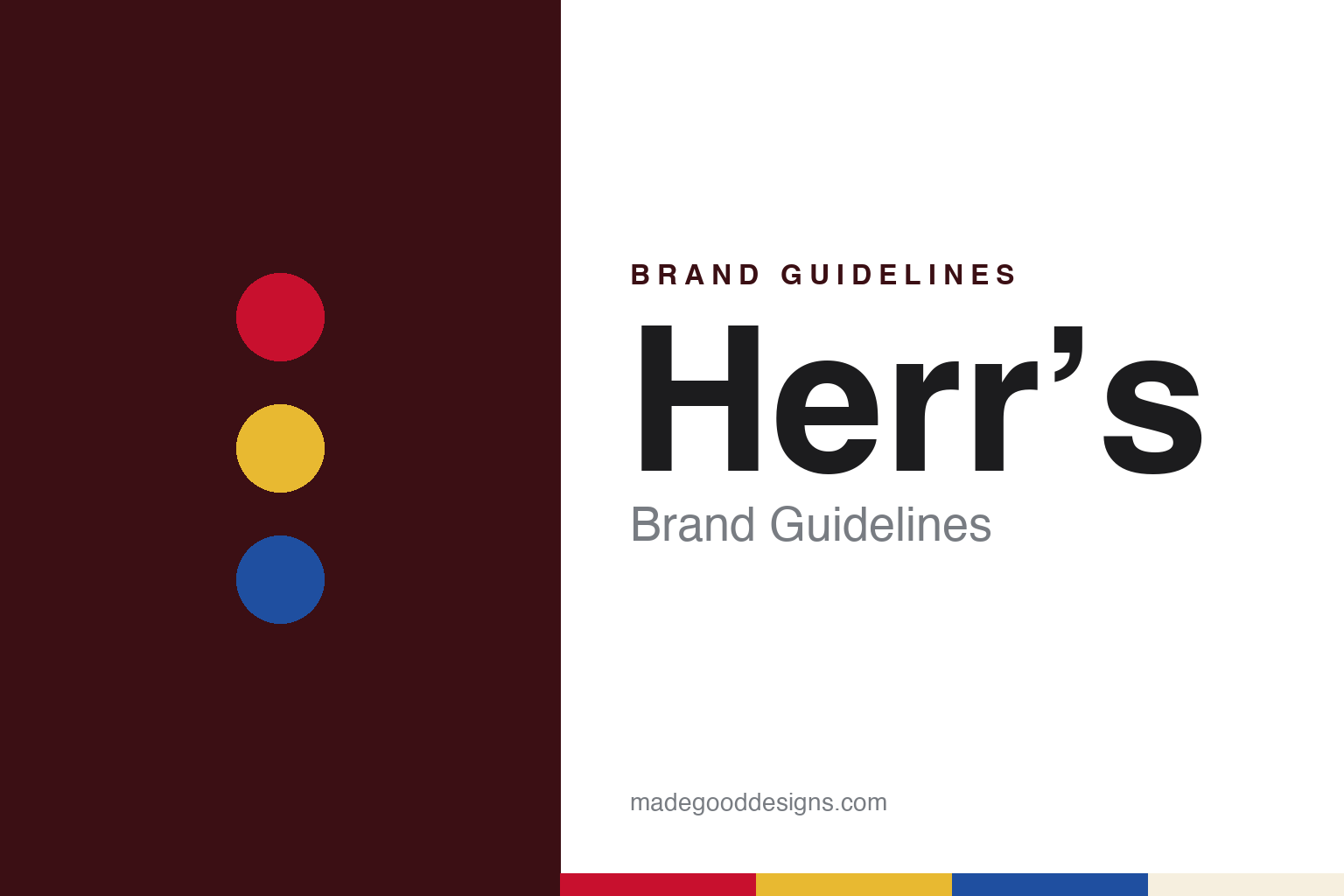
Two constants: a foil red, chip gold and bag blue palette and a rounded display sans register. Abstract homage — not a Herr’s product or mark; no bag, barrel or logo is reproduced.
A chip firm in Lancaster County
A farm boy, a fiancée, a door-to-door round and a fire.
Herr’s is an American brand of potato chips and other salty snacks made by Herr Foods Inc., a family-owned company based in Nottingham, Pennsylvania, in southern Chester County. Food Business News described it in September 2025 as a family-owned snack manufacturer, founded in 1946, that offers chips, cheese curls, pretzels, popcorn and tortilla chips among other snacks.
The founder was James S. Herr, known as Jim. The Philadelphia Inquirer, in an article by Maria Panaritis published on 7 April 2012, said he had spent his teenage years tending laying hens on his family’s farm, and that in 1946 he and Miriam Hershey, then his fiancée, agreed to buy a small potato-chip company in Lancaster County as partners. Their son Ed Herr told the paper it was a one-man operation: his father made the chips by day, then picked up Miriam, and the two sold chips door to door on their dates. Main Line Media News, reporting on 6 April 2012, said Jim Herr was born in Lancaster, married Miriam Hershey in 1947 and moved with her to Nottingham in 1951, where they raised five children.
The company’s own history, as published on its website in 2012 and again in 2026, fills in the early years. Herr Foods says Jim Herr bought the business in Lancaster in 1946 and moved it in 1947 into a vacated tobacco shed on the Herr family farm. In the spring of 1949, the company says, he rented a bakery building in West Willow, Pennsylvania, which with an adjacent house became both workplace and home for the couple.
Then came a setback. On 5 September 1951, according to the company, a fire broke out late in the afternoon when cooking oil dropped onto a hot fire brick, and the chip factory was destroyed. With help from family, friends and the bank, the Herrs then bought land in Nottingham and built a new plant there in 1952, which Herr Foods says it fitted with an automated cooker. The company says it began seasoning its chips in 1958, starting with barbecue, a flavour it says it still makes.
Local television retold the story. CBS3 in Philadelphia, in a segment by Susan Barnett dated 2 November 2006, retold how Jim Herr made chips during the day and sold them door to door at night, and followed visitors through the Nottingham factory, where pretzel rods, cheese curls, corn chips and tortilla chips were made alongside the potato chips.
Colour
A founder, two sons and a grandson in charge.
Herr’s has stayed with the family that started it. The Inquirer noted in 2012 that while many families cash out successful businesses by selling to competitors, Jim Herr did not, and that the company had its headquarters and a potato-chip factory in Chester County. The Herr family has owned the business since 1946, and Food Business News still called it family-owned in 2025.
Leadership passed down in stages. The company’s timeline says J.M. Herr, the founder’s son, became president in 1989 and chief executive in 2000, when his brother Ed became the company’s spokesperson. Main Line Media News reported that Jim Herr turned the chairmanship over to J.M. Herr on 7 January 2005 and continued to serve on the board. The Inquirer identified Ed Herr as the company’s president in April 2012, and Main Line Media News reported on 6 April 2012 that Jim Herr had died at his home in West Nottingham. The company says that in 2016 J.M. Herr became executive chairman and Ed Herr president and chief executive.
The third generation took the top job in 2025. Food Business News, in a report by Brooke Just published on 18 September 2025, said Herr Foods had promoted Troy Gunden to chief executive. Gunden joined the company in 2004 as a route truck driver and had been president for the previous six years. He succeeded Ed Herr, who stepped down as chief executive and moved to the role of executive chairman, guiding long-term strategy, mentoring leadership and supporting the board of directors and trustees, according to the company. The report described Ed Herr as the son of the founders, James S. and Miriam (Hershey) Herr, and Gunden as the son of June Gunden, née Herr, and a grandson of J.S. Herr.
The product range widened over the decades, the company says. It bought a small plant in Chillicothe, Ohio, in 1976 to make potato chips, and added cheese curls in 1976, popcorn in 1978, pretzels in 1981, corn and tortilla chips in 1983 and onion rings in 1984. Herr Foods says kettle chip production began at Nottingham in 2004, that a second plant for extruded and baked snacks was built in 2008, and that in 2013 it bought part of Silk City Snacks of Clifton, New Jersey, a deal it says was finalised in 2015.
The company also keeps a farm. According to the company, stricter waste rules in the early 1980s led Jim Herr to set up the Herr Angus Farm in 1983 on land near the plant, where cattle were fed potato peelings and rejected snacks mixed with traditional feed, and the company says the farms still take in the factory’s potato peels.
Typography
Design and documentation.
The brands in this group sell chips, pretzels, jerky and cookies, and snack brands in general sit at many different points in the trade, from family companies that still carry a founder’s name to labels that now belong to much larger food groups, and a single name can be sold everywhere from a petrol-station counter to a supermarket aisle.
A snack brand’s identity is usually carried less by any single product than by a bag, a pack and a name, because the company behind the name may have changed hands, moved its baking or frying to another plant, or grown far beyond the town where it started. A chip bag, a jerky pack or a cookie package sits on a crowded shelf, and each guide looks at the colours, lettering and characters a brand uses there. That makes the questions behind each name worth asking plainly: who started it, who owns it now, and where its snacks are actually made.
Each guide separates what independent sources record from what the company says about itself — its founding story, its owners over time, where its products are made and how its packaging has changed — and marks plainly what rests only on the company’s own word.
Aa
A rounded, heavy display sans — the bright, cheerful register of a foil snack bag. (Specimen set in Titan One, a rounded display STAND-IN; NOT the Herr’s logo.)
Wax paper, a barrel and foil
A cardboard barrel, a switch to foil, a father-and-son act and Philadelphia merch.
The company’s history traces how its packaging changed. Herr Foods says its chips were sold for years in wax paper bags in three sizes. In 1964, it says, a packaging salesman persuaded Jim Herr to sell chips in a 20-ounce cardboard barrel, which resembled the wax-lined ice cream cartons of the day, kept the chips from breaking and shielded them from light. The company says the oil shortage of the mid-1970s forced it to rethink deliveries, that the shape of the “King Style” barrel made it awkward to pack on the trucks, and that it discontinued the barrel in 1977.
The bag changed too. Herr Foods says that in 1974 it switched from glassine to foil bags, because foil kept out light and kept chips fresh for longer, even though the changeover was difficult and the foil cost more. The Inquirer wrote in April 2012 of Herr’s “trademark glossy, colorful packaging”, and said Jim Herr and his son were often the face of the company in television commercials that identified them simply as “Jim and Ed”. The company dates its television advertising to 1963.
Those bag colours resurfaced in a merchandise line in 2024. The Philadelphia Inquirer, in an article by Mike Newall published on 23 April 2024, reported that Herr’s had launched a limited collection designed with the South Philadelphia T-shirt shop South Fellini and Dirty Hands Studio. It included a T-shirt of dancing cartoon Herr’s bags, a hat embroidered with a Herr’s delivery truck, a tote bag showing William Penn eating chips and the slogan “City of Brotherly Spud”. Socks stitched with flavour names matched the reds, yellows and blues of the chip bags, the paper said.
The designers described what they were drawing on. Johnny Zito of South Fellini told the Inquirer he remembered seeing the bags in metallic blues, yellows and reds as a child in the supermarket, and the metallic shine of them. Tim Gough of Dirty Hands Studio drew on the vintage style of Pennsylvania Dutch potato chip packaging and put it through what he called a “punk rock filter”. Bob Clark, a vice president of marketing at Herr’s, said the idea grew from the company’s Flavored by Philly contest, which produces limited-time chip flavours inspired by local eateries, among them a tomato pie flavour based on Corropolese Bakery in Norristown.
The factory is part of the identity as well. The company says it built a visitors’ centre beside the Nottingham plant in 1989, where guides lead tours through the centre and the plant, and the CBS3 segment of 2006 showed visitors tasting chips fresh off the line.
For a design guide, Herr’s shows how a regional family brand can hold its place with a few repeated signals: a founder’s story told on air, a factory open to visitors and foil bags in strong primary colours. Compare it with Utz, another Pennsylvania chip brand, and Lay’s, the national potato chip brand of Frito-Lay. For this guide we use foil red, chip gold, bag blue and farm cream with a rounded sans, an unofficial interpretation; no product or logo is reproduced.
Explore & save
Keep Herr’s’s identity on hand — save it to a board in the Made Good inspiration library.
Herr’s identity set
Pin the Herr’s foil red, chip gold and bag blue palette and the rounded display sans register to your own board.