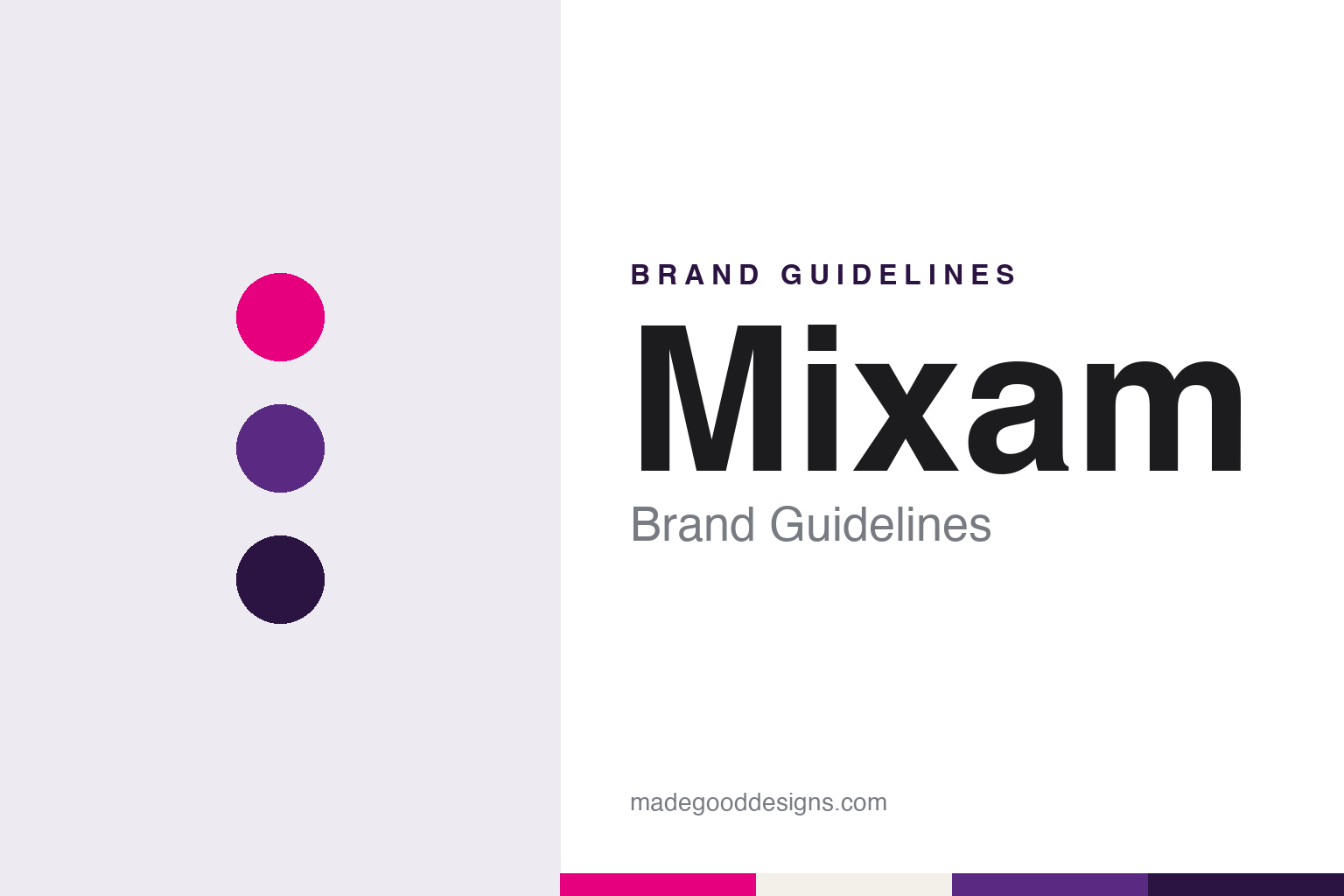
Mixam Brand Guidelines
A press in Watford that put its price list behind a calculator.
Aa
Two constants: a process magenta, press violet and uncoated-stock palette and a grotesque sans register. Abstract homage — not a Mixam asset or mark; no logo, icon, wordmark or typeface is reproduced.
Two presses and a price calculator
Watford, 1991 to 2007.
Mixam tells its origin story in a few lines. The company’s British website says Mixam was born in Watford, Hertfordshire, in 1991, and that its staff worked day and night to get the business running. The same page says the head office and customer service team are still in Watford, and that the company now prints at centres across the UK.
The decisive change, in the company’s account, came in 2007. Mixam says that was the year it moved online, when its developers built an instant price calculator so that a customer could choose a product, set the options and see a price at once, without filling in a quote request. The company says it grew quickly after that step.
An older version of its website, archived with a copyright line for Mixam UK Ltd, describes the business in the same terms. That page called Mixam an online printing company specialising in brochures, magazines, posters, flyers and books, and said large and small format lithographic printing was its specialty. It said the online quote system was linked to the company’s management information system, so that an order moved from the website into production without a middleman.
The older page also set out the working routine that still shapes the service. Mixam said it sent PDF proofs before going to press and delivered finished printing to any address in the UK. It offered, in its own words, to reprint from the same files free of charge if a customer was unhappy with the result.
Those steps — upload, choose options, check proofs, order — are how the company still describes itself. Its current British pages say customers upload their work, pick printing options, review and edit their proofs with help from the system in spotting problems, and then place the order. The product menus list books in hardcover and paperback, bound brochures, booklets, magazines, catalogues, wiro and loop binding, zine printing, folded leaflets, business cards, postcards, greeting cards, posters and letterheads.
Colour
Zines, comics and crowdfunded books.
Outside its own pages, Mixam appears through the people who print with it. The tabletop games publisher Steve Jackson Games wrote on its Daily Illuminator news page on 21 November 2020 that when it launched Hexagram, a zine for its game The Fantasy Trip, in 2019, it took the print job to Mixam. The post, written by Phil Reed, said the publisher went back to Mixam again and again and printed each issue of Hexagram through the service.
Reed’s post pointed other would-be zine makers to Mixam’s selection of papers, sizes and bindings. He added that when problems had arisen, the Mixam team had responded quickly to resolve them, and he noted that the company shared pictures of recent print jobs on social media, which he described as a way to find new books, comics and role-playing zines. The same post suggested that the crowdfunding platform Kickstarter might run a Zine Quest event in early 2021.
Kickstarter later became a formal partner. A post on the Kickstarter blog dated 11 June 2025, written by Mixam, describes a partnership between the two companies aimed at comic creators. In that post Mixam calls itself a technology business helping creators produce comic books, graphic novels, zines and other printed products, rather than only a printing company.
The same Kickstarter post lists the tools Mixam puts in front of creators. It names the Instant Quote Calculator as the starting point, alongside free downloadable PDF templates that a designer can use as an underlay in their own software, and a browser-based Design Online tool for making print-ready files. Mixam says in the post that its print support team can be reached by chat, email and phone, and it describes bulk printing as an option for creators fulfilling orders to backers.
That positioning, aimed at independent publishers as much as at offices, shows in the company’s current wording. The trade news site PrintCAN, reporting in April 2026, quoted Mixam’s claim that it “empowers anyone to create, print, and share their work”, and listed its target customers as creators, publishers and brands.
Typography
How a print service shows up.
For a print-service brand, the identity is not confined to a logo on a homepage. It is carried through a sequence of moments that a customer passes through, often without noticing that each one has been designed. The order flow is the first of these: the upload screen, the template picker, the preview window and the progress bar all speak in the brand’s type, colour and tone of voice, and they set expectations long before anything is printed.
The proof is the second moment. A digital proof, a soft-proof warning about low-resolution images or a printed sample sent ahead of a larger run is where the service shows how carefully it handles someone else’s work, and the language around it matters as much as the layout.
Paper samples and swatch packs make the brand tangible. Stock names, finish labels and the small card that explains weight and coating turn technical choices into something a customer can hold and compare.
Finally there is delivery. The shipping box, the tape, the protective sleeve, the packing slip and any insert card are often the only physical contact a customer has with an online printer, so they become the most direct expression of the identity. Designers studying the category should look at these surfaces together, as one continuous system rather than as separate pieces.
Aa
A grotesque sans — plain, workmanlike type suited to order forms and price tables. (Specimen set in Archivo, a sans STAND-IN; NOT the Mixam logo or any Mixam typeface.)
Mixam
A stake from Vistaprint.
In 2026 Mixam gained a new shareholder from inside the online-print business. PrintCAN reported on 29 April 2026, under a Watford dateline, that Vistaprint, which is owned by Cimpress, had acquired a stake in Mixam, which it described as a British web-to-print platform. Vistaprint has held that stake since 2026.
The same report described the reach Mixam had built from its Watford base. PrintCAN said Mixam ran online stores for Britain, Ireland, the United States, Canada, Japan, Germany and Australia, and that its products included books, magazines, comics, art books and albums, along with printed items for business and marketing.
Read together, the company’s pages and the outside coverage describe a business whose brand rests on process more than on a single product. The 1991 story is about presses in Watford; the 2007 story is about software that prices a job instantly; the later story, told by Steve Jackson Games in 2020 and by Mixam itself on the Kickstarter blog in 2025, is about independent publishers printing zines and comics in short runs.
The vocabulary on its pages follows the same lines. Product names are plain descriptions — booklets, catalogues, wiro bound, loop bound — and the tools carry functional names such as the Instant Quote Calculator and Design Online, so that a new customer can find a binding or a paper without knowing printing jargon.
For a design guide, Mixam shows how a printing firm can build an identity around ordering — instant prices, proofs and templates — and around the creators who print with it. Compare MOO, another British online printer, and Shutterfly, an online photo-print service. For this guide we use process magenta, press violet and uncoated-stock cream with a sans, an unofficial interpretation; no product or logo is reproduced.
Explore & save
Keep Mixam’s identity on hand — save it to a board in the Made Good inspiration library.
Mixam identity set
Pin the Mixam process magenta, press violet and uncoated-stock palette and the grotesque sans register to your own board.