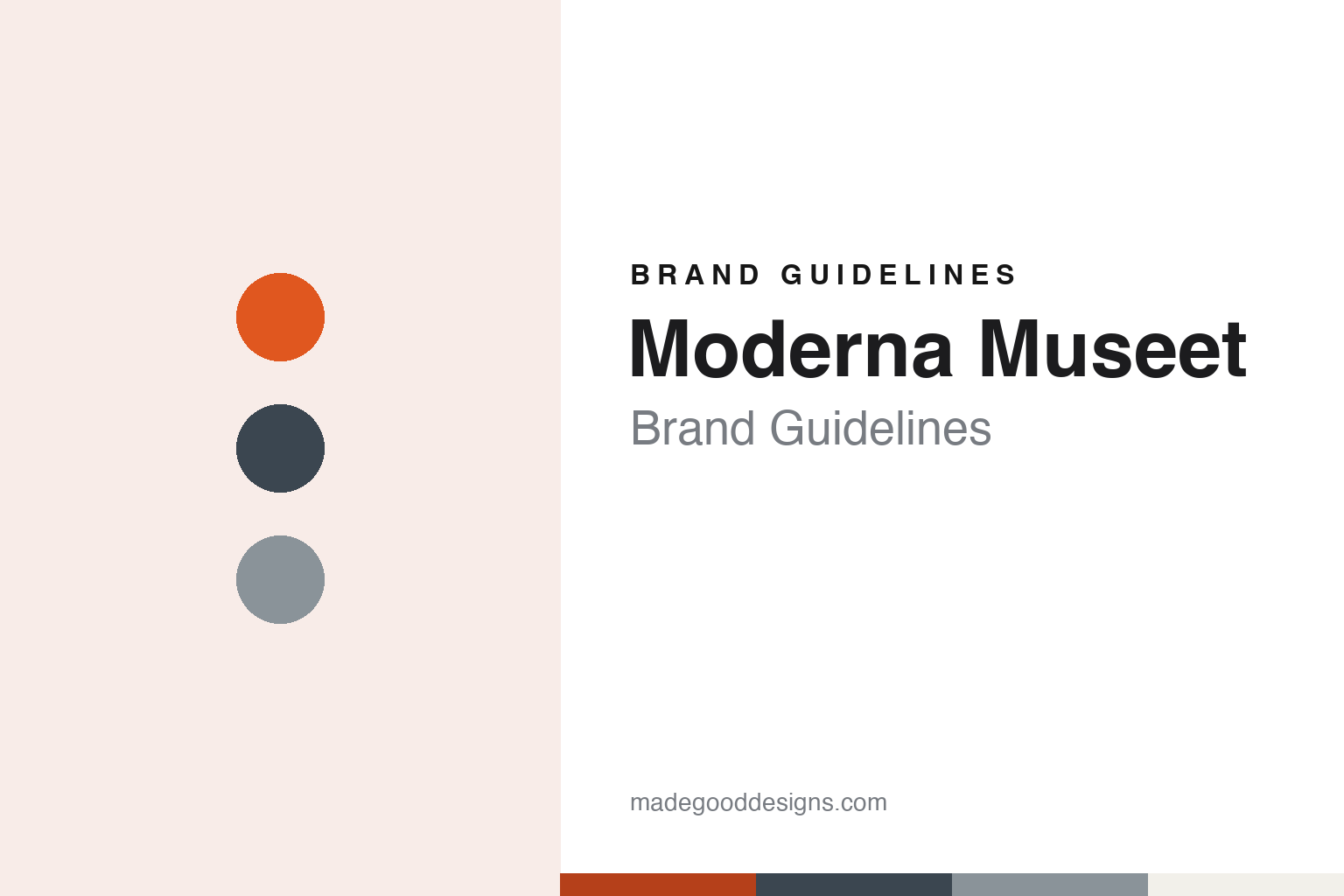
Moderna Museet Brand Guidelines
A signature for a name, a grid-built typeface for everything else and an orange annex in Malmö.
Aa
Two constants: an annex orange, signature black, Skeppsholmen slate, Baltic grey and gallery white palette and a grid-built monospace register. Abstract homage — not a Moderna Museet asset or mark; no logo, artwork, photograph or signage is reproduced.
A modern museum on an island
A break from the Nationalmuseum, a drill hall on Skeppsholmen and a new building by Rafael Moneo.
Moderna Museet, “the modern museum”, is Sweden’s state museum for modern and contemporary art, and it sits on the island of Skeppsholmen in central Stockholm. Swedish Wikipedia says it was set up in 1958 as an institution separate from the Nationalmuseum, where modern art had been shown until then, and that it is run by a government agency of the same name, charged with collecting, preserving, showing and explaining the art of the twentieth and twenty-first centuries in all its forms. Its collections span painting, sculpture, photography and artists’ film from 1900 onwards, and photography from about 1840.
The museum was inaugurated on 9 May 1958 in Exercishuset, a former naval drill hall on the island. Swedish Wikipedia credits Otte Sköld, superintendent of the Nationalmuseum, as decisive in creating it, together with the supporters’ society Moderna Museets Vänner, formed in 1953. The directors who followed, above all Pontus Hultén, who led the museum until 1973, and later Olle Granath, used their contacts to build the programme. English Wikipedia lists the directors since then as including David Elliott, Lars Nittve, Daniel Birnbaum and, since 2019, Gitte Ørskou.
The museum grew in stages. Swedish Wikipedia says it was once planned as a tenant in Peter Celsing’s Kulturhuset at Sergels torg but withdrew in February 1970 to expand on Skeppsholmen instead, and that an extension by Per-Olof Olsson doubled the floor area in 1974–75. In May 1990 an architecture competition was launched for a new building, and the Spanish architect Rafael Moneo won. While it was built the museum moved, in 1994, to the former tram depot Spårvagnshallarna on Birger Jarlsgatan. The new museum was inaugurated in 1998. Mould damage then sent the institution into temporary premises, and it was rededicated on 14 February 2004.
English Wikipedia says the Moneo building is shared with the Swedish Centre for Architecture and Design, and that in 2005 Hultén bequeathed more than 700 works, together with his archive and library, which are shown in the Pontus Hultén Study Gallery designed by Renzo Piano. Outside, a sculpture park on the island includes Alexander Calder’s The Four Elements (1961), Jean Tinguely and Niki de Saint Phalle’s Le Paradis fantastique (1966) and a Picasso design realised by Carl Nesjar in 1962.
Colour
A signature lettered in 1983, a customised Gridnik and a rededication in 2004.
The museum’s name is written in an artist’s hand. Moderna Museet’s research pages describe a long relationship with Robert Rauschenberg: he took part in Movement in Art (1961), 4 Americans (1962), the Five New York Evenings performances of 8–14 September 1964, Inner and Outer Space (1965) and The New York Collection for Stockholm (1973), and his combine Monogram (1955–59) is singled out there as one of the museum’s key works. The same page says the museum has had a logo based on Rauschenberg’s handwriting since 2004, and its press material says the graphic profile appears on the façade, on some interior walls, on signs and on products.
The lettering is older than the identity. The project page of the Swedish designer Henrik Nygren at the Alliance Graphique Internationale describes an identity for the museum’s 2004 rededication, built on a logotype originally lettered by Rauschenberg in 1983. It lists a specially designed typeface, an indoor and outdoor display system, books, printed matter, packaging, sales products, work clothes and stationery, made between 2003 and 2005 in collaboration with Stockholm Design Lab under Björn Kusoffsky and with the architects Greger Ulf Nilson and Thomas Eriksson. The museum’s press material credits the graphic profile to Stockholm Design Lab.
Fonts In Use, in an entry by Stephen Coles dated 27 July 2012, says the museum in Stockholm and Malmö was rebranded by Stockholm Design Lab in 2004 using the handwritten Rauschenberg logo and a customised version of Gridnik for all signage, publications and branding. In a reply on the same page Coles explains that Foundry Gridnik was developed from a single-weight monospaced “typewriter” face drawn by the Dutch designer Wim Crouwel in the 1960s, whose devotion to grids earned him the nickname “Mr Gridnik”.
The pairing is the system: a loose, personal signature for the name, and a rigid, geometric typeface built on a grid for everything else. See the Stockholm Design Lab guide, which lists the Moderna Museet identity among the studio’s work.
Typography
A signature on the façade, a grid typeface on the signs.
Some art institutions hand their identity to artists rather than to a design agency. A painter or sculptor may draw the logotype, letter the façade or design a run of posters, and the mark then carries the hand of a particular person instead of a neutral corporate typeface. Others work the other way round and build an in-house studio: a small team of designers who sit beside the curators and produce the invitations, wall labels, catalogues and screens across the year. A team that close to the programme can follow it show by show, shifting colour and imagery from one season to the next while holding on to a few fixed rules, such as a single typeface, a poster grid or a set position for the name.
The façade is where passers-by meet that work. Banners hung between columns or across a glass front announce the current exhibition at street scale, and their size forces a plain layout: a name, a pair of dates and one image or a field of colour. Temporary architecture does similar work inside, where scenographers build walls, platforms and display furniture for each show and so change the character of the rooms from one exhibition to the next. Print workshops add another layer. A centre with its own press, screen-printing table or duplicator can make small editions, zines and posters with visiting artists, and those objects, with their limited inks and visible textures, come to stand for the institution as much as any logo does.
Aa
Grid-built monospace — after the customised Gridnik used beside the Rauschenberg signature. (Specimen set in Share Tech Mono, a monospaced STAND-IN; NOT the Moderna Museet logo, Gridnik or any Moderna Museet lettering.)
Moderna Museet
A second museum in a Malmö power station and the same handwriting on both.
Moderna Museet has had a second home since 2009. English Wikipedia says Moderna Museet Malmö opened to the public on 26 December 2009 in the building that had housed the Rooseum centre for contemporary art from 1988 to 2006, an electricity plant built in 1901. It is a branch of the Stockholm museum with an exhibition programme of its own, and it opened with exhibitions by Luc Tuymans and Astrid Svangren alongside works from the 1960s drawn from the collection.
The architects Tham & Videgård Arkitekter kept the industrial shell and inserted new galleries, circulation and technical systems inside it, an approach English Wikipedia says has been described as a “building within a building”. Two new staircases divide the former turbine hall into exhibition areas, an educational workshop and a loading area. On the street side they added an orange-red annex clad in perforated metal, containing the entrance, reception, café and an upper gallery; the colour was chosen to relate to the brick of the old power station, while the glazed ground floor lets daylight through the perforations. English Wikipedia notes that much of the building’s public presence comes from that façade and a large Moderna Museet logo.
The museum has also looked after its collection in digital form. Swedish Wikipedia says that in 2020 digital copies of the collections were deposited in the Arctic World Archive. In Stockholm the building on Skeppsholmen continues to host temporary exhibitions through the year, among them, until 4 October 2026, a show of the photographer Brassaï’s pictures of Parisian street life, signs and graffiti.
For a design guide, Moderna Museet shows an identity in which an artist’s handwriting carries the name and a grid-built typeface descended from Wim Crouwel carries everything else, across a Moneo building in Stockholm and an orange annex in Malmö. Compare the Stockholm Design Lab and Louisiana Museum guides. For this guide we use annex orange, signature black, Skeppsholmen slate, Baltic grey and gallery white with a monospace sans, an unofficial interpretation; no product or logo is reproduced.
Explore & save
Keep Moderna Museet’s identity on hand — save it to a board in the Made Good inspiration library.
Moderna Museet identity set
Pin the Moderna Museet annex orange, signature black, Skeppsholmen slate, Baltic grey and gallery white palette and the grid-built monospace register to your own board.