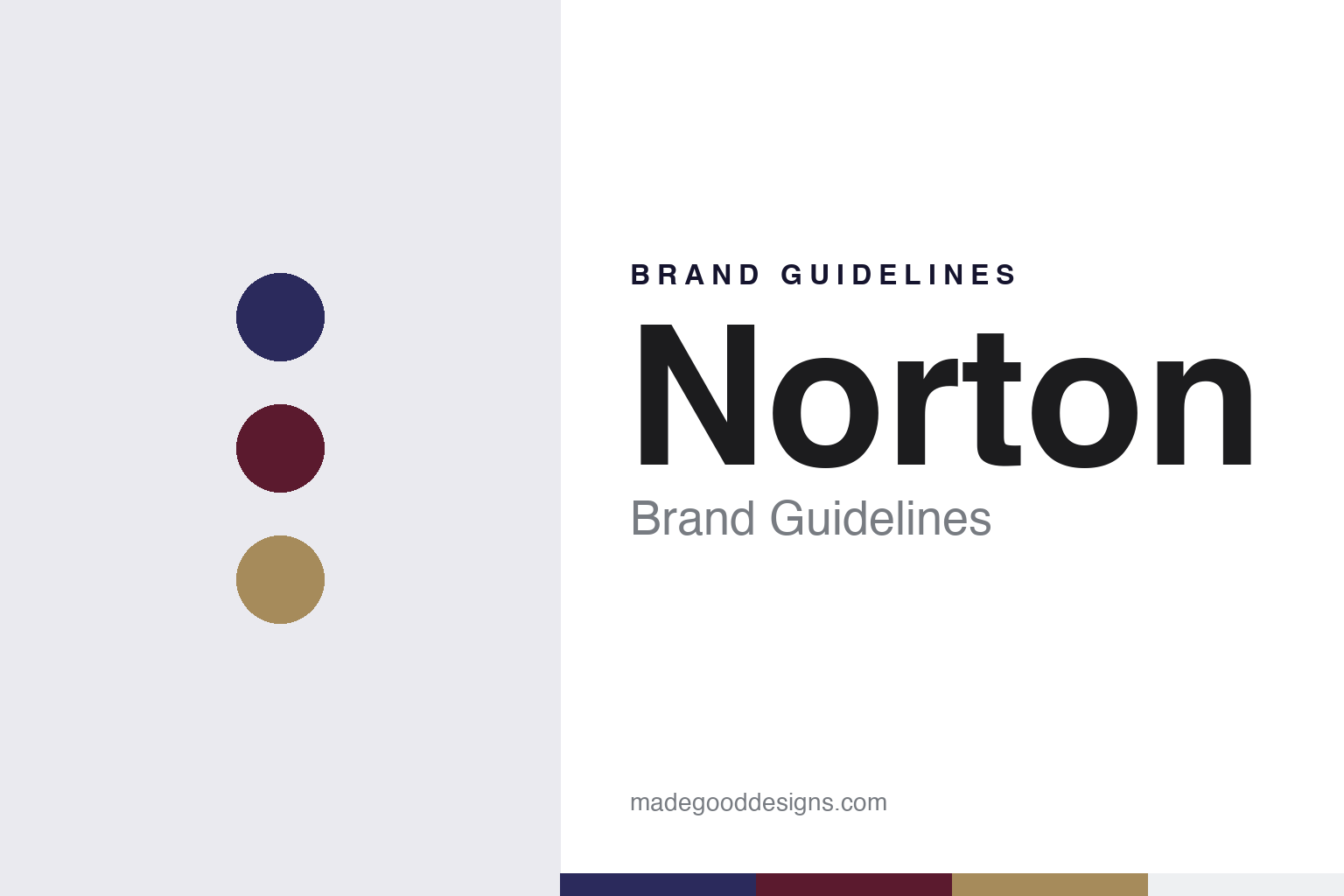
Norton Brand Guidelines
The Luján de Cuyo winery founded by an English railway engineer in 1895.
Aa
Two constants: a Malbec indigo, deep red and Perdriel earth palette and a classical serif register. Abstract homage — not a Norton product or mark; no bottle, label or logo is reproduced.
Perdriel, 1895
An English railway engineer and a vineyard south of the Mendoza River.
Bodega Norton dates its founding to 1895 in Perdriel, in the department of Luján de Cuyo, Mendoza. The company says its founder, the English engineer Edmund James Palmer Norton, came to Argentina to help build the railway across the Andes, bought a vineyard in Perdriel, planted it with French vines and built a winery there. English Wikipedia, citing a 2021 report by the Canadian broadcaster CHCH, gives the same founder and year, and Infobae, reporting in October 2025, described the company as founded in 1895 in Luján de Cuyo.
The railway mattered to the wine as well as to the man. The company says that by 1910 rail links had carried Norton wines onto the dining cars of the trains crossing the Andes and to Buenos Aires, and it credits itself with the first wine bottled at origin in that period. It also says that in 1973 Norton shipped the first Malbec exported from Argentina, to the United States. Both are the company’s own claims.
The modern chapter began in 1989, when the Austrian businessman Gernot Langes-Swarovski, of the family behind the Swarovski crystal company, bought the winery; English Wikipedia and the company both give that year. The company says the cellar’s historic wines, going back to 1936, were kept, and that a new phase of investment and exports began in 1991. English Wikipedia names Michael Halstrick as running the company as of 2021. The Swiss newspaper Blick, reporting in January 2026, described Halstrick as Langes-Swarovski’s stepson and said he left the company in 2023.
Colour
Where the wine is made.
Norton is a Luján de Cuyo winery first. Its winery and its oldest vineyards sit in Perdriel, south of the Mendoza River, and Blick put the Perdriel vineyards around the winery at about 100 hectares. Figures for the whole estate vary by source: Blick described an operation of around 700 hectares, while English Wikipedia, citing the Irish wine merchant O’Briens, counts five farms with more than 1,200 hectares suited to vines, 680 of them planted. The company says it bought Finca La Colonia, a property of 1,047 hectares, in 1997, and that the purchase made it the largest landholder in Luján de Cuyo.
Place is also part of how Norton labels its wine. The company says it was one of the first four wineries certified under Luján de Cuyo’s Controlled Designation of Origin, in 1994; a Norton Malbec D.O.C. remains in the range. Since 2014, the company says, it has also bought grapes from growers in the Uco Valley, the higher district to the south, and it launched Lote Negro, a blend of Cabernet Franc and Malbec, the same year.
The winery has tried less obvious grapes too. The company says that in 2019 it released the first wine made entirely from Grüner Veltliner in South America, and the first harvest of that Austrian white grape in Argentina. In 2021, it says, it added a room of concrete eggs and tanks to the cellar. Forbes Argentina has profiled its winemaker David Bonomi.
Norton sells well beyond Mendoza. In its October 2025 statement, reported by Infobae, the company said it was present in more than 72 countries.
Typography
Design and documentation.
The seven brands in this group are all Argentine and Chilean wine names: Catena Zapata, Trapiche, Norton, Santa Rita, Montes, Errázuriz and Cono Sur. Wine brands in general sit at many different points in the trade, from family houses that still carry a founder’s name to labels that now belong to much larger drinks groups, and a single brand can be sold everywhere from a corner shop to a restaurant list.
A wine brand’s identity is usually carried less by a single bottle than by a label, a name and the place it promises, because the company behind the name may have changed hands, moved its production or grown far beyond the place where it started. That makes the questions behind each name worth asking plainly: who started it, who owns it now, and where its wine is actually made and bottled.
Each guide separates what independent sources record from what the company says about itself — its founding story, its owners over time, where its wine is made and how its labels have changed — and marks plainly what rests only on the company’s own word.
Aa
A classical serif for a long-established Mendoza house. (Specimen set in Libre Caslon Text, a serif STAND-IN; NOT the Norton logo.)
Bodega Norton
A new look, and a restructuring.
The brand’s look has changed recently. In November 2022 the Mendoza weekly Punto a Punto reported a redesigned label for Norton Malbec D.O.C., described as modern and sophisticated, as part of a wider renewal of the winery’s image and logo, quoting brand manager Francisco San Miguel; the company’s own timeline dates its new visual identity and logo to 2023. Earlier, iProfesional reported that the winery had adopted indigo blue to mark its top wines, a colour it linked to the deep Malbec of Luján de Cuyo.
The business has had a harder recent chapter. On 31 October 2025 Norton filed for a concurso preventivo de acreedores, Argentina’s court-supervised restructuring process, Infobae reported, citing a difficult local and international context for wine; chief executive Tomás Lange said the step was taken to secure jobs and keep the operation running. Blick reported in January 2026 that the winery belonged to the Langes-Swarovski Privatstiftung, a family foundation set up in 1996, that Lange had been chief executive since July 2025, and that Lange had told The Drinks Business the process was a legal tool to preserve the company, not a liquidation.
The name needs care online. Norton is also the antivirus brand owned by Gen Digital, a British motorcycle maker, the Norton Simon Museum in Pasadena and an American grape variety; the winery’s own site is norton.com.ar.
For a design guide, Norton shows how a founder’s surname, a single district and a deep blue for the top wines can carry a Mendoza house through more than 130 years and a change of owner. Compare Catena Zapata, a fellow Mendoza house, and Trapiche, another long-established Mendoza winery. For this guide we use Malbec indigo, deep red and Perdriel earth with a classical serif, an unofficial interpretation; no product or logo is reproduced.
Explore & save
Keep Norton’s identity on hand — save it to a board in the Made Good inspiration library.
Norton identity set
Pin the Norton Malbec indigo, deep red & Perdriel earth palette and the classical serif register to your own board.


