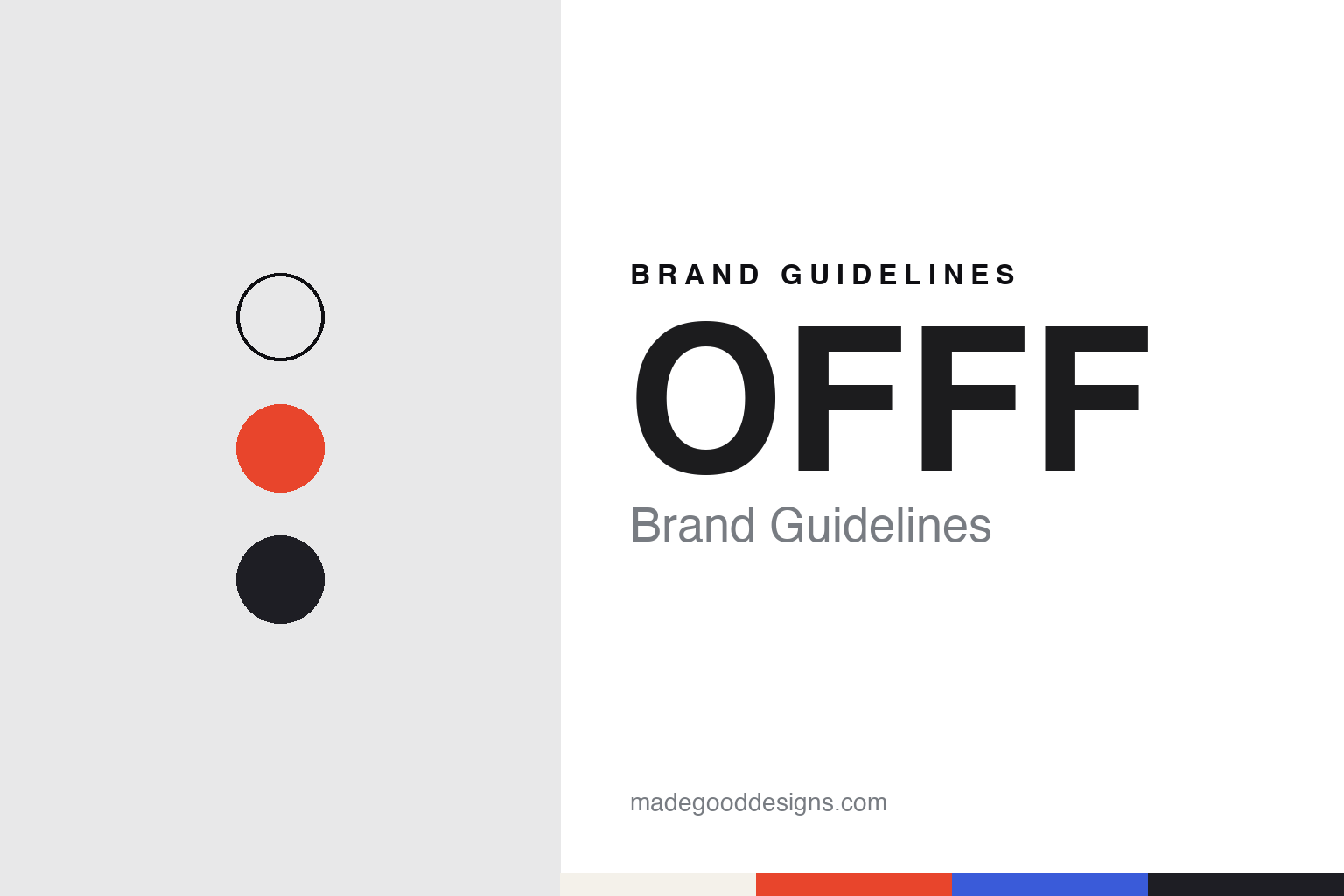
OFFF Brand Guidelines
A Barcelona festival that opens each year with a commissioned film.
Aa
Two constants: a screen white, title red and projection black palette and a heavy grotesque register. Abstract homage — not an OFFF asset or mark; no logo, icon or wordmark is reproduced.
A festival born on a sofa
From the Online Flash Film Festival to OFFF.
OFFF is a festival of design, motion graphics and digital culture held each spring in Barcelona. Its founder and director is Héctor Ayuso, who told the Japanese magazine Shift in an interview published on 28 July 2006 that he had left his home city of Valencia for Barcelona at around seventeen or eighteen to study film direction. After some work as a filmmaker he bought a computer and set up his own web design studio, he said, just as the boom in Flash, the web animation software, was getting under way.
Ayuso has told the founding story more than once, and the details are consistent. In the Shift interview, written up by Eduard Prats Molner, he said the idea came to him on a Sunday afternoon while Barcelona’s football team was on television: he was thinking about using Flash in some of his own short films, and then about an event where other people could show that kind of work too. That, he said, is why the event was called the Online Flash Film Festival at the beginning, a name that survives in the three letters OFFF. On the same day, by his account, he built a website for the event and wrote to the American designer Joshua Davis, whom he did not know; Davis posted the idea on his site Praystation. Ayuso called Davis the festival’s “godfather”.
AIGA Eye on Design, in a piece by Madeleine Morley published on 22 January 2016, placed that Sunday afternoon in 2000, and described Ayuso playing with Flash and wanting a space where people could share their work and talk about how new platforms were changing the industry. The festival itself dates from the following year. Ayuso told Computer Arts, in a Q&A published by Creative Bloq on 21 April 2006, that “OFFF was born in Barcelona in 2001”, and the festival’s communications director Nathalie Koutia gave the same year to the events site Neon Moiré in 2020.
Shift described Ayuso as general director of an agency called inofffensive since 2000 and said he had founded an earlier studio for interactive projects in 1995. The same profile said he had taught in the graduate programme in motion graphics at Barcelona’s BAU design school since 2005. In 2006 he named Aimee Campos as OFFF’s creative director and an important influence on how the festival developed.
From the start Ayuso described OFFF as neither a pure conference nor a party but something in between. In the 2006 Computer Arts interview he spoke of a “post-digital creation culture”, in which digital tools had become simply tools, and pointed to an area called Openroom, an open space where new artists and agencies could present themselves.
Colour
Main titles, campaigns and two logos.
A central part of OFFF’s identity is not a logo but a film. Each Barcelona edition opens with main titles, a short sequence commissioned from a different studio that presents the names of that year’s speakers. Ayuso explained the idea to Neon Moiré in an interview by Thomas Dahm published on 10 February 2020: as a filmmaker with a passion for cinema, he said, he decided from the beginning to present each speaker in an audiovisual piece, to honour them and to give the festival a kind of narrative. In the same interview he said that for more than ten years each edition had also been given its own campaign by a different studio, and that he chose the studios himself as part of his work as curator, sometimes picking teams that had never made titles before.
Those titles have been written up in the motion-design press year by year. Motionographer, in a post by Harm van Zon on 12 June 2013, listed earlier OFFF titles by The Mill, PostPanic, Upperfirst and Brosmind, and noted that PostPanic had placed speakers’ names on objects two years before. The 2013 titles, it reported, were a collaboration between the Dutch studio From Form and Part of Something, directed and written by Ashley Govers, Jurjen Versteeg and Wouter Keijzer, telling the story of a collector with the speakers’ names merged into his souvenirs. Motionographer said the sound was by Ben Lukas Boysen, whose work for OFFF it described as becoming a tradition.
Art of the Title has catalogued later sequences. Its page on the 2016 titles, published on 27 July 2016, credits Gavin Strange and Merlin Crossingham as directors of a piece combining stop-frame animation, live action and type. Its page on the 2017 titles, published on 30 July 2017, credits the studio Vallée Duhamel, with direction by Julien Vallée and Eve Duhamel and production by Sailor Productions. Neon Moiré credited the 2019 Barcelona titles to Chris Bjerre.
The festival’s mark has changed less often than its films. Koutia told Neon Moiré in 2020 that the Barcelona studio CROWD presented an OFFF rebrand in 2013 and created the official logo used from then on, and that CROWD also produced a new global look in 2019 designed to bring all OFFF events together. For the festival’s twenty-fifth edition, Creative Boom reported on 18 February 2025, OFFF unveiled a new identity by the New York agency COLLINS, which the agency described as “a dual force: one that attracts and one that expands”.
Typography
A festival named for its own first format.
A festival or conference carries its brand differently from a product. The name and the core mark usually stay fixed, while the look around them is rebuilt for each edition. That annual identity is often commissioned from a different studio or artist every year, which turns the event into a running sequence of design briefs and makes the archive of past posters, badges and websites part of the brand itself.
Moving image matters as much as print. Title sequences, stage openers and short idents run between talks and set the tone in a room before anyone speaks, and they are often where a commissioned designer has the most freedom. The venue becomes a brand surface too: a city, a building or a recurring location can attach itself so closely to the name that the two are remembered together, and a move to a new place can feel like a redesign.
The programme is the working document of the identity. Stage names, track colours, wayfinding, lanyards and schedule apps all carry the system at small sizes and under pressure, so type choices and colour coding have to stay legible on a phone screen, a printed map and a large projection in the same week.
Aa
A heavy grotesque — after a festival whose name is three capital letters and a doubled F. (Specimen set in Archivo Black, a sans STAND-IN; NOT the OFFF logo, wordmark or any festival typeface.)
OFFF
Venues, tours and an anniversary, dated.
OFFF has kept Barcelona as its base while changing venues inside the city. The Barcelona City Council’s culture listings announced OFFF Barcelona 2014 for 15 to 17 May 2014 in the Disseny Hub Barcelona building, with a programme of talks, performances, installations, exhibitions and projections. Neon Moiré reported in February 2020 that the festival was preparing its twentieth-anniversary edition at the Museu del Disseny de Barcelona, the design museum housed in the same building, and that the Barcelona event ran over three days on three stages around that venue, with an outdoor area alongside.
The festival has also travelled. In the 2020 interview Ayuso said he did not think of OFFF as a franchise: people in other countries asked to bring it to their cities, and OFFF partnered with local promoters to stage smaller editions under the name OFFF on Tour. Art of the Title lists title pages for OFFF Porto 2015 and OFFF Mexico 2015 among its related sequences, and Creative Boom reported in 2025 that editions were planned that year in Mexico, Montreal and Seville.
The twenty-fifth Barcelona edition took place from 8 to 10 May 2025 at Disseny Hub Barcelona, according to Creative Boom’s report by Abbey Bamford. The same article described Pep Salazar as an OFFF founder, alongside the festival’s long association with Ayuso. It said Territory Studio would present the main titles that year, that DixonBaxi would show a film made for the anniversary, and that the festival would extend into the city with free public events under the name OFFF a la Ciutat, including an open-air design market and projections on the Disseny Hub façade.
Across these accounts the festival’s identity rests on a small set of habits: an annual commissioned film, an annual campaign by a different studio, a short name built from an early description of the event, and a steady home in Barcelona.
For a design guide, OFFF shows how an event can renew its look every year while keeping one fixed ritual, the opening titles, at the centre. Compare Pictoplasma, a festival of character design, and Semi Permanent, another creative festival in this collection. For this guide we use screen white, title red and projection black with a heavy grotesque sans, an unofficial interpretation; no product or logo is reproduced.
Explore & save
Keep OFFF’s identity on hand — save it to a board in the Made Good inspiration library.
OFFF identity set
Pin the OFFF white, red and black palette and the heavy grotesque register to your own board.