Semi Permanent Brand Guidelines
A Sydney design festival that travels.
Aa
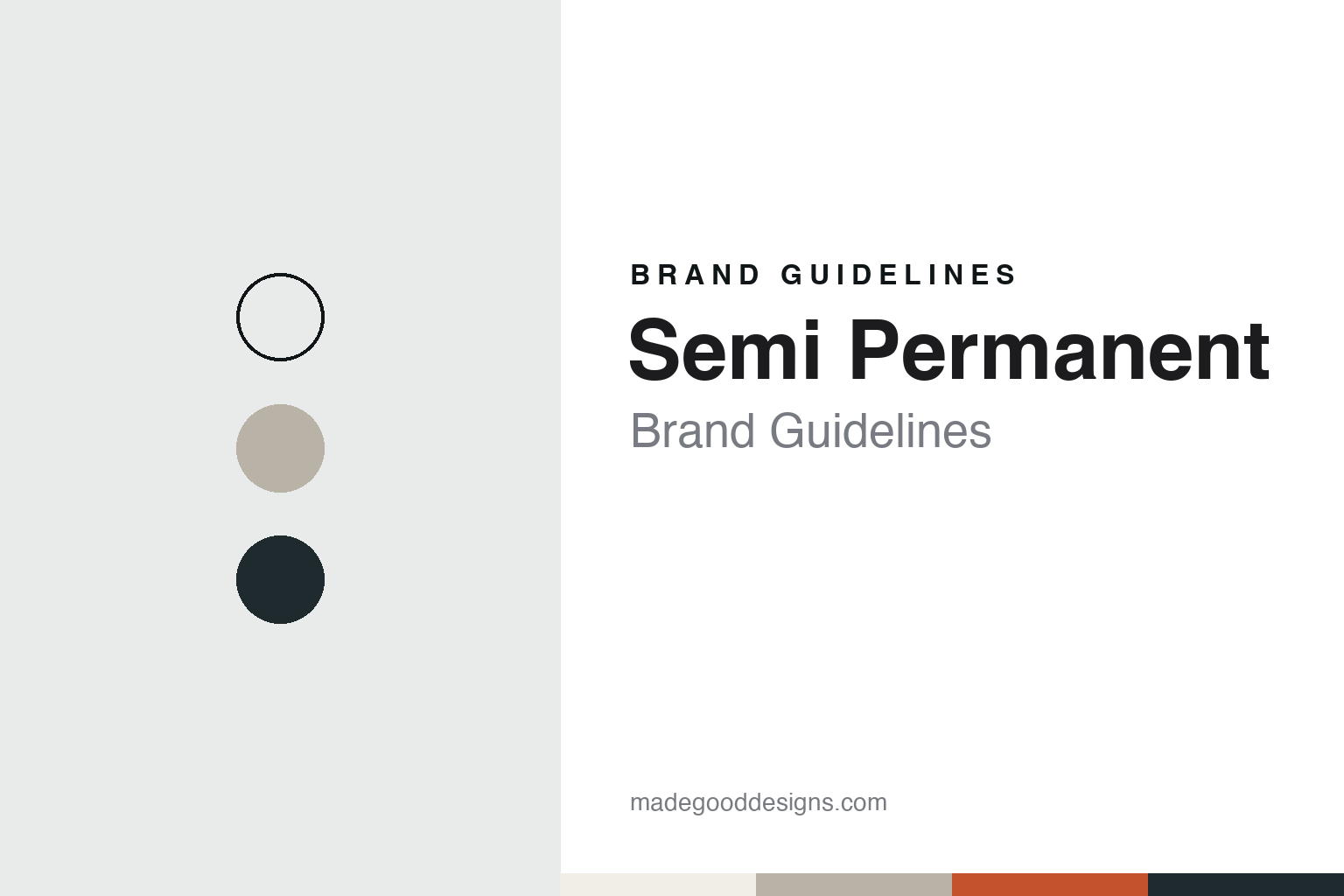
Two constants: a white, stone and charcoal palette and a grotesque sans register. Abstract homage — not a Semi Permanent asset or mark; no logo, icon or wordmark is reproduced.
A festival from a design studio
Design is Kinky and the first Sydney event.
Semi Permanent is a creative festival and events company based in Sydney, Australia. English Wikipedia says it was founded in Australia in 2002 by Murray Bell and Andrew Johnstone, and that the first Semi Permanent event was held in Sydney in 2003. The name has been written both as “Semi Permanent” and with a hyphen, as “Semi-Permanent”, in coverage over the years, and the organisers’ website is at semipermanent.com.
The festival grew out of a design studio. Wallpaper*, in an article published on 3 May 2012, described Semi-Permanent as the creation of Bell and Johnstone of Design is Kinky, an online creative hub. English Wikipedia’s article on the Australian magazine Empty says that it was published by the Sydney-based Design is Kinky studio, the curators of the Semi Permanent festival, and that Johnstone, its editor, created Empty, Design is Kinky and Semi Permanent. According to that article, Empty was launched in April 2004, was published roughly every two months, carried little advertising and was distributed within Australia, with art direction by the Design is Kinky studio.
From the outset the festival’s subject was creative work in the broadest sense. Wallpaper* wrote in 2012 that the event took place over two days and covered fields from photography to typography, architecture and fashion. Alongside the talks, it said, the programme took in exhibitions, workshops, master classes, launches and parties. That year it also introduced a webcast format called “Hangout”, through which audiences could put questions to the American filmmaker Roman Coppola.
English Wikipedia describes the organisation today as more than a festival. It says Semi Permanent comprises three businesses: the festival itself, SP Brand Studio and SP Productions, the last described as an events and production agency. The festival side, it says, includes the annual event, an annual book and a website, and the company’s office is in Sydney.
A Habitus listing for the 2014 festival, published on 3 March 2014, quoted Andrew Johnstone as Semi-Permanent’s director, while English Wikipedia names both Bell and Johnstone as founders.
Colour
Carriageworks, Vivid and cities abroad.
Sydney has remained the festival’s home, and for many years its venue there was Carriageworks. The Habitus listing of March 2014 said that the 2014 edition would run for three days, from 22 to 24 May, at Carriageworks, with presentations, exhibitions, installations, screenings and workshops, and that it would be the opening event of the Vivid festival, with parties hosted with FBi Radio.
The link with Vivid Sydney dates from the year before. The same Habitus article quoted the New South Wales Deputy Premier, Andrew Stoner, saying that Semi-Permanent had been part of the Vivid Ideas programme in 2013 and that in 2014 it would take place exclusively as part of Vivid Sydney. English Wikipedia also says Semi Permanent has been part of the Vivid Ideas calendar since 2013.
The Carriageworks connection continued. An announcement carried by Mumbrella on 7 December 2017 said the festival would return for a three-day event on 24, 25 and 26 May 2018 at Carriageworks. The venue’s own event page for 2019 set out that year’s theme, “Truth”, presented as a question of how designers can shape and authenticate the future they believe in. English Wikipedia gives “Restless” as the theme of the 2020 edition.
The festival has also been taken abroad. Wallpaper* reported in 2012 that, conceived in Australia and staged in cities around the country, Semi-Permanent had brought its programme to London, New York, Hong Kong and Singapore. It said the 2012 season opened in Sydney, with Auckland in New Zealand as the next stop. English Wikipedia’s list of host cities adds Abu Dhabi, Los Angeles and Portugal, and says the company has held events in Australia, New Zealand, the United States, the United Kingdom and China.
Typography
A festival from Sydney.
A festival or conference carries its brand differently from a product. The name and the core mark usually stay fixed, while the look around them is rebuilt for each edition. That annual identity is often commissioned from a different studio or artist every year, which turns the event into a running sequence of design briefs and makes the archive of past posters, badges and websites part of the brand itself.
Moving image matters as much as print. Title sequences, stage openers and short idents run between talks and set the tone in a room before anyone speaks, and they are often where a commissioned designer has the most freedom. The venue becomes a brand surface too: a city, a building or a recurring location can attach itself so closely to the name that the two are remembered together, and a move to a new place can feel like a redesign.
The programme is the working document of the identity. Stage names, track colours, wayfinding, lanyards and schedule apps all carry the system at small sizes and under pressure, so type choices and colour coding have to stay legible on a phone screen, a printed map and a large projection in the same week.
Aa
A grotesque sans — after a festival of talks, exhibitions and books from a Sydney design studio. (Specimen set in Space Grotesk, a sans STAND-IN; NOT the Semi Permanent logo, wordmark or any festival typeface.)
Semi Permanent
Books, brand work and a 2020 partnership.
Each festival is accompanied by print. English Wikipedia says Semi Permanent publishes an annual book featuring interviews with people from the creative industries, and it names the 2020 book after that year’s theme, Restless.
The company also produces work for clients. English Wikipedia describes SP Brand Studio and SP Productions as the arms that provide creative and production services, and says that in 2021 the brand studio co-created a two-day live event combining sport and creativity. It also credits the studio with an immersive retrospective of the artist Stanley Donwood’s work with the band Radiohead, with sound design by Thom Yorke. The company lists further client work on its own website.
In December 2020 Semi Permanent announced a partnership with a media brand. An announcement carried by Mumbrella on 11 December 2020 said that Highsnobiety and Semi Permanent had formed a strategic partnership to bring immersive experiences to Australia, and English Wikipedia describes the arrangement in the same terms, as a partnership with the digital publisher.
Speakers have come from many disciplines. Wallpaper* named, for the 2012 Sydney edition, the local graphic designer Vince Frost, the New Zealand photographer Derek Henderson, the digital agency Hi-ReS and the magazine’s own art director, Meirion Pritchard, as well as the motion designer GMUNK from Los Angeles. The Carriageworks page for 2019 listed the artist CJ Hendry, the filmmaker Michel Gondry and Tom Armstrong of The New York Times.
For a design guide, Semi Permanent shows how a festival’s identity can be carried by a studio’s outlook and a yearly theme: a Sydney event founded by two people from the same design studio, attached to Carriageworks and Vivid Sydney, and published each year as a book. Compare OFFF, another festival built around digital and visual culture, and Design Indaba, another design conference in this collection. For this guide we use white, stone and charcoal with a grotesque sans, an unofficial interpretation; no product or logo is reproduced.
Explore & save
Keep Semi Permanent’s identity on hand — save it to a board in the Made Good inspiration library.
Semi Permanent identity set
Pin the Semi Permanent white, stone and charcoal palette and the grotesque sans register to your own board.