Oliver Brand Guidelines
Two fibreglass hulls, one Tennessee factory, and a name taken from the family.
Aa
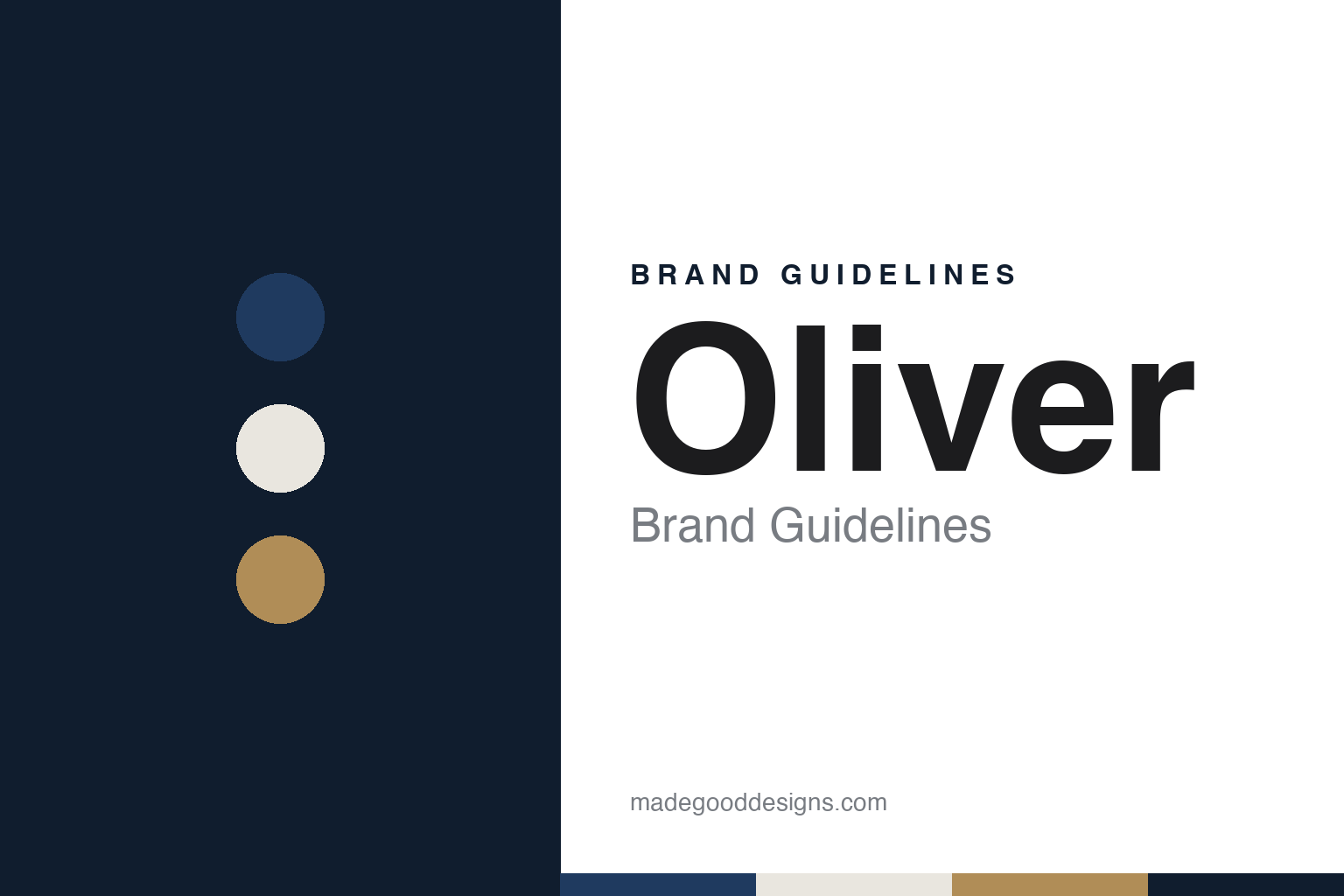
Two constants: a lake navy, gelcoat white and brushed brass palette and a Steady bookish serif register. Abstract homage — not an Oliver product or mark; no trailer or logo is reproduced.
Hohenwald, 2008
A foundation-products family turns to fibreglass trailers.
Oliver Travel Trailers is a fibreglass travel-trailer brand built in Hohenwald, Tennessee, a small town south-west of Nashville. The company’s own about page says the trailers have been made by Oliver Fiberglass Products (OFP) in Hohenwald since 2008, and that they are one of several product lines produced at the OFP plant. The website’s copyright line runs from 2007, which fits a brand being prepared in that year and selling in the next.
The trailers came out of an established family business. The company says Oliver Technologies, LLC was founded in December 1995 by James and Evon Oliver in Hohenwald, to develop, make and sell foundation products for the manufactured-housing industry, such as pads, anchors, stabilising systems, perimeter piers and steps. Before forming that business in Tennessee, the company says, the Olivers had spent years designing, making and selling products for the same industry in California and Arizona.
The fibreglass side is a separate company. The about page says Precision Polymers, doing business as Oliver Fiberglass Products, is headquartered in Hohenwald and has made fibreglass products since 1995. Besides travel trailers it makes walk-in bathtubs and showers; the company says it is the sole manufacturer of Safe Step walk-in tubs and showers, a Ferguson company.
Why trailers? The company gives its own reason: the idea came from the Oliver family’s love of the outdoors and from experience with trailers that did not hold up, and the goal was a trailer that would last them and their families for decades. An owner’s blog, Technomadia, writing in June 2009, told a similar story: the business was then headed by twin brothers Jim and John Oliver, who had camped for years in small fibreglass trailers, drawn up a long list of improvements they wanted, and spent several years with their own workforce and hired fibreglass specialists designing their ideal trailer.
Colour
Legacy, Elite and two hulls.
The first name on the trailers was Legacy. A copy of the company’s website archived by the Wayback Machine in May 2008 shows the range as the Legacy Classic and the Legacy Elite, with pages for floor plans, specifications, plant facilities and ordering, and a forum invitation addressed to “Oliver Legacy owners.” A news post on that archived page, dated 2 April 2008, announced changes to the options on the “Oliver Elite,” so trailers were already being ordered by spring that year.
The launch met a difficult market. Technomadia, whose writers had bought an Oliver, reported in June 2009 that the company’s debut the previous year had coincided with the economic downturn. Rather than close the line, it wrote, Oliver had put the trailer factory to work making high-end accessible bathtubs, using many of the same techniques and equipment so that its trained staff stayed employed while trailer orders were collected. The same post described a new 22-foot model being finished at the Hohenwald factory that spring.
The construction is the brand’s main idea. The company describes its trailers as built with a double-hull fibreglass and composite shell: an outer hull and an inner hull, rather than a single moulded skin with panelled interior walls. It says the goal was the most durable trailer it could build. That is the company’s own framing, and it is the theme that runs through its website, from pages on quality and craftsmanship to a section titled “Manufacturing in Tennessee.”
Today’s range keeps the original names. The company’s website lists the Legacy Elite, a compact model under 20 feet, the twin-axle Legacy Elite II, and a newer flagship, the Apex X23. Owners, the company says, are invited to factory tours in Tennessee, an annual owner rally and owner forums hosted on its own site.
Typography
Design and documentation.
Small travel trailers and recreational vehicles occupy a particular corner of the road-going world. Some are built in compact factories in small towns, often by families who have run the business across more than one generation; others come from much larger groups that hold many nameplates under one roof. A lightweight moulded shell and a towing hitch can look much the same from one maker to the next, so the name on the side has to do a good deal of the work.
That is why the plain questions matter here: who started the company, who owns it today, where the trailers are actually built, and how the product range has changed over time, from the first floor plan to the latest one. Owner clubs, rallies and enthusiast forums often keep that history alive as carefully as the makers do. Model names, body shapes and liveries tend to persist for decades, while the people and owners behind them change.
Each guide in this group sets out what independent, dated sources record next to what the company says about itself, and marks clearly where a fact rests only on the maker’s own account.
Aa
A steady bookish serif — calm and upright, like a name plate fixed to a polished hull. (Specimen set in Libre Baskerville, a transitional serif STAND-IN; NOT the Oliver logo.)
Oliver
A family name on a factory product.
Oliver remains a family business by its own account. Its website groups three operations in Hohenwald under the Oliver name: the foundation-products company Oliver Technologies, the fibreglass manufacturer Oliver Fiberglass Products, and the travel-trailer brand itself, which carries an “About the Oliver Family” page among its company links. Technomadia noted in 2009 that the trailer business ran from a factory down the road from Oliver Technologies and that many members of the extended Oliver family worked there.
The company says OFP sells its products across the United States and Canada through distributors and independent representatives. For the trailers, its website offers a dealer locator, a guide to importing a trailer into Canada, factory visits and a list of trailers for sale.
The brand’s choices are consistent. The name is the family’s surname, the model names, Legacy and Elite, point to permanence and quality rather than to speed or adventure, and the product story is told through the way the shell is built. Even the newer Apex X23 sits alongside the Legacy models rather than replacing them.
That gives Oliver a different tone from many trailer brands. Where some lean on bright liveries and outdoor imagery, Oliver’s identity rests on a factory in a small Tennessee town, a construction method it can describe in a sentence, and a family name it puts on everything it makes.
For a design guide, Oliver shows how a manufacturing family can carry its surname from foundation products into travel trailers, using sober model names and a clearly described construction method as the core of the brand. Compare Casita, another small moulded fibreglass trailer, and Scamp, a family-run fibreglass trailer maker in Minnesota. For this guide we use lake navy, gelcoat white and brushed brass with a serif, an unofficial interpretation; no product or logo is reproduced.
Explore & save
Keep Oliver’s identity on hand — save it to a board in the Made Good inspiration library.
Oliver identity set
Pin the Oliver lake navy, gelcoat white and brushed brass palette and the Steady bookish serif register to your own board.


