Open Spaces Brand Guidelines
Wire baskets, shelf risers and bins from the agency team that turned to making its own brands.
Aa
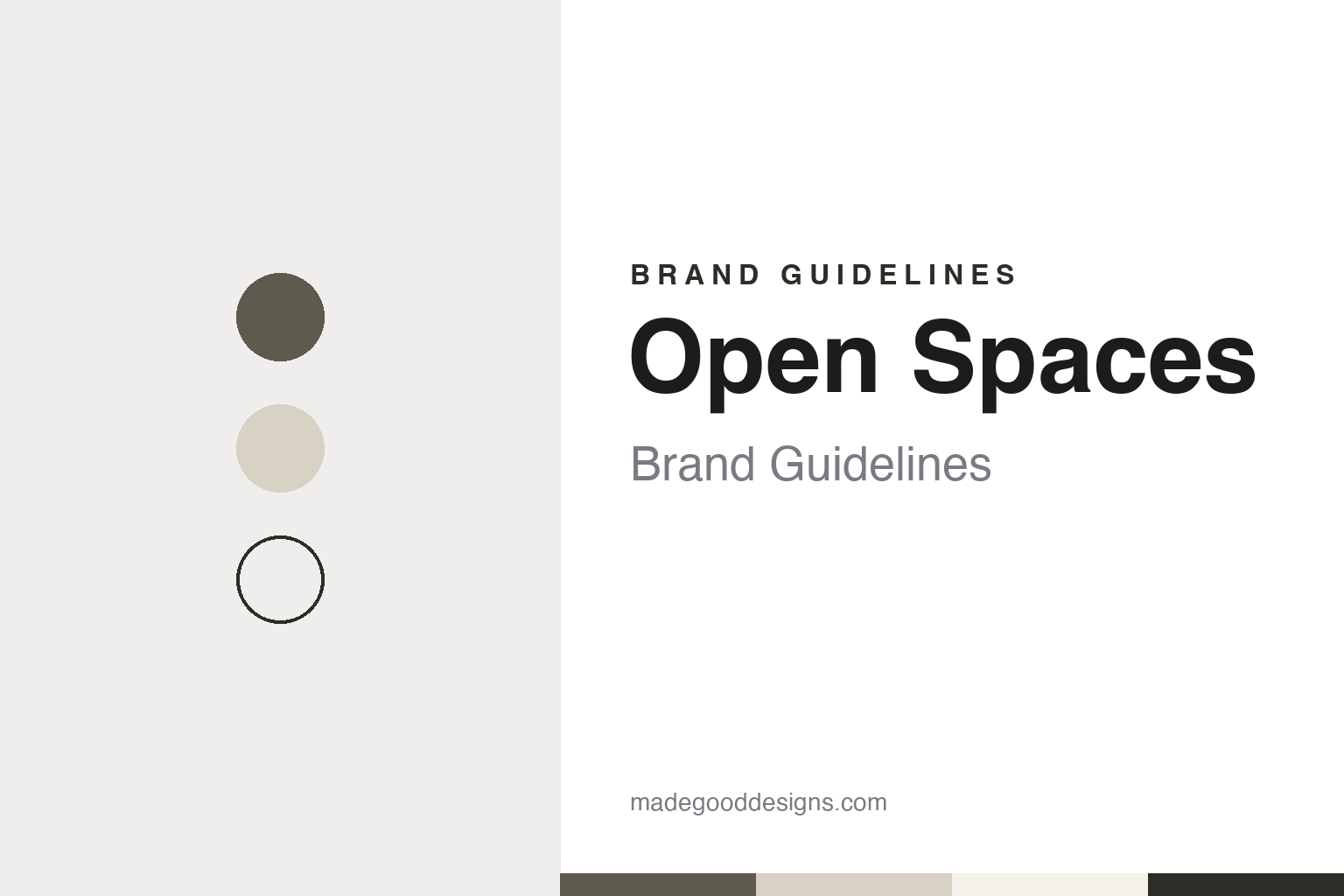
Two constants: a stone grey, oat and linen palette and a soft geometric sans register. Abstract homage — not an Open Spaces product or mark; no basket, bin or logo is reproduced.
A brand from an agency
Pattern’s second brand, after Gin Lane.
Open Spaces is a home organisation brand that was launched in January 2020 by Pattern, a company that builds and owns consumer brands for the home. It came from an unusual background: Pattern was, in the words of the technology and consumer writer Dan Frommer in The New Consumer on 29 January 2020, “the spinoff of what used to be Gin Lane,” a New York branding agency. Frommer described the idea as a holding company of like-minded consumer product brands, and covered Open Spaces as “Pattern’s new brand.”
Gin Lane’s past explains the attention the launch received. Retail Dive, reporting on Pattern on 8 June 2021, said that before Pattern’s inception Gin Lane had helped launch direct-to-consumer companies including Harry’s, Hims, AYR and Stadium Goods. Pattern, the same report said, was “formerly branding agency Gin Lane,” and at that point had two brands of its own: Open Spaces and Equal Parts, a cookware brand.
Frommer framed Open Spaces against a familiar name. His headline note on the launch read: “With Open Spaces, the former Gin Lane team continues its unbundling (or rebundling?) of IKEA.”
The launch was also covered by the advertising trade press. Adweek, in its launch-day article, reported that the brand was going on sale with wire baskets, shelf risers, hangers and bins, and quoted Katy Marshall, vice president and general manager at Pattern. “Our generation is moving more frequently and moving into more space,” she said, adding that “the organization journey only gets more complex.”
Colour
“Create Space to Enjoy.”
The brand’s line was its own name for its purpose. An archived copy of its website, getopenspaces.com, from 4 January 2021, carried the title “Create Space to Enjoy | Open Spaces,” and invited customers to share photographs of their rooms under the hashtag #CreateSpacetoEnjoy. The same page spoke of a “new standard of home storage” and of “design-driven pieces that pair well in any room.”
Its products were presented as a small system. The archived homepage featured the Bin Trio, described as a spacious storage system “intentionally designed for versatility,” alongside a kitchen storage range for pantry staples and cabinets. A line on the page read: “Having a place set aside for an activity you love makes it more likely you’ll do it.” That sentence sums up the brand’s pitch — storage as a way to make room for the things a person enjoys, rather than as a way to hide clutter.
The brand also made material claims. Its 2021 homepage listed three promises: “Responsibly-sourced materials for a lower impact,” “No single-use plastics in our products or packaging,” and premium, long-lasting quality. We give those as Open Spaces’ own statements.
Press quotations were part of the visual presentation. The same archived homepage ran a carousel of lines from coverage, among them “This new organizing company will cancel your clutter” and “If Ikea defined your collegiate interior decoration, then this marks the next step in adult living.” The site’s menus pointed to pages called Our Design, Our Story and Our Guide, a trade programme and an affiliate programme, and its footer read “© 2021 Pattern.”
That footer names the owner. Retail Dive’s 2021 report listed Open Spaces among Pattern’s own brands, alongside the cookware of Equal Parts, at the moment Pattern announced it was adding GIR.
Typography
Design and documentation.
Storage and organisation brands in general sit at many different points in the home and office trade, from closet-system makers that design and install whole rooms to companies that sell plastic boxes, shelving and desk accessories through retailers and their own websites. A single name can cover anything from a stackable bin to a built-in wardrobe or a range of office furniture.
A storage brand’s identity is usually carried less by a single product than by a system: a colour range, a modular set of parts that fit together, a catalogue or a showroom that shows how the pieces add up to a room. Because the company behind the name may have changed hands, moved its production or broadened its range, the plain questions behind each name are worth asking: who started it, who owns it now, and where its products are actually made.
Each guide separates what independent sources record from what the company says about itself — its founding story, its owners over time, where its products are made and how its look has changed — and marks plainly what rests only on the company’s own word.
Os
A soft, rounded geometric sans in the spirit of a calm home-storage catalogue. (Specimen set in DM Sans, a sans STAND-IN; NOT the Open Spaces logo.)
Open Spaces
A brand inside a family of brands.
Pattern kept adding to that family. Retail Dive reported in June 2021 that the company was raising money specifically to buy direct-to-consumer brands in the home goods space, and that the first would be GIR — “Get it Right” — a home accessories brand launched in 2012. Open Spaces and Equal Parts, by contrast, were brands Pattern had launched itself.
The brand’s web address now tells a different story. In October 2026, getopenspaces.com redirects to patternbrands.com, the website of Pattern Brands in New York, which describes “our family of consumer brands — designed to elevate the home” and lists Onsen, a towel brand, Miracle Made, a sleep brand, and GIR. Open Spaces is not among the brands that site lists. This guide describes its identity as it stood in 2020 and 2021.
That identity was built in a register familiar from the agency work behind it. The tone of the archived site was calm and instructive: a “guide” section, product names that described what each piece was, and a line that turned storage into a lifestyle promise. The brand spoke to a generation that, in Pattern’s own words at launch, was moving often and into more space.
Open Spaces began with a small set of objects — baskets, risers, hangers and bins — and a single phrase about what storage is for. The New Consumer’s comparison with IKEA placed it against the big home retailers; Retail Dive’s account placed it inside a holding company that would go on to buy other brands.
For a design guide, Open Spaces shows how an agency team turned its branding method onto a product of its own, and how a brand can live inside a parent’s name. Compare The Container Store, the American storage retailer, and IKEA, the home retailer it was measured against at launch. For this guide we use a stone grey, an oat and a linen with a sans, an unofficial interpretation; no product or logo is reproduced.
Explore & save
Keep Open Spaces’s identity on hand — save it to a board in the Made Good inspiration library.
Open Spaces identity set
Pin the Open Spaces stone grey, oat and linen palette and the soft geometric sans register to your own board.