Poppin Brand Guidelines
Staplers, pens and desks in matching colours, sold first as a website and later as office furniture.
Aa
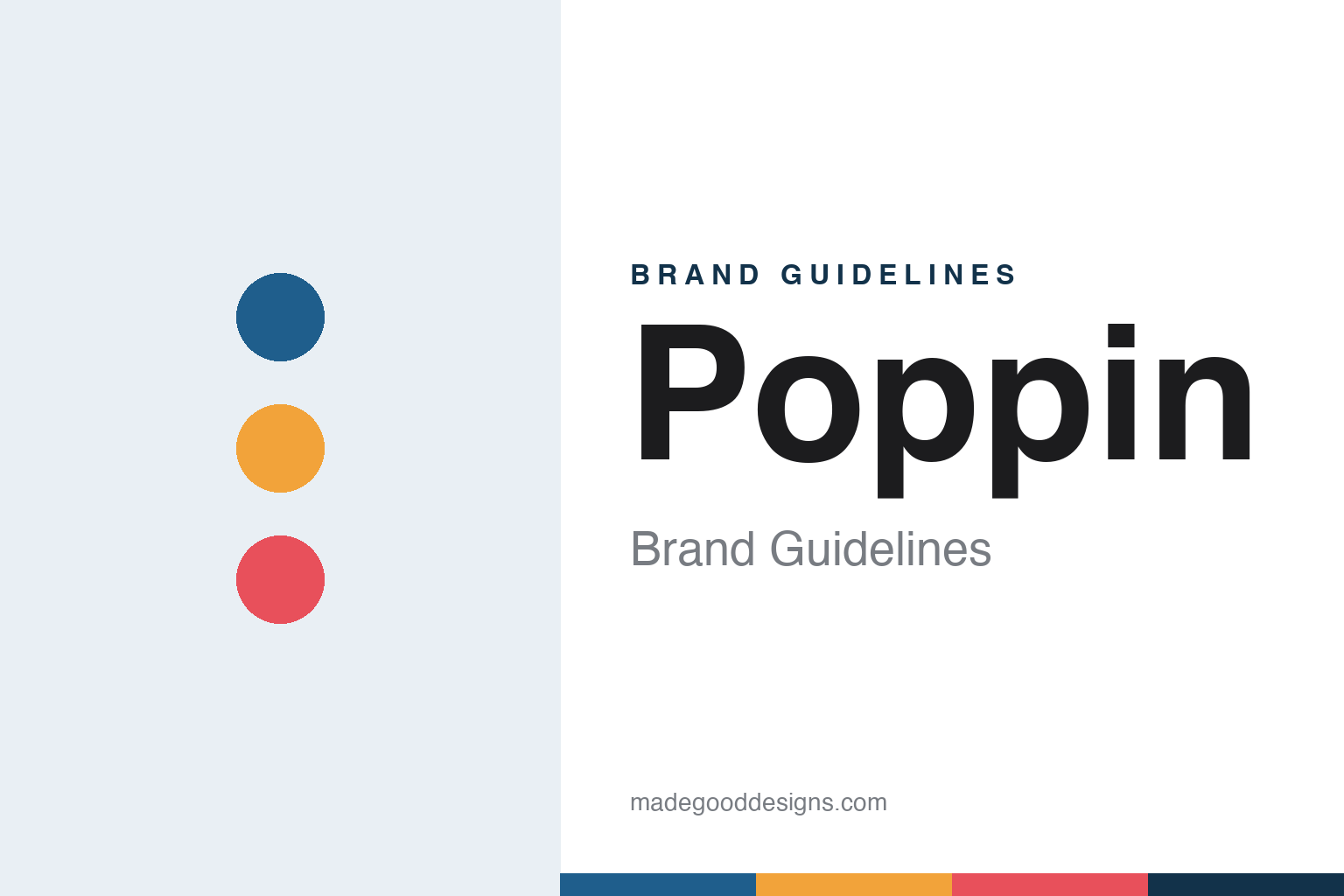
Two constants: a desk blue, marigold and coral palette and a rounded geometric sans register. Abstract homage — not a Poppin product or mark; no stapler, desk or logo is reproduced.
Office supplies with a point of view
A New York web shop that set out to make the stapler a design object.
Poppin is a New York City brand of office products and, later, office furniture, built on the idea that everyday desk items could be designed and sold in coordinated colours. Its beginnings are described differently by different publications. Fortune, writing on 2 February 2011, introduced Poppin.com as a site that wanted to do for staplers what a coffee chain had done for coffee, and summed it up as a sort of Apple-meets-Office Depot concept. That article named Ken Seiff, the founder of the online retailer Bluefly, as Poppin’s founder and chief executive, said the venture capitalist Chris Burch, a co-founder of the Tory Burch label, was also involved, and named Noah Maffit, formerly head of e-commerce at Office Depot, as chief operating officer. The site, Fortune said, was opening on an invitation-only basis.
Later coverage put Burch at the centre of the story. An article by Gwen Moran for Entrepreneur, republished by NBC News on 19 August 2012, said Burch had founded Poppin to bring some pizzazz to the market, and that in 2009 his firm, J. Christopher Capital, had provided seed money to a team aiming to make eye-catching office products at low prices. The same article dated Poppin’s public start to a soft launch in June 2011. TechCrunch, in a report by Sarah Perez on 2 May 2013, also described J. Christopher Burch as the company’s founder.
Poppin’s later chief executive joined in 2011. According to the 2012 Entrepreneur article, Randy Nicolau had sold his data-management company, Demdex, to Adobe in January 2011 and bought a significant share of Poppin in December that year. When Kimball International announced its agreement to buy Poppin in November 2020, its press release described Nicolau as Poppin’s chief executive officer and co-founder, and said the business would continue to be led by him and his leadership team.
Colour
Designed in New York, made largely in China, sold online and then through other retailers.
Where Poppin’s products are made was reported early on. The 2012 Entrepreneur article said China was where most of the company’s manufacturing took place, and that Poppin used facilities where larger companies already worked. TechCrunch reported in May 2013 that the company’s manufacturing was in China and that Poppin had its own staff there. Design work was led from New York: the same TechCrunch article named Jeff Miller as Poppin’s head designer, leading a merchandising strategy team.
The range grew quickly beyond the desk drawer. Fortune in 2011 listed staplers, pens and notepads, custom-designed by the company’s own team. By May 2013, TechCrunch described Poppin as an online shop for office products and furniture, selling furniture, office accessories and supplies, kitchenware and organisational items, with wall art and lighting recently added. At that point the products were sold only through Poppin’s own website, and the company said it planned to let other retailers, both online and in stores, carry them. A headline in Internet Retailer on 27 June 2013 recorded one result: Staples stores were offering the colourful office supplies of the e-retailer Poppin.
Furniture eventually became the centre of the business. Kimball International’s press release, datelined Jasper, Indiana, 4 November 2020, described Poppin as a tech-enabled business-to-business commercial furniture design company headquartered in New York City, which designs commercial-grade furniture made to mix, match and scale in modern office and work-from-home settings. Kimball said Poppin would operate as a separate business unit. On 9 December 2020, Kimball announced that it had closed the acquisition of Poppin, Inc.
The ownership chain then moved twice more. HNI Corporation of Muscatine, Iowa, announced on 1 June 2023 that it had completed its acquisition of Kimball International, and Poppin came with it. HNI’s annual report for 2023 records that Poppin had been acquired as part of the Kimball transaction in June 2023, and that on 12 September 2023 HNI closed the sale of substantially all of Poppin’s assets, in a transaction structured as an asset sale.
Typography
Design and documentation.
Storage and organisation brands in general sit at many different points in the home and office trade, from closet-system makers that design and install whole rooms to companies that sell plastic boxes, shelving and desk accessories through retailers and their own websites. A single name can cover anything from a stackable bin to a built-in wardrobe or a range of office furniture.
A storage brand’s identity is usually carried less by a single product than by a system: a colour range, a modular set of parts that fit together, a catalogue or a showroom that shows how the pieces add up to a room. Because the company behind the name may have changed hands, moved its production or broadened its range, the plain questions behind each name are worth asking: who started it, who owns it now, and where its products are actually made.
Each guide separates what independent sources record from what the company says about itself — its founding story, its owners over time, where its products are made and how its look has changed — and marks plainly what rests only on the company’s own word.
Pp
A rounded geometric sans in the spirit of a bright, friendly office catalogue. (Specimen set in Poppins, a sans STAND-IN; NOT the Poppin logo, and the font is unrelated to the brand.)
Poppin
A brand that treated colour as a system, not a finish.
Colour runs through the early coverage of Poppin. Fortune noted in 2011 that the company’s products came in multiple colours so that customers could coordinate them with their own company’s brand, a pitch aimed at offices rather than individual shoppers. The 2012 Entrepreneur article reported that many items were then available in only one or two colours, and that Poppin planned to offer its core products in a wider range of colours by that September, so that a stapler, a pen cup and a file box could be bought to match.
The same coverage captured the tone of voice. Entrepreneur described the website’s snappy copy and graphics and its “not your father’s office supply” attitude, and quoted Burch as saying the company believed there was an open market for beautiful products. TechCrunch in 2013 spoke of the brand’s bright, colourful style.
As the business moved into furniture, the language of the brand shifted with it. By 2020, the Kimball International release described Poppin’s furniture as made to mix, match and scale, carrying the matching idea from desk accessories over to desks, storage and seating for offices and home workspaces.
For a design guide, Poppin shows how an office brand can turn colour into a coordinating system that runs from a single pen to a whole workspace. Compare The Container Store, the storage and organisation retailer, and IKEA, the flat-pack furniture brand. For this guide we use desk blue, marigold, coral and ink navy with a sans, an unofficial interpretation; no product or logo is reproduced.
Explore & save
Keep Poppin’s identity on hand — save it to a board in the Made Good inspiration library.
Poppin identity set
Pin the Poppin desk blue, marigold and coral palette and the rounded geometric sans register to your own board.